
Cafeterias. Markets. Grocery stores. These are the historical sanctuaries of immigrant communities. But in the initial months of the second Trump Administration, the streets have gone quiet.
A litany of chaotic immigration executive orders have overloaded an already dehumanizing system and deepened a reliance on terror as policy. Masked officers brazenly engage in abduction. Errors in enforcement are ignored by the administration. Social media posts and political views are punished.
And of course, the raids and deportations.
Immigration raids are nothing new, nor are they exclusive to this administration. What feels different now, as our writers told us, is the broadly chilling effect on public space and the palpable feelings of fear. But there has been bravery and building, too. Communities around the country have rallied, mobilized, and protested, often at great personal risk.
Three writers—from New Jersey, California, and Michigan—went into their local communities, searching for stories from those who have felt the tensions rise.
SOUTH JERSEY
by Hira Qureshi
Muhammed Emanet returned to his family’s restaurant on a chilly February morning to help his father set up a new grill. He found the doorway blocked by “a man with a U.S. marshal vest” and what he described as “a machine gun.”
“Dude, this is my restaurant,” Emanet told the man. “Let me in.”
Just as he entered, the twenty-five-year-old’s parents were handcuffed and taken away by federal immigration agents.
Sitting inside the restaurant months later, Emanet recalled trying to take a step forward as his father told him no. “My dad just took his car keys out of his pocket [for the groceries truck] and handed them to me. And my mother said to take care of the catering order.”
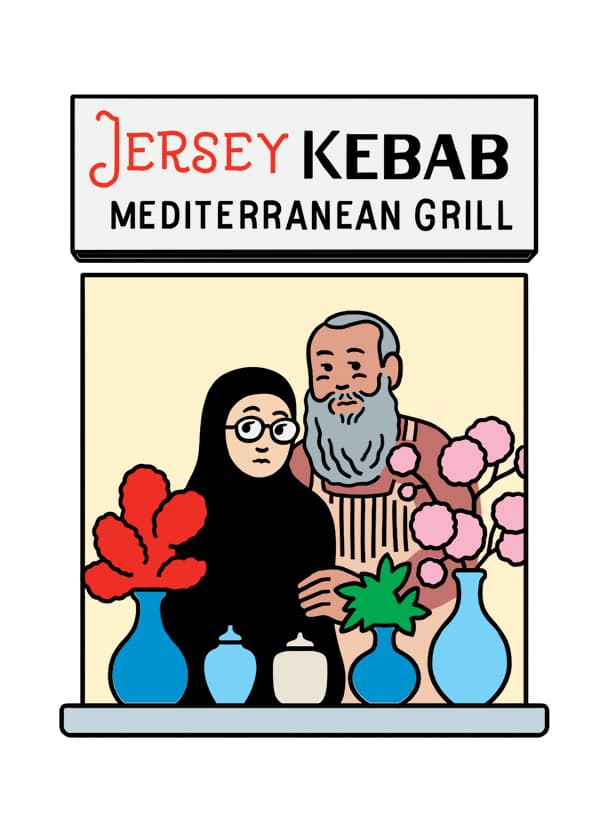
On the corner of Wynnewood and Haddon Avenues in South Jersey, the Emanet family own and operate Jersey Kebab, a beloved neighborhood institution. Colorful variations of Turkish delight line the display case up front. Plates of iskender, other types of kebabs, and baklava are served at cozy tables. The Turkish decor and music invite customers to linger.
But on February 25, the family became a target of ICE, and the restaurant shuttered for the two weeks that Emanet’s mother, Emine, was held in a detention facility. His father, Celal, was released with an ankle monitor after about seven hours.
“They prepared everything — they got our restaurant picture, house picture, our cars’ picture, our pictures,” Celal said. “They know how many members in our family — they got everything.”
Celal first came to the U.S. in 2000 on a student visa to study at Temple University and later received a tourist visa to study in the U.S. for another year. In 2008, the elder Emanet was offered a job as an imam at Bridgeton Islamic Center and received a five-year visa for himself and his wife, son, and daughter. Before his visa was to expire, in 2013, Celal and his family applied for green cards.
But in 2011, his employer changed its name to Garden State Islamic Center. Immigration flagged the mismatch as a complication on the Emanet family’s application. The family repeatedly contested it with evidence that the mosque was under the same leadership, but the U.S. Citizenship and Immigration Services (USCIS) remained focused on the issue.
The Emanet case was transferred to different USCIS offices, where their green card applications were denied three times. In 2013, a car accident landed the father in the hospital for over a year, and he couldn’t return to work. His visa expired, but the file was still in the system. The family tried to contact immigration a couple of times in 2016, including an email from Celal’s daughter. USCIS responded to the email saying their case was still under investigation and the family had to wait. Nine years later, the case remains in limbo.
And now, the family is dealing with deportation proceedings. “Life is tough for us,” Celal said. “Most of the American people think that immigrants’ life is free—our life is not free.”
In February 2025, Emine spent twenty-four hours in a holding cell before being taken to the Elizabeth facility. “They told us when we compare Texas or other [detention] centers, Elizabeth is a good one,” Celal said. “It was very bad, like [an] animal shelter—there is no window, no fresh air, nothing.”
While in the facility, Emine fasted for Ramadan and fashioned a hijab out of the clothes provided to detainees, according to her husband, who said he spent up to $500 to call her and send meals.
Back in Haddon Township, Emanet went to the mayor’s office and campaigned on social media for support. Neighbors, strangers, and some local politicians responded ready to help. One customer created a GoFund Me to help with the bond, cover legal fees, and supplement the family’s income while the restaurant was closed.
When Emine was released, she returned home to find an iftar feast prepared by her daughter-in-law and many news outlets eager to hear her story. “She didn’t believe it—she had lost her hope,” Celal said. The family reopened the restaurant on Eid al-Fitr, embraced by their South Jersey community.
While the family is back in full swing at the restaurant, they are still being watched and monitored by ICE through monthly check-ins.
The Emanet family’s imam keeps them strong. Months later, Celal sees this “trial” as a blessing in disguise with the growth of the business and support from the community.
“Everything is coming from Allah,” Celal said. “And Allah makes trials for us sometimes with [scariness], but you have to show your sabr, patience. If something happened that’s very hard, Allah will make it easy for you.”
LA'S LITTLE BANGLADESH
by Tanzila Ahmed
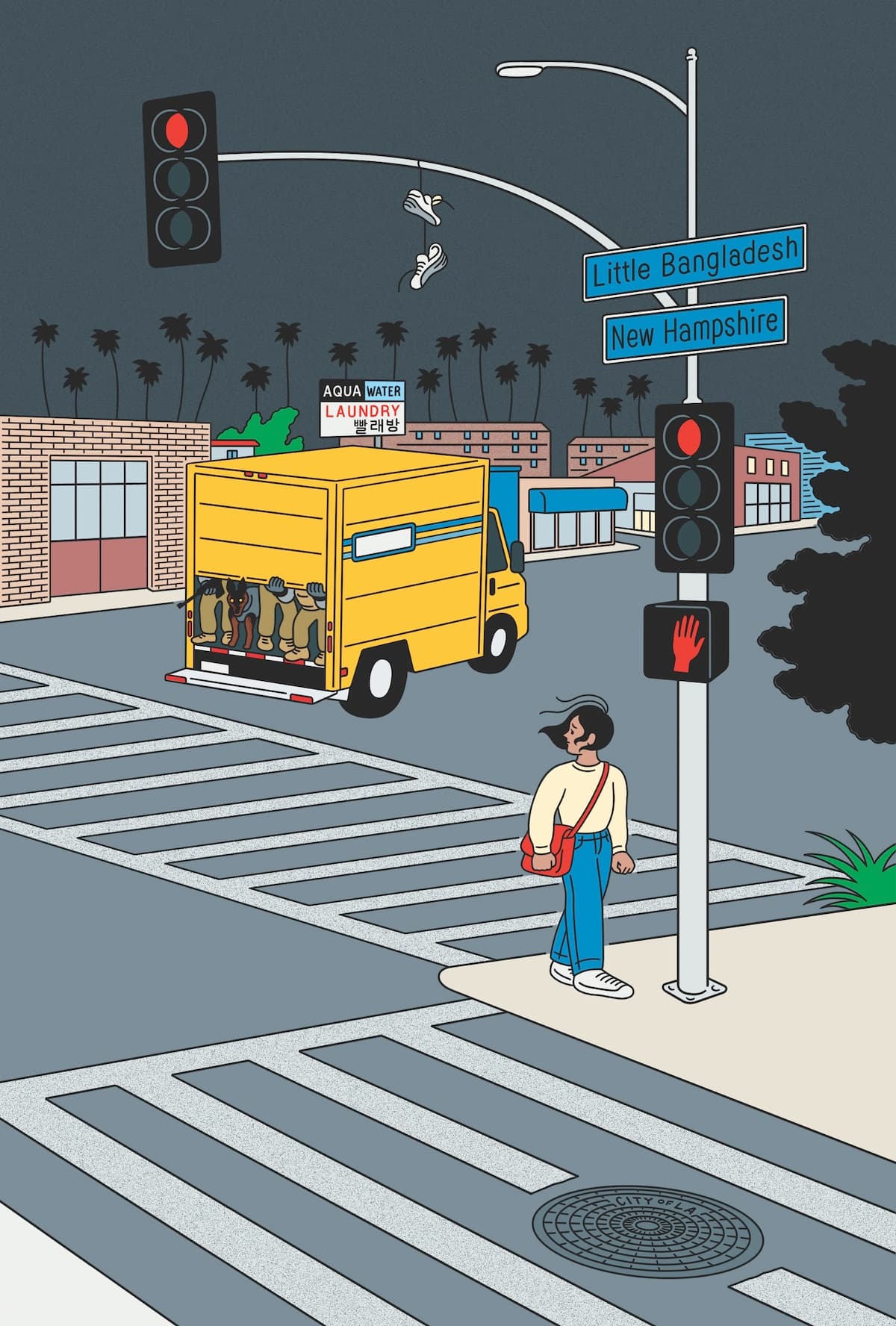
In the early morning of August 6 a Home Depot was raided by men in green military clothes with rifles, helmets, and face coverings. The men jumped out of the back of a Penske rental truck and ambushed the day laborers and taco abuelas set up on the sidewalk. Self-dubbed by U.S. Customs and Border Protection agents as “Operation Trojan Horse,” the raid resulted in sixteen arrests and a substantial amount of professional-grade video footage from the camera crew filming them jumping out of the truck. This Home Depot is located in the heart of Los Angeles, just a mile from Little Bangladesh. It’s my Home Depot, and as I drove by later that day, I didn’t see any day laborers, but I did see news vans gathering in the parking lot.
The raids in Los Angeles started on June 6 and have had a deadly quieting effect on the city of Los Angeles. There is the Los Angeles that everyone else sees—the shiny, Hollywood Los Angeles you for tourists. But I was born and raised here, and I know that the heart of Los Angeles is the working-class people of color who keep this city moving. In Los Angeles, everyone looks brown, and now anyone who looks brown is getting indiscriminately caught up in the illegal sweeps, regardless of immigration status.
As I continued my drive to Little Bangladesh that day, the streets were eerily empty. The traffic, usually backed up on Third Street, which is the backbone of this neighborhood, was now easily drivable. The fruit seller and eloteros on the corner were gone. The line outside California Donuts had disappeared. At restaurants like Deshi, uncles who sit and drink chai in the red booths, talking politics, were staying safely at home, fearful of being caught on the streets. The bus stops were empty.
As I write this, there hasn’t been a raid yet within the designated borders of Little Bangladesh, but there was a raid at the big Vons grocery store at the end of the neighborhood. A man told staff inside that three ICE vans had pulled up outside the staff entrance in the back—the store closed all its front glass doors—and over the intercom the man requested a few specific employees to come to the back. An organizer at South Asian Network (SAN), who had been shopping at the time, said it was so scary to be trapped in the store. She immediately sent out a text to SAN’s WhatsApp thread for the local Bangladeshi community, telling them to avoid the area. She snuck out of the grocery store through the front doors—she was afraid her legal and valid green card would not be enough to keep her protected during these times.
Officially designated in 2010, Little Bangladesh is a half-mile stretch of Third Street in the middle of Los Angeles—north of Koreatown, south of Silver Lake, west of downtown Los Angeles, and east of Hollywood. Unlike LA’s Little India, which is spread across a suburban block with shops selling 14 karat gold and designer saris, and well-stocked grocers, Little Bangladesh is populated by new immigrants and minimum-wage workers, taxi drivers, cooks, and students. The hijabi aunties cooking the food in the kitchen are often the ones being paid cash under the table.
On this part of Third Street, you will find a handful of dingy Bangladeshi restaurants that have chicken biryani, fried fish, and panch phoron–spiced mixed vegetables in heating trays attached to dusty, sparsely shelved grocery sections. There is a brow threading spot, a salon that sells sequined salwars and hair dye, a mosque run out of a house, a Bangla driving school, and a small music school to learn tabla and harmonium. The Little Bangladesh Press Club has paid for the murals dotting the street—the Bangladesh Martyrs’ Memorial, the Shaheed Minar, and a landscape of farmland. Alpona dot some sidewalks. There is a mural of the founder of Bangladesh, Sheikh Mujibur Rahman, with a red paint splotch pouring down his face that was added after the 2024 uprising in Bangladesh.
The apartment buildings in Little Bangladesh are postwar and art deco in style, with many of the buildings in deep disrepair and falling under rent control. By the 1960s, many of the posh residents in this area had moved to the suburbs, and as property values declined, it allowed space for the post-1965 Immigration and Nationality Act population boom of international immigrants to live cheaply. The older Bangladeshi uncles and aunties speak fondly of the neighborhood as their first landing spot when they arrived in America in the seventies and eighties—there was always someone to help them land on their feet here. Now in 2025, it is still a safe place for new immigrants to land.
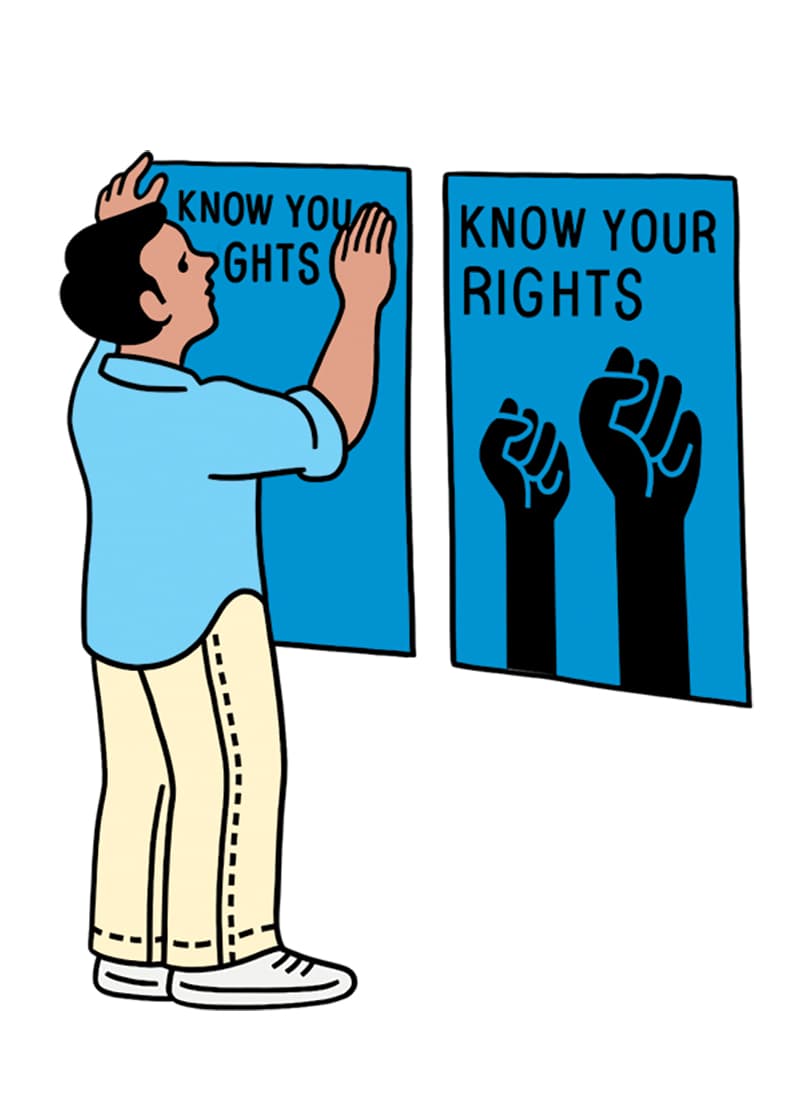
At the SAN office, tucked away in a strip mall at one end of the block, around thirty local Bangladeshis slowly trickled in for an immigration Know Your Rights training. The women wore salwar kameezes and hijabs; the men wore suit jackets or jeans. The bilingual training explained what their rights are in this critical time, from immigration to health care. Afterward, people asked questions. They were most concerned about travel—would they be allowed back in this country if they visited Bangladesh? (Likely) Would their visa be valid if they transferred between universities? (Probably) Did they need to carry their documents with them at all times? (Photocopies, at least). After talking with SAN’s staff, I learned the story goes much deeper—SAN has been distributing funds for rent to Bangladeshi women who were victims of domestic violence and too scared to work outside in light of the raids. After the grocery store was raided, SAN sent groceries to community members who were too afraid to buy their own. On the table by the samosas and chai, pocket-size red cards stating rights are available in Bangla, Hindi, Urdu, and Farsi to be handed to an officer if they should ever confront one.
When I asked another local youth organizer who was raised in the neighborhood how community members were feeling, he mentioned that there was a sector of elders in the community who felt sheltered— they thought this was a Latino issue and wouldn’t affect them as Bangladeshis. He had tried to explain that these ICE agents were racists and they wouldn’t be able to differentiate a Mexican brown from a Bangladeshi brown—we were in this together. One of the grocers angrily yelled at him when he asked if he could put up Know Your Rights posters in his store; the grocer didn’t believe in it. I asked him where he had obtained the Know Your Rights flyers to hand out and if he was working with an organization—he said he had ordered them online and had distributed them to all the stores on the block on his own initiative. He worked by himself simply because he wanted to keep his neighbors safe.
The raids in Los Angeles have been partially an opportunity to film propaganda to fire up the MAGA base by making Los Angeles seem dangerous and criminal. To an outsider looking in, especially one who falls for the propaganda, Los Angeles is a frightening immigrant-infested place. In reality, the Los Angeles anti-ICE uprisings this summer did not warrant the presence of the National Guard. When the wildfires were raging this January and we did need the National Guard for help, for days they were nowhere to be found. The dispatch from inside is that Los Angeles’s immigrants are what make this city beautiful and safe. We Angelenos know how to take care of ourselves, especially the immigrants who have had to figure out ways to survive.
As Shakeel Syed, the executive director at South Asian Network, told me, “South Asians in general and Bangladeshi Americans in particular seek refuge in resilient resistance to triumph over troubling times.”
Bangladeshis have fought centuries of famine, colonization, and oppression—for us this fearmongering in LA’s Little Bangladesh now is just a blip in the long run of survival for our people.

SOUTHWEST DETROIT
by Serena Daniels
In Southwest Detroit, where immigrant communities often face fear and isolation, Vámonos shows how a café can be more than a café—it can be a sanctuary.
At Vámonos, neighbors start their mornings with a steaming cup of coffee, a smoothie, or a spinach wrap sandwich—and the buzz of activity. The day often begins with Zumba classes and the pulsing beats of salsa or reggaeton drifting through the building. The near-daily sessions, led by a rotating cast of instructors who use the space to hold classes, draw women from the Latino community who come not only to exercise but to laugh, connect, and find joy together. The walls double as a gallery of community pride, populated by local artists, newspaper clippings, and bold posters in Spanish and English, reminding visitors they’ve stepped into more than just a workout space.
Co-owner Denisse Lopez Avila remembers how abruptly that rhythm was disrupted when Trump took office for a second term at the start of 2025. Classes that once bustled with fifteen or sixteen women suddenly dropped to just four or five. “At the beginning, a lot of them were afraid to just even come to the Zumba class,” she recalls. Fear of deportation and increased surveillance hung over the neighborhood. Southwest Detroit has long lived with that tension. Just across the river from Canada, the Mexicantown neighborhood has been home to Mexican immigrants for more than a century, drawn to work in auto factories and other industries in the region.
Detroit’s position as a major point of entry in and out of the United States has also meant a heightened Border Patrol presence, with agents historically targeting Latino residents in Mexicantown’s streets, schools, and gathering places—a pattern immigrant families here have long endured. Southwest Detroit shares a border with the city of Dearborn, home to one of the country’s largest Arab American populations: Rashida Tlaib, who represents Michigan’s 12th Congressional District, has become nationally recognized along with other local leaders for challenging federal immigration enforcement and calling to abolish ICE. For Southwest Detroit’s Latino families, the renewed threat of ICE raids under Trump’s second term has only heightened a familiar sense of vulnerability.
Instead of letting fear take over, Lopez Avila and her community leaned in. She went live on Facebook during classes, showing hesitant regulars that others were still gathering. Community organizers and others handed out Know Your Rights cards and hosted teach-ins and organizing meetings. White allies stood guard outside so families felt safe entering. In recent months, Vámonos has been part of a broader mobilization: neighborhood cafes, restaurants, and small businesses posting know-your-rights information on their walls and social feeds, while others help activate local “Migra Watch” efforts—volunteer networks that monitor and document immigration enforcement activity in real time. Slowly, attendance stabilized—not back to pre-Trump highs, but enough to remind Lopez Avila that Vámonos could still be a place of refuge.
“We were busy helping out a lot,” Lopez Avila says. “It kept us sane, because it was scary at the beginning especially seeing the lack of the Latinos so immediately. But thankfully, other folks showed up, too.”
That spirit of solidarity continues to define Vámonos. At least once a month, the café transforms into a marketplace where immigrant vendors sell artisan crafts and traditional foods, offering both income and visibility. The works of local artists line the space’s fitness studio area, while the spot’s basement serves as a gathering place for Migra Watch meetings and community organizers. Two licensed therapists host workshops in Spanish on mental health, helping to destigmatize therapy and make support more accessible.
The café’s menu also reflects this commitment to comfort and culture. Vámonos serves coffee from COMSA, a company owned by José Robinson, who directly sources beans from a coffee cooperative, also called COMSA—made up of 1,240 farmers in Honduras, including his father. Smoothies feature tropical fruits like mango and pineapple—a nod to the flavors many immigrants grew up with. And there are light bites like wraps, avocado toast on sourdough, and yogurt parfaits. Each dish carries both nutritional value and the subtle comfort of memory.
For Lopez Avila, this vision is rooted in an earlier chapter: Michigan Squeeze Station, the juice bar she and her husband once ran just a short distance away. Back then, a menu of aguas frescas and cold-pressed juices grew into something more—a wellness hub and gathering space for the neighborhood. After she and her husband stepped away from Michigan Squeeze Station, she carried her vision to Vernor Highway, opening Vámonos in 2023. The new space is the continuation, built on the belief that food, movement, and activism can be bridges connecting people. It serves as a living reminder that in Southwest Detroit, solidarity is what keeps the neighborhood moving.

