
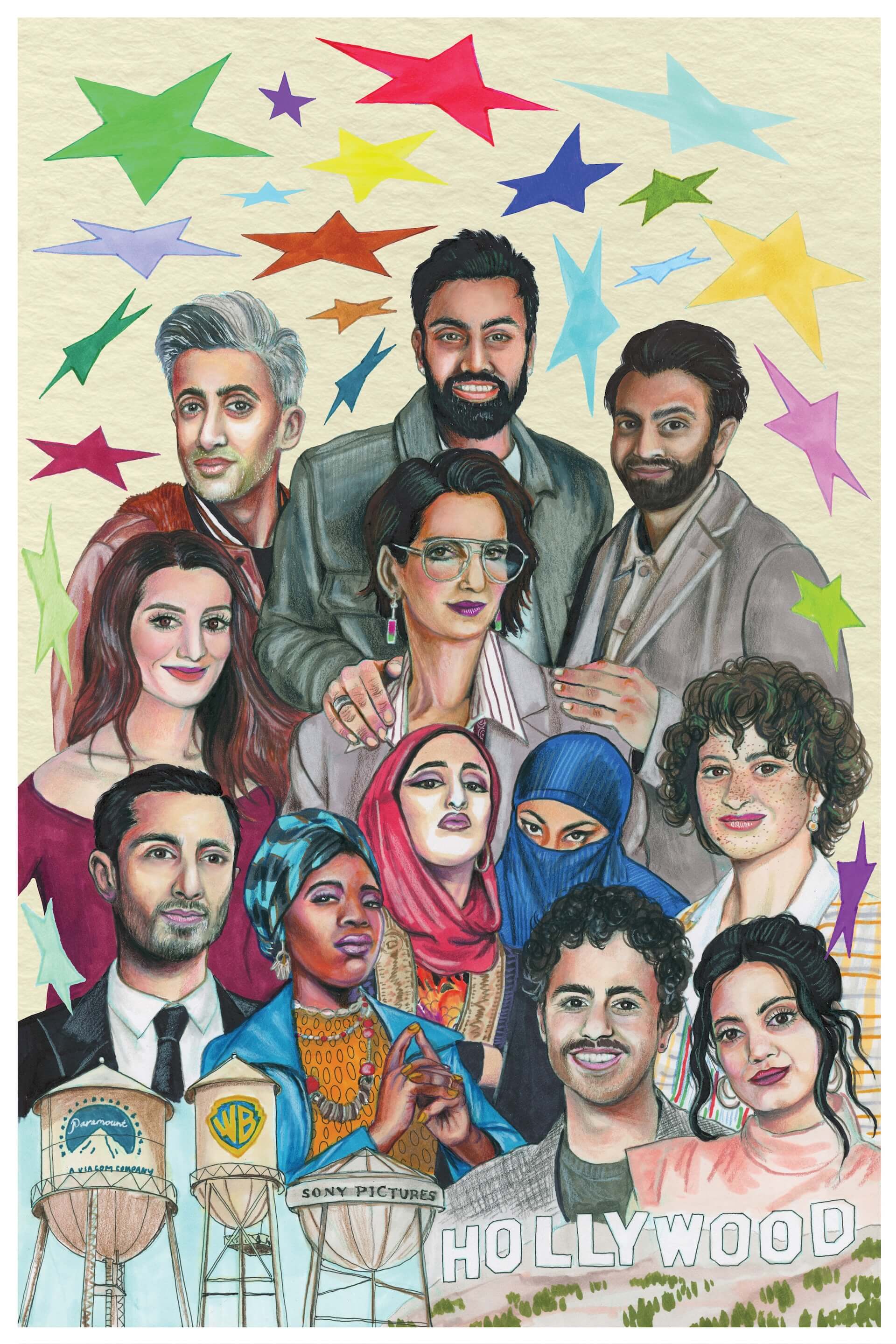
The pilot of Hulu’s Deli Boys is a sweeping thrill. In just under thirty minutes, we are introduced to the Dar family—a wealthy Pakistani American dynasty that lays claim to an impressive collection of convenience stores, left unmoored in the demise of their patriarch. Two sons, Mir (Asif Ali) and Raj (Saagar Shaikh) are quickly shepherded into the dark underbelly of their Baba’s actual enterprise—a fragile house of cards that is upheld by suspicious business contracts and a firm hand in the narcotics industry—under the guidance and oversight of the murderous Lucky Aunty (Poorna Jaganathan). As the brothers take the reins, it is their criminal corporation, not their identity as Muslim Americans, that leaves them under the monitoring thumb of FBI surveillance—resulting in a cat-and-mouse caper involving the federal government, the black market, and two millennials tasked with shepherding an unsavory enterprise into legitimacy.
Also released in 2025, Ramy Youssef’s first animated series, #1 Happy Family USA focuses on the surreal and chaotic experiences of an Egyptian family in New Jersey in the wake of 9/11. The narrative heft of the show is situated around the Hussein family’s fluctuating relationship with the American dream and what it represents: adherence to capitalist principles, fear of cultural diffusion via assimilation, and navigating social hierarchies while under the thumb of rampant Islamophobia. Youssef utilizes different voices for his dual roles: gruff and contemptuous for father Hussein Hussein and pubescent and scratchy for son Rumi Hussein. Like the Deli Boys, the Husseins are framed in relation to the FBI—in this case, their new neighbor, Dan Daniels (Timothy Olyphant), who openly admits to being an agent with the Bureau.
Surveillance is a well-worn theme rooted in true experiences, but it continues to find audiences in new genres. Hasan Minhaj told the depressing and tragic story of his NorCal community being infiltrated by an undercover FBI agent in the King’s Jester (2022), using the unexpected format of stand-up comedy. A story in the New Yorker that challenged the details led to public debate over the moral obligation of fidelity versus “emotional truths” in joke-telling. Now, adult animation is the latest genre to wrestle with the humor and heartache inherent in the surveillance that takes place in mosques and Islamic cultural centers.
The burden of representing the historical policing of Muslim communities must hang heavy in these writers’ rooms. The fact that Deli Boys’ surveillance is predicated not on terrorism, but on something as cravenly capitalistic and American as the illicit drug trade is a welcome subversion on Hollywood screens, suggesting a slow shift from the burden requirement that Muslim stories must pointedly address matters of representational politics. In Happy Family, the boisterous Husseins contend with the trauma and shock of how the Islamophobic reaction to 9/11 leaves them on the outside looking in on the place they call home. The father desperately attempts to cling to Americana as a shield while his wife, Sharia (Salma Hindy), recommits to her faith and retires her American name, Sharon. Meanwhile, Rumi and his elder sister, Mona (Alia Shawkat), attempt to find their place in a rapidly shifting social environment, all while under the intense scrutiny of not just the FBI, but people they once considered beloved neighbors and classmates. The granular, unique character moments related to surveillance serve as a potent backdrop to the pedestrian experiences of coming-of-age, not just for the high schoolers but also for the American Muslim family unit.
For years, Muslims within the entertainment industry based their creative output on reflexive reactions to the avalanche of Islamophobia that flooded cultural consciousness post-9/11, whether in apologia, stigmatization, or outright defense against Islamophobic tropes. Years of media analysis had focused on the impact of “bad” representation, painstakingly annotating the plethora of Orientalized representations of Arab and Muslim individuals, ranging from the sensationalized and dehumanized “Somali pirates” to the brainwashed terrorist to the patriotic refugee wedded to Americana. Shows like 24 and Homeland became fertile ground for Orientalist narratives, creating added pressure for Muslim-led projects to engage with and reject the harmful stereotypes. In the 2000s, projects like Jack Shaheen’s Reel Bad Arabs: How Hollywood Vilifies a People were critical interventions into the harmful framework and established a new basis for analysis.
A 2021 report by the Pillars Fund and USC Annenberg Inclusion Initiative argued that “Muslim characters are rooted in times and places that promote the idea of the Muslim faith as ‘foreign’ or ‘other,’” often as either perpetrators or targets of violence. “Fundamentally, the lack of imagination on behalf of creatives curtails both the overall number of Muslim characters on screen and the roles these characters fill,” the report argues. Pillars published the subsequent Blueprint for Muslim Inclusion in collaboration with the actor Riz Ahmed, with the aim of adding dimension to representation by minimizing terrorist tropes, veering away from the reductive good Muslim/bad Muslim binary, and rejecting “clash of civilizations” approaches to discussing Islam’s position in the Western world. Simultaneously, many shows helmed by Muslim visionaries began to directly contend with “good” or “bad” representation, in a phenomenon the media scholar Evelyn Alsultany described as simplified complex representation.
“The representational mode that has become standard since 9/11 seeks to balance a negative representation with a positive one,” Alsultany wrote in her 2012 book Arabs and Muslims in the Media after 9/11: Representational Strategies for a ‘Postrace’ Era. In an effort to reject the prolonged representational neglect that was part and parcel of the copaganda phenomena Homeland, 24, and various other programs that willfully depicted its Muslim characters as uncivilized and dogmatic religious fanatics prone to brutality and violence, Alsultany observed there had been an effort to emphasize the idea of Islam as friendly, not hostile, to American normative culture.
“Such positive representations have taken several forms, such as a patriotic Arab or Muslim American, an Arab or Muslim who is willing to help the United States fight terrorism, or an innocent Arab or Muslim American who is the victim of post 9/11 hate crimes.”
While the first two decades of the 2000s seemed consumed by arguments over humanistic representations of Muslims on-screen, the current decade has thus far suggested shifting attitudes toward “good” representation—utilizing new frameworks that Alsultany defined in later scholarship as “stereotype-confined expansion” and the “diversity compromise.” Ramy Youssef broke ground with Ramy (2019–), a series about the ultimate Egyptian fuckboy—one who pursues self-interest and creates chaos with minimal apology or accountability on a vacillating journey with his faith. Youssef helped complicate this representational tension in shows like Netflix’s Mo (2022–) which he co-created with his frequent collaborator and the titular star, Mo Amer. The show grounds experiences in a more universal emotional center, displaying the trials and tribulations of Muslims as relatable elements of the working-class American experience. Mo Amer introduces audiences to a character whose Palestinian identity serves as a bridge to relate to other cultures, bringing forth the tension and rejection that come with his status as a refugee. In a single episode, Amer will switch from Arabic to Spanish to African American Vernacular English, adjusting his character like a kaleidoscopic lens through which the audience may view the realities of stateless life.
“For me, with my background, someone named Mohammed living in the South in a pre- and post-9/11 world, it just became even more prudent that I show how relatable I am,” Amer explained in a recent interview with NPR’s Code Switch podcast. Grounded within that relatability, however, is reality—the tactile feeling of displacement, disconnection, and despair that anchors many refugee communities, including and especially the Palestinian people. Within the humor of relatable experiences lies a distinct pathos rooted in loss and longing, made explicit by dreams of olive trees and abandoned hometowns. It sits in direct dialogue with the nuanced discourse around Youssef’s critically lauded series, Ramy. In the Hulu show, the titular antihero navigates his complexities around identity and faith with a pointed ennui and simmering resentment, most palpably realized in the way the character relates to the women in his life, both platonically and romantically—a limitation in the series that has increasingly been addressed as both Ramy the showrunner and Ramy the character evolve.
Subversion of the Muslim narrative is not only racial, but also falls across gender tropes. The We Are Lady Parts creator and showrunner Nida Manzoor sought to bring viewers into a world where Muslim identity was viewed as inextricable with the idea of repression. “I haven’t been so thrilled with the representation on TV of Muslim women as oppressed and lacking agency, and often lacking joy and humor,” Manzoor explained in an interview with Variety. “I couldn’t possibly represent everyone, and what I have found so much joy in doing is speaking my own truth and connecting with the people who this does speak to.”
Indeed, #1 Happy Family USA benefits greatly from narrative intentionality in how Sharia and Mona Hussein’s characters progress. Like many Muslim women on-screen, Sharia spends the season experiencing an identity crisis, reconsidering her relationship with religion. But her start and end points are inverted; she begins moving toward a more open expression of Islam, despite the protestations of certain men in her family who start leaning more secular. Her transformation from Sharon to Sharia is about honoring the legacy of her parents, not her role as a wife and mother. Mona’s arc around shame and fear about coming out as queer has as much to do with academic and social expectations within a homophobic 2000s high school as it does with her family. Within the overarching familiarity of a coming-of-age tale, the individual touchpoints of their characters offer a unique flexibility and relatability to the “conventional” American experience that is not rooted in rejection of one’s own identity as lesser than or substandard. Instead, the show opts to wrestle with how all of these distinct elements impact a person’s self-image equally.
Representation can be a fraught lens for media analysis—when deployed in the interest of reparative coverage, the desire to overwrite stigmatized presentations with positive narratives can unintentionally circumscribe the creative agency of those depicted. What we are currently left with, however, is a spectrum of modalities. For those who are still eager for the shiny trappings of representation for its own sake, avenues are still available: Nasim Pedrad’s Chad, for example, hits all the well-worn marks of a fish-out-of-water, assimilationist coming-of-age story. The standard tropes may still offer comfort and entertainment.
The protagonist of Mo is a proud Palestinian man who is not immune to vices and sin, yet none of it is used to render a verdict of whether he is representative of a “good” or “bad” Muslim. Deli Boys, in the context of corporate malfeasance, is the ultimate American caper, in which Muslim identity is not necessarily the focus, but is understood. Some shows make this choice even more explicit: every episode of #1 Happy Family USA opens with its own twist on a parental advisory guideline: a “representation warning.” Etched in bold white letters, the series is rated “H” for Haram, urging viewers to “not use this animated show as cultural representation for any of the following communities: Muslims, Arabs, people from New Jersey.” As a “post”-representation transition, it’s not perfect, but it expresses a desire to tell a singular story and not be held responsible for accurately portraying nearly two billion people.
As the years have progressed, Muslim creators have found various ways to toy with the good-bad binary on-screen, creating characters and shows that defy strict taxonomies of Muslim tropes and subverting them into unique stories with universal themes that manage to still be grounded in their experiences and heritage. While this won’t eliminate the constant struggle for “good representation,” it is a positive harbinger of the ways that Muslim creators can continue to push and bend the guidelines of how “representation” onscreen should look and feel as they continue to seek new stories to tell.

