
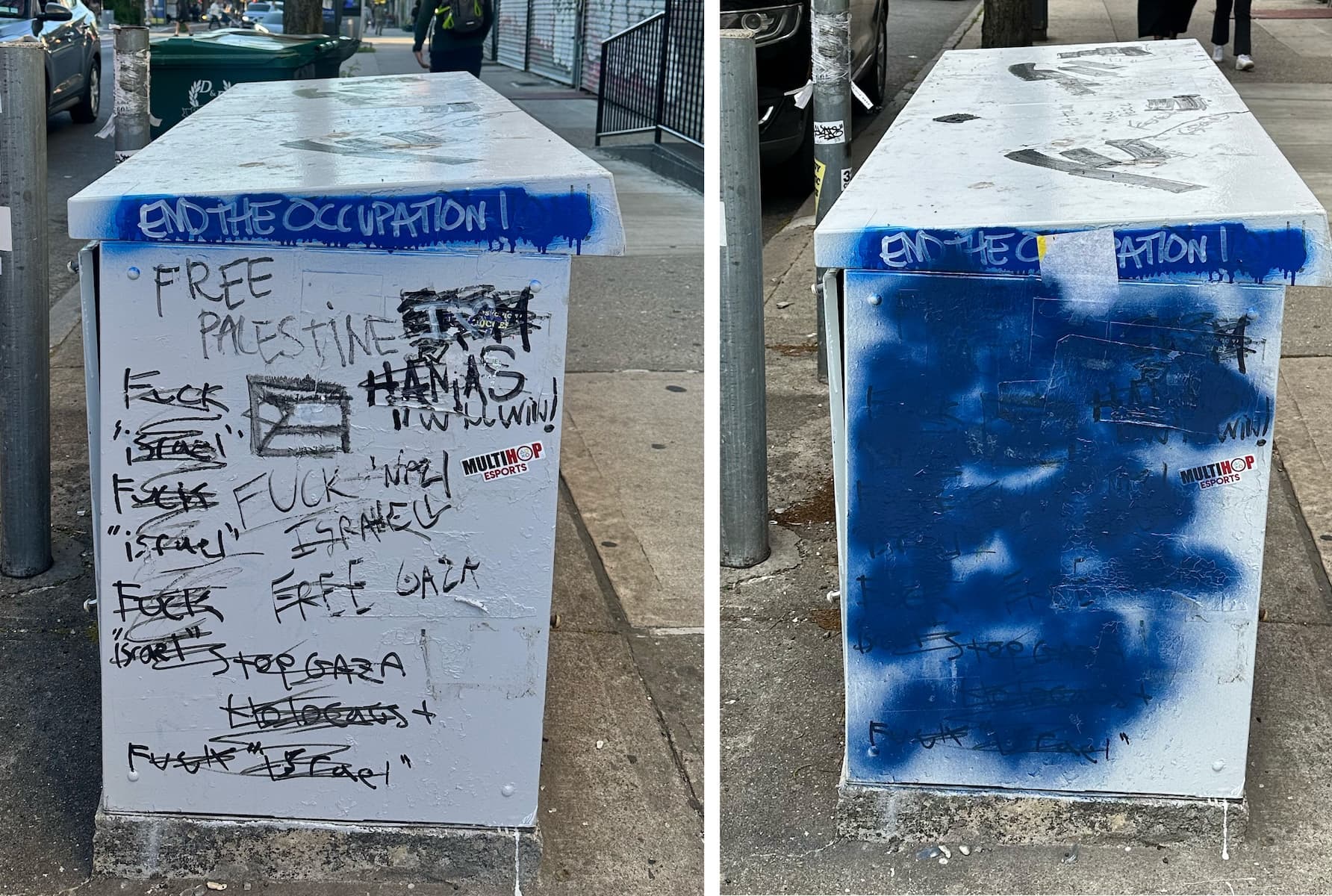
The electrical box on Nostrand Avenue is speaking. For months, pro‑Palestinian messages have appeared on its gray panels, only to disappear then reappear just as quickly. Passersby in Crown Heights, Brooklyn, often pause to observe the visual conversation between anonymous neighbors.
This fixture has become a microcosm of the political tensions that have swept through the neighborhood since October 7, 2023. Along Nostrand, an approximately eight‑mile thoroughfare lined with Caribbean eateries and independent businesses, a graffiti battle continues to unfold daily, placing Palestine at its center.
The dialogue sprawls across lampposts, utility boxes, storefronts, and walls. The statements are loud; you can’t unsee them. Save Palestine. Stop Bombing Gaza. End the Genocide. Some slogans are layered with symbols: Handala, a key, a watermelon, the Palestinian flag. Others are indictments: Israel Snipes Kids in the Head. 100,000+ Palestinians Murdered W/ Your Taxes. Friends Don’t Let Friends Support Genocide! Resist colonial power by any means necessary. One quotes Nelson Mandela: Our freedom is incomplete without the freedom of [the] Palestinians. On a traffic signal pole, a sticker simply declares: It’s Genocide.
But these markings are in flux; pro-Israel detractors regularly erase, deface, and write over them. On the electrical box, Free Palestine appears in black Sharpie. By evening, from Hamas is scrawled beneath it. Soon after, both messages are sprayed over, leaving only marks—a redaction of resistance. No More Genocide later reasserts itself, sometimes in the same handwriting, sometimes in a different hand. Elsewhere, Free Gaza becomes Free Gaza Hostages.
This decentralized exchange between strangers can trigger alternating feelings of political belonging or exclusion among residents. It is at once a palimpsest of outrage and mourning, a war of narratives fought in pen, paper, and spray paint on the neighborhood’s skin.
To some observers, the unfiltered back-and-forth serves a vital democratic function in the face of what they see as increasingly authoritarian tactics by the ruling class; it demands that urgent moral questions remain in the public eye, beyond the gatekeepers of institutional power.
“It’s like the original tweet,” says Sabri Sami Sundos, a Brooklyn‑based Palestinian American artist. “The street art tagging is like a nod to your fellow comrades in this conversation, and then also a proclamation of where we stand.”
Fault Lines
Crown Heights, as a political canvas, carries particular weight in these conversations; the area has long been a site of complex racial and religious dynamics. It is home to one of the world’s largest Lubavitch Hasidic communities and a significant Black population, though the latter has declined from 79 percent in 2000 to just over half of residents by 2023 because of gentrification.
The 1991 Crown Heights riots, which began after a car in a Hasidic motorcade struck and killed a Black child, remain a defining moment in the area’s collective memory. Today’s tensions echo those historical fault lines, while also introducing new ones.
Alsarah, a forty-three‑year‑old African Muslim who has lived in Crown Heights since 2006, has witnessed an evolution in how solidarity around Palestine is expressed, and who’s expressing it. “This is literally what activism is, this is community conversations,” she says. “New York has always had a very heavy Zionist hand, so [the defacement] is not something shocking to me. I’ve actually never seen New York push back against Zionism the way it has been … So I really f***ing like it.”
Despite some underlying tensions between communities, Alsarah sees pro‑Palestinian Black, Arab, and Jewish residents as united in visual protest. Jewish Voice for Peace has described this kind of alignment as “the braid,” an allyship that has been strengthened in recent years by the devotion of Black activists in the U.S. to the Palestinian cause.
Crown Heights is undoubtedly “diverse, but still super self‑segregated,” according to Judy, thirty-six, a social change worker who has lived in and around the area for a decade. “I can definitely feel a difference walking in the streets, especially in certain parts of Crown Heights, post–October 7,” she adds, referring to the uptick in street signage.
The Gaza graffiti offers her hope that “I’m not alone in staying up at night thinking about the horrors being perpetrated using American tax dollars and my family’s religious [Jewish] affiliation in that name.” But it also reminds her that “nobody’s figured out a way that we can concretely fight back”—and exposes the divisions within her religious community.
(One sticker on Nostrand, which illustrates some of these tensions, depicts a keffiyeh‑patterned fence and asks, What if you were in Gaza? What if they were your kids? Someone has added or Israel after Gaza and scrawled onto it: This is antisemitic bc it dehumanizes Jews. Everyone matters. The original poster writes back: Babe, I’m literally Jewish and I put this up xoxo.)
The rawness of the pro‑Palestine graffiti, Judy notes, underscores its authenticity: “It’s someone who felt a conviction and was looking for something that they could do, and they grabbed a can of spray paint and went out and started writing.”
By comparison, soon after October 7, Kidnapped posters of Israeli hostages appeared across New York. Their orderly type and coordinated rollout, complete with downloadable templates and instructions and a WhatsApp group, stood in stark contrast to the scrappy, anonymous pro-Palestinian signs, Judy tells me. One installation even reached Art Basel in Miami, where the flyers were transformed into ten-foot “milk cartons.”
Judy notes that most of the Crown Heights defacement follows a predictable pattern: “You can tell who put something down first and who’s being reactionary towards it,” she says. “The original piece that’s up is something expressing anguish about what’s happening in Palestine, and then there’s a reactionary piece from someone saying ‘This is anti-Semitic’ or crossing it out.” Local coverage bears this out, with a report on pro-Palestinian flyers in COLlive, a Crown Heights Orthodox Jewish publication, prompting immediate calls in the comments section for residents to “take them down” with scrapers, make stickers that say Stupid AntiSemites to cover the posters, or use spray paint to obscure them.
.jpg)
Visibility and Vulnerability
This cycle of visual activism and erasure has deep roots in the city’s history. Graffiti emerged in New York City in the late 1960s and early 1970s, predominantly in Washington Heights in Manhattan, the Bronx, and Brooklyn. Graffiti artists, especially those from Black, Latino and other marginalized backgrounds, sought to reclaim public space in an urban landscape that often excluded or criminalized them.
Indeed, for some longtime residents of Crown Heights, this latest wave of political markings feels familiar. Michael, who has lived here his whole life and sells goods including incense and bracelets on Nostrand, views the graffiti pragmatically: “It’s freedom of speech,” he says. “It’s been going on for years.” As for the defacement, he notes that “obviously there’s something being said and done that one side don’t like.” The son of Puerto Rican and Jamaican parents, he sees Palestine solidarity as part of ongoing cycles of political proclamation manifesting as graffiti.
During the 2020 Black Lives Matter protests that spread through the country in the aftermath of George Floyd’s murder, signs showing support for the movement appeared in windows, front yards, storefronts, and on walls. In many neighborhoods, including in Brooklyn, they served as personal declarations of solidarity, rage, and grief, and as public markers of political alignment. But these quiet acts of dissent were at times met with pushback, force and violence.
Pro-Palestinian graffiti in Crown Heights today stands in this same lineage, with marginalized communities using public walls to contest power and assert their presence.
Small Acts, Big Risks
Nicholas Mirzoeff, a visual-culture theorist and professor at NYU, sees Crown Heights’ contested messages as “granular visual activism”—small-scale, individual acts of marking public space that collectively add up to a form of resistance. Unlike organized protests, this happens at the most basic levels, he says: someone with a marker makes a quick intervention before disappearing into anonymity. These symbolic gestures, Mirzoeff explains, transform everyday facades into political terrain.
Nizar, a 41‑year‑old Lebanese resident, says the tagging across Crown Heights and the Palestinian flags at Yemeni‑owned bodegas make him feel like he’s not alone. “I would probably not feel as good if I didn’t see any signage and people were just ignoring what’s happening,” he says. “I feel I belong. I’ve never felt like an outsider here.”
Nizar’s sense of belonging comes at a time when long-standing Black-led groups have also voiced support for Palestinians. Equality for Flatbush, a Black Caribbean–led anti-gentrification association, said in a statement in 2023 that it “stands in solidarity with the people of Palestine as they fight for their liberation from a genocidal Zionist apartheid state. … As Black people, we know, there cannot be a call for ‘Peace’ until there is Justice!”
The Crown Heights Tenant Union, a member-run organization fighting gentrification and displacement, has a Palestine solidarity working group. In a 2024 Instagram post, the Union said “we recognize this struggle as our struggle—a movement to end genocide, occupation, and displacement for all from Crown Heights to Gaza.” This framing intertwines the fight for Palestinian liberation with Brooklyn’s own battle against gentrification.
Earl, a seventy-six-year-old resident who moved to Crown Heights from Harlem and has lived here for a quarter of a century, regards today’s pro-Palestinian messaging as a continuation of the activism that motivated the civil rights protests he participated in during the 1960s, ’70s, and ’80s. “Why wouldn’t there be?” he says, when asked about allyship between the Black community and Palestinians in the face of ongoing oppressions. As long as the activism “doesn't dictate hate,” he supports people’s right to express their views.
Nizar notes this kind of activism takes courage, and that not everyone feels safe enough to display it. Across the country, pro‑Palestinian activists—especially noncitizens—have faced backlash, such as deportation threats, harassment, and detention by ICE; among them, the Columbia student activist Mahmoud Khalil. Others fear being doxxed by websites like Canary Mission, ostracized, or quietly passed over by employers, universities, or media gatekeepers for expressing solidarity. (Several interviewees, including Nizar, declined to share their full names or used pseudonyms, citing similar concerns.)
This visual activism, Mirzoeff notes, is emerging in a moment when faith in traditional institutions has collapsed. In that vacuum, graffiti becomes both a reclaiming of public space and an act of anticolonial, anticapitalist resistance. Revolution entails knowing when to turn away, he adds. “There are no institutions that will do this work for you.”
For many immigrant businesses in Crown Heights, graffiti and protest posters appear under the shadow of federal enforcement. In January, ICE agents stopped and detained several Hispanic domestic workers in the neighborhood during early morning raids, stoking fears.
At a bodega on Nostrand, where flyers for pro‑Palestine protests have been taped to the front windows, Omar, a Yemeni cashier, tells me that while some customers have expressed dismay about the signs, most have shown support. “Look out there, on the street. It says ‘I love Gaza.’ It makes me feel happy,” he says, gesturing at graffiti on Nostrand. “It puts a smile on my face because people know the truth. When I see people walking in the scarf [the keffiyeh], when I see the signs, I feel the support. I feel like my head is up to the high.”
“I’m only scared from God,” he says. “If you ask any Arab, of course we’re going to say we support Palestine. It’s free Palestine till the day we die.”
.jpg)
Somebody I Love Is Palestinian
Among those behind the borough’s pro-Palestinian messaging is Sundos, an interdisciplinary artist who coined the slogan Somebody I Love Is Palestinian. He describes the phrase as intentionally diasporic, liberal, and Western, designed to be palatable while testing public responses to Palestinian solidarity. Stickers emblazoned with the words have appeared across the city, including his Brooklyn neighborhood of Greenpoint.
While many allies embraced the stickers, Sundos has also witnessed them being angrily scraped off surfaces. “The amount of hate you have to have to scrape a sticker that says I love somebody” says it all, Sundos feels. “I used to cover them up, but sometimes I would leave them there, to show how ugly the haters are. Showing the realities, and then seeing the response … shows a lot about what we’re up against.”
Sundos sees small‑scale actions like graffiti as necessary tactics: not grand gestures, but sustained, decentralized pressure that keeps Palestine visible. “In a movement that’s so suppressed, it’s nice to see others signaling to each other that we’re not afraid. That inspires other people to not be afraid,” he says. (He acknowledges his American passport shields him from fears others may have.)
At Secret Riso Club, a community-based print space in Bushwick, staff have noticed an increase in the number of artists coming together to create pro-Palestinian work since October 7. According to an employee, these materials sell out quickly, demonstrating demand for visual tools to communicate coalition. One poster currently on display reads, From Sudan to Palestine to Brooklyn / Our struggles are intertwined. Liberation for all people. External pressures have merely given artists “more reason to speak up,” they said.
The Sign Lady
A few months into Israel’s assault on Gaza, Lina, a Brooklyn mom with family in Palestine, felt helpless. Gaza’s devastation filled her screens, collapsing the distance between here and there. While pro‑Palestine protests and their diverse crowds galvanized her, she was disappointed that the energy didn’t translate into visible expressions of solidarity in her neighborhood.
So she took matters into her own hands by designing yellow Cease Fire Now signs and distributing them across parts of Brooklyn, including Crown Heights. When some mistook them for messages in support of Ukraine, she added watermelon symbols. Over time, she expanded the effort with new placards that read: Free Palestine: Freedom and Equality for Palestinians.
“It’s not meant to be a whisper. It’s meant to be a scream,” she explains. “I want [people] to know that most of their neighbors feel the same way, and that our politicians have to respond to the majority of their constituencies.”
Working with Jewish allies, Lina has distributed about two thousand signs through what she calls “spiderweb activism”: neighbors telling neighbors. The effort survives on small donations, with no website, sponsors, or organizational backing.
“If you ask seventeen to twenty people to put up a sign, seventeen will say yes,” she says. “We are not just a majority; we are a supermajority.” But she’s also noticed that wealthier, whiter neighborhoods are harder to convince, while communities of color immediately connect the activism to their own experiences of colonialism and oppression.
Her handouts haven’t gone unchallenged; some have been defaced or torn down. “I laugh every time I see that because it means you can’t win fairly. That tells me you’re desperate,” she says. “But I have a rule: Every sign you deface, we put up two more on the same block.”
The work is affirming, but moments of hate have broken through. During door-to-door outreach, a man told Lina he wished Israel should “finish the job … like in Hiroshima or Nagasaki.”
Still, she persists. Her neighbors call her “the sign lady,” and she wears the name like a badge.
Selective Enforcement
Graffiti and unpermitted posters are generally illegal in New York City. Even on private property, posting signs requires the owner’s permission and may also be subject to city regulations or permits. Under state law, graffiti is classified as a Class A misdemeanor, punishable by up to a year in jail, though enforcement is inconsistent and often depends on content.
Molly Crabapple, a Williamsburg-based artist and writer whose work has taken aim at state violence, has spent years observing the limits of what the city and its residents will tolerate. “Pro‑Palestinian messaging is confronting to American power,” she says. “There’s much more of a crackdown on it. Whereas the hostage flyers, which technically are illegal too, were almost sanctified.”
The defacers “do not like to be reminded that they lost the war of public opinion,” she adds. “They do not like to see Palestinian and pro-Palestinian voices anywhere.”
Since October 7, 2023, the NYPD has taken swift and often heavy-handed action against pro-Palestinian markings on the city’s public property, while pro-Israel materials posted in the same spaces have remained untouched by authorities. In November that year, an activist was arrested for spray-painting Free Palestine onto the facade of the New York Public Library’s main branch. And in May 2024, police arrested a teenager for painting Gaza and Free Palestine on a World War I memorial in Central Park, charging him with two counts of a felony and misdemeanor. Also that month, the NYPD said it was searching for a group responsible for putting up Free Palestine posters and stickers on the subway.
The disparity became even more stark with the Antisemitism Vandalism Act, a bill introduced in the New York State Senate that would make it a Class A misdemeanor to remove or damage pro-Israel posters or banners in public spaces, where the intent is to “bring awareness for Israeli individuals who have been victims of a crime, or to positively support the country or citizens of Israel in any way.” The act would effectively absolve the poster of the very same misdemeanor that should apply to them, granting special legal protections to one side’s political statements. No such protections exist for pro-Palestinian expression—a clear double standard introduced into law.
When the Kidnapped placards appeared across Manhattan, Mayor Eric Adams and other officials condemned their removal in several instances and suspended a city staffer caught on camera tearing one down. Similar actions by others, including a student at NYU, resulted in doxing, suspensions, and firings. Critics, among them Sundos, have argued that the hostage posters serve as propaganda to manufacture consent for war, while the U.S. government is already providing billions in military aid to Israel under the pretext of securing their release.
The pattern of disparate treatment is not limited to New York. In Texas, prosecutors charged an activist with a hate crime for allegedly spray-painting Fuck Israel on a church wall; he faces up to ten years in prison. His attorney argues the statute, which is meant to protect people and not states, is being misapplied to conflate criticism of Israel with anti-Semitism—a move civil-liberties advocates warn sets a dangerous precedent for silencing dissent.
Meanwhile, the destruction and removal of pro‑Palestinian signage, even on private property, rarely attracts police attention or public acknowledgment. The NYPD’s long-standing ties to Israel, including exchange programs, may help explain why visual protest for Palestine is seen as more threatening—and treated as more expendable—than pro-Israel messaging.
The dynamics around pro-Palestinian expression reveal themselves not only in the street-level erasure, but also in how institutions respond to violence. A woman attacked in April by a mob of men outside an Itamar Ben-Gvir event at the Chabad-Lubavitch world headquarters in Crown Heights filed a notice of intent to sue the city for $1.25 million, alleging that the NYPD’s inaction “emboldened” her attackers and forced her to confront “how connected Zionist violence is to New York and to Palestine and beyond.” The men, who had mistaken her for a pro-Palestinian protester, chased her through the streets, spitting on her and threatening her with rape as they shouted “Death to Arabs!”
Mirzoeff, who wrote To See in the Dark: Palestine and Visual Activism Since October 7, ties this crackdown back to a broader political shift, whereby sympathy for Palestinians among Democrats now outweighs sympathy for Israelis by nearly 3 to 1, a reversal that aggravates the establishment. YouGov polling from August 2025 underscores this trend, with a plurality of Americans (41 percent) viewing Israel’s attacks on Gaza as unjustified, while 43 percent believe Israel is committing genocide.
“They know at one level they’ve lost people. But that’s a very dangerous moment, where they’re tempted to resort to other means,” Mirzoeff asserts. “And we’ve seen this, obviously, at the government level, with direct collusion between pro-Israel forces and the Trump Administration to try and contain and silence universities and other bodies that might speak out.”
.jpg)
Murmurations in the Metropole
Mirzoeff describes Crown Heights as “a kind of epicenter” for the convergence of visual activism, anticolonial resistance, and political rupture, particularly since the pro‑Palestinian democratic socialist Zohran Mamdani won 55 percent of the neighborhood’s vote in the June Democratic mayoral primary, defeating former Governor Andrew Cuomo citywide.
“Visual activism is always a coming to the colonial metropole from the formerly colonized world,” the academic says. He links local graffiti tactics to historical struggles in South Africa, and traces their emergence in the U.S. through symbolic acts of defiance, like the 2015 tagging of the Robert E. Lee statue with Black Lives Matter. That gesture presaged the 2017 Unite the Right rally in Charlottesville, when tensions over Confederate monuments erupted into violence. (The statue was removed in 2021.) For Mirzoeff, this and similar incidents serve as both a precedent and a warning for Crown Heights today.
“The work of seeing in the dark is to try and see outside the glare of permanent surveillance,” he says. These messages, which he refers to as “murmurations” and “a form of conversation under authoritarianism,” represent “an attempt at a very organic and granular level for a person to say no. This can’t go on.”
Most of the graffiti is done at night to avoid detection, residents say, with new pro‑Palestinian inscriptions often appearing by morning, quietly reclaiming surfaces that had been wiped clean just hours before. “Night has always been a resource for the colonized, for the enslaved,” Mirzoeff explains.
The street art has become part of what Mirzoeff calls the “smartphone intifada,” a digital uprising in which images—from videos of devastation in Gaza to protest footage and snapshots of graffiti—circulate online, helping to reshape public discourse around Palestine beyond traditional media.
Mirzoeff distinguishes between “the city capital”—the dominant, visible New York—and “a revolutionary city, which comes into being at certain moments.” The tagging, he adds, signals the surfacing of the revolutionary city.
The anonymous, fleeting nature of these murmurations makes them especially potent. The messaging “creates beauty spontaneously, brilliantly, but maybe for a minute, maybe five. Then it’s gone. You can’t see where it came from.”
The Blank Box
By August 2025, the gray electrical box on Nostrand Avenue had been painted over. It wasn’t the first instance. But through the month, it remained blank. I wondered what had become of the person who had so persistently tagged that surface for nearly two years.
There was something unsettling about its silence. The box had hosted a layered, messy, insistent conversation, and now it sat mute. As I write, the genocide — long named by Palestinians and allies before human rights organizations and scholars caught up — continues unabated. Israel is starving a besieged population as the world watches. It is targeting and killing journalists. This felt like a peculiar time to go quiet.
Maybe the tagger had moved on, worn down by the cycle of erasure. Maybe they’d regrouped and found another canvas. Or maybe this was its own kind of message: that visual resistance, too, has rhythms of visibility and retreat, as Mirzoeff suggests. That this particular murmuration is complete.
The murmurs do continue elsewhere on Nostrand, though, and so too does the defacement. We owe Gaza Endurance, reads one. Stickers declaring It’s Genocide have been particularly stubborn, despite the scrapers.
But only one message has proved wholly lasting: Free Palestine, carved deep into the concrete sidewalk within a block of the electrical box. The tag predates October 7, and no amount of paint or scraping can erase it.
It lingers as a reminder that some expressions of conscience can be made permanent, not just in concrete, but in collective memory.
This story was produced with support from the Round Earth Media program of the International Women’s Media Foundation.

