
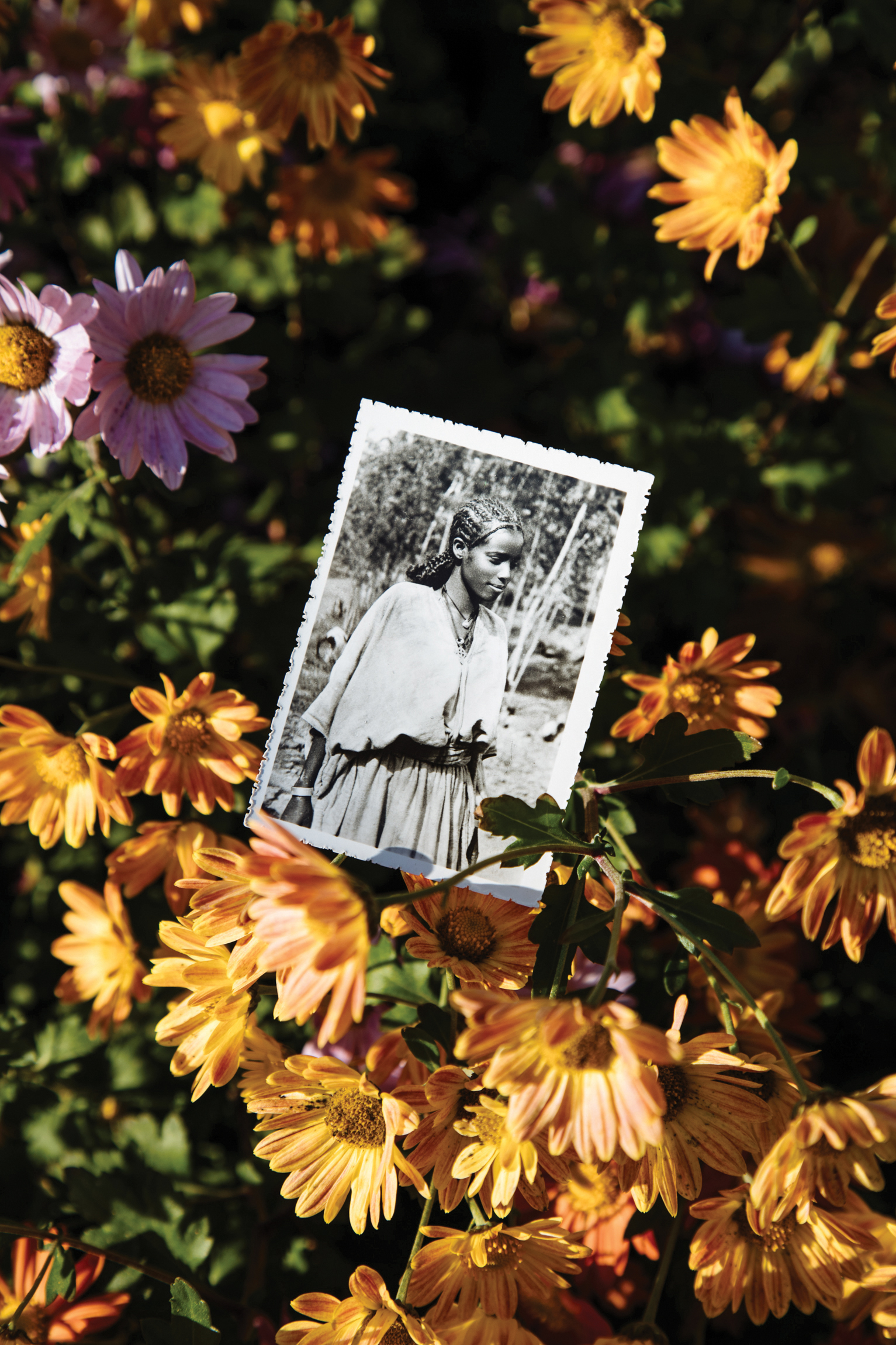
When the writer Abdi Latif Ega arrived in Harlem, it didn’t take him long to encounter a scent reminiscent of home. It was 1987, and he was a musician and a student of music theory who would later teach at Columbia University.
The scent, an oil sold in many stores uptown, was called Harlem Rose. But to some, it was known by another name, Somali Rose, because of its traditional ingredients: frankincense, sandalwood, anise, musk, a dash of rose, and a twist of green moss. Since its inception, the scent has expanded into other forms with a sprinkle of differing ingredients. For Ega, who has lived in Harlem for forty years, the smell brought into focus the long histories of Somalis in New York City since the 1880s.
According to the elders of the neighborhood, the scent was created in Harlem by a man named Haji Sateen Yusuf. He came to New York long before Ega. A seafarer from Somalia, he fled as a teenager during colonization in search of an alternative life abroad. On British ships, he found his way to the city in 1911. To support himself, he helped build MTA subway stations, including Jamaica Station. But Sateen also found a side hustle, creating scents that became part of New York’s cultural fabric. He was not isolated when he arrived at the turn of the twentieth century. He met with a dozen other Somali roses who’d made a home in Harlem since the late 1880s.
There are scientific links between smell and memory. Scents transmit olfactory signals through our limbic systems, which trigger the front of the brain, which sends information to the amygdala and hippocampus, the parts of the brain related to memory and emotion. Of all our senses, scent triggers our sites of memory the most.
During World War II, oils and perfume became contraband, as their ingredients were diverted to military needs, making scents a luxury good. Despite this, seafarers, often of the Islamic faith, kept re-creating scents of home. An act of Sunnah for Muslims, these scents were an extension of their spirituality. These oils, like Somali Rose, are now a trend on TikTok, showing us that the diasporic impacts of Harlem remain prevalent.
Harlem’s history is deeply rooted in migration and remains so. In the 1920s, Harlem was more than a literary, sonic, or cultural explosion. Amid Jim Crow, between two world wars, in slavery’s afterlife, and on the eve of decolonization, Harlem emerged as one of the most prominent Black diasporic neighborhoods in the world. This was largely thanks to the Great Migration, but also the arrival of thousands of seafarers from Africa, Asia, and the Caribbean.
“There were far more gaps in passport enforcement and border control a century ago than there are now,” says Patrick Bixby, a scholar of modernist literature and the author of License to Travel: A Cultural History of the Passport (2022). “In the 1920s, the modern passport system was still in its infancy, so there were gaps in enforcement that allowed certain people, seafarers among them, to move about the globe without being subject to the same limitations we face today.” Seafarers, because of the way they traveled, had more access to those gaps than others—and more mobility as a result.
After a few years of maritime labor on a British steamship, using a shovel to feed coal to the ship’s boiler, Sateen called New York City home for almost eight decades. In time, he became a mentor to the new waves of Somali seafarers who joined him during the twentieth century, including some Somali elders still living in Harlem. He guided them to local masjids, offered financial support upon their arrival and references to cultural epicenters for Black Muslims in the city. One of Sateen’s mentees, Tahir Abdullah, has lived in Queens for a little under sixty years. Arriving as a teenager in the 1970s, Tahir was part of a new wave of Somali seafarers who joined him during this decade.
As new city dwellers, they looked to their elders for mentorship. Sateen was an influence on Tahir, who regarded himself as a troublemaker at the time, in search of guidance. He is one of the few who carry the story of Sateen.
Tahir also found ways to take care of his mentor. He was Sateen’s companion during long subway trips to doctors’ appointments in Chinatown. He would then watch Sateen stomp, cane in hand, through downtown. Sateen would yell to anyone in earshot about the mass gravesite of enslaved Africans below them. He would spend these outings telling the younger Tahir details about the history of Somalis in New York—and with these stories, he offered him maps of Black life throughout the city.
The earliest story among these elders of Somali history in New York City is the arrival of a sailor in 1887. By the 1920s, the expanding community formed its enclaves. Somali seamen found ways to congregate and meet. They lived along a stretch of West 116th Street near Manhattan Avenue. They took long strolls together from uptown to downtown to find menial work. The jobs typically available to Black people at the time were domestic or personal (maids, cooks, doormen, and waiters) or skilled trades, such as port workers, train porters, or elevator operators.
They formed community spaces in cafés like Café Aladdin, a Somali-owned restaurant at the corner of Cornelia Street in Greenwich Village, serving chicken with wild honey sauce and tamarind drinks. They congregated at the Somali Hajj Yusef’s Shoe Shine stand on 125th Street and gathered around tables at the African Quarter restaurant in Brooklyn, where oils and scents of home were shared.
The seafarers of the early twentieth century were part of the Lost Generation—those who came of age during or shortly after World War I. Disillusioned by the horrors of the Great War, this cohort was disoriented, wandering, and a bit directionless. They had endured a loss of faith in traditional values. Many African and Asian seafarers, making sense of a forced nationalism, played with the rules of racialization. They would exchange and swap identification cards; many Somali sailors arrived in America with the identification cards of Yemenis.
As the world expanded through the cruelties of colonialism, these flaneurs and high-seas Black stowaways were lost between borders, wars, and the old world that was being replaced by a new order. This generation was born during and after the Berlin Conference of 1884–1885: as European occupiers arrived with ships and weapons at the ports of their ancestral lands.
The rise of nationalism and its subsequent Great Wars led to an era of wanderers deemed colored, “without tickets, passports, or portfolios,” as the scholar Gary Edward Holcomb wrote in his introduction to Claude McKay’s Romance in Marseilles (2020).
Many of the Somali seamen who arrived in early twentieth century America never returned to their homeland. Their wanderings through city life were cut short. Economic disparities, immigration detention, premature death, and the afterlives of slavery shaped their destinies. There are stories of men who died impoverished and alone, never returning to their lands of birth.
Shortly after Sateen’s passing in the 1980s, Tahir learned of another Somali sailor who was buried in Hart Island, a potter’s field in the Bronx. Tahir was alerted by a community member that the sailor had died in obscurity. The unknown man was killed on Christopher Street, then a site for queer and trans communities. Tahir was one of the few community members in attendance at his funeral.
We may never know if many of these wanderers and sailors intended to return. Their archives and stories only leave us with speculation.
Now Somali Rose oil is sold on stands across New York City, alongside a few dozen other perfumes hailing from many parts of the globe, including Jamaica, Ethiopia, Egypt, and Bangladesh. Like Sateen’s creation, these oils have their own maps and stories.
During the two great wars, as seamen spent weeks, months, or years at sea, they bypassed the restrictions of nation-states not by smuggling oils from their places of origin, but by creating them onboard. They relied on oils and memories of home to carry them in between worlds.
At Muhammad’s Place, an oil and fragrance shop in central Brooklyn established in 1995, one quickly sees the expansiveness of these domestic scents. A bottle of Somali Rose is sold for less than twenty dollars, depending on the size, and is described by the shop as “an exotic and luxurious fragrance with rich rose notes and a touch of spice, perfect for special occasions.” The shop’s owner, Muhammad Elzendy, 54, an immigrant from Egypt, has sold scents and shared their histories with customers over the decades. “The Somali Rose is one of the oldest domestic scents we sell,” he told me one afternoon.
Muhammad’s Place, much like other oil shops across the city, organizes its ouds, oils, and perfumes into two major categories: domestic and imported. An imported Egyptian scent costs much more than Somali Rose, one of the domestically produced oils. A scent created by an African Muslim immigrant has now become a sensory part of the Black fabric in America.
There is currently a rise in African Muslim migrants across New York City, and it’s the highest migration pattern of this group since the Middle Passage. In 2023 alone, there was a 300 percent increase (from 13,406 in 2022 to 58,462).
“The passports of many Muslim-majority countries have been deemed a liability by other nation-states,” says Bixby. “The Muslim travel ban signed by Donald Trump is an obvious example, but the relative “weakness” of passports from countries such as Iraq, Syria, and Afghanistan (i.e., their lack of visa-free or visa-on-arrival access to other countries) suggests a general effort to limit the mobility of Muslim populations around the globe.”
Yet, along West 116 Street and Manhattan Avenue in Harlem, you can find this current wave of migrants living in a corner of the city that bears the unwritten, long legacy of African Muslim seafarers who roamed a century ago. It’s also along this strip where you can still find Sateen’s Somali Rose and other oils sold by Senegalese, Gambian, and Black American shopkeepers.
These oils are a reminder that the many migrants from Africa who currently shape New York City, despite estrangement or precarity, are home here, as they have been for many centuries.
Harlem is a neighborhood with unique indigenous, diasporic, and migrant roots. It’s an American neighborhood that troubles our understanding of migrants and refugees. It has long been shaped by a diasporic fugitive practice: it is where migration becomes strategy, not just survival; migration as tactical evasion, radical solidarity, and cross-border political consciousness. It was in Harlem that the multiplicity in the framing of the New Negro expanded beyond borders.
The sea drifters of Harlem left us sensory maps to trace; trails through scents, and the city they strolled in, walking against dominant structures and systems. This wandering and scent-making is a practice of memory making. The oral histories that live within oil stands tell us a different mapping of New York City. How do these sensations left behind by these early-twentieth-century drifters surface hidden archives?
After almost seventy years in the city, Sateen passed away in the 1980s. At his request, he was buried in his homeland. He left behind dozens of mentees, now family, including other seafarers, such as Tahir, who continues to share his oral history today. But Sateen also, perhaps unknowingly, left behind a long-lasting scent, now imprinted on New York City’s oil culture.
His story reminds us how high-sea stowaways turned flaneurs maintained their iman, culture, and creativity as they subverted borders in search of a safe enclave to live an ordinary life in diaspora.

