
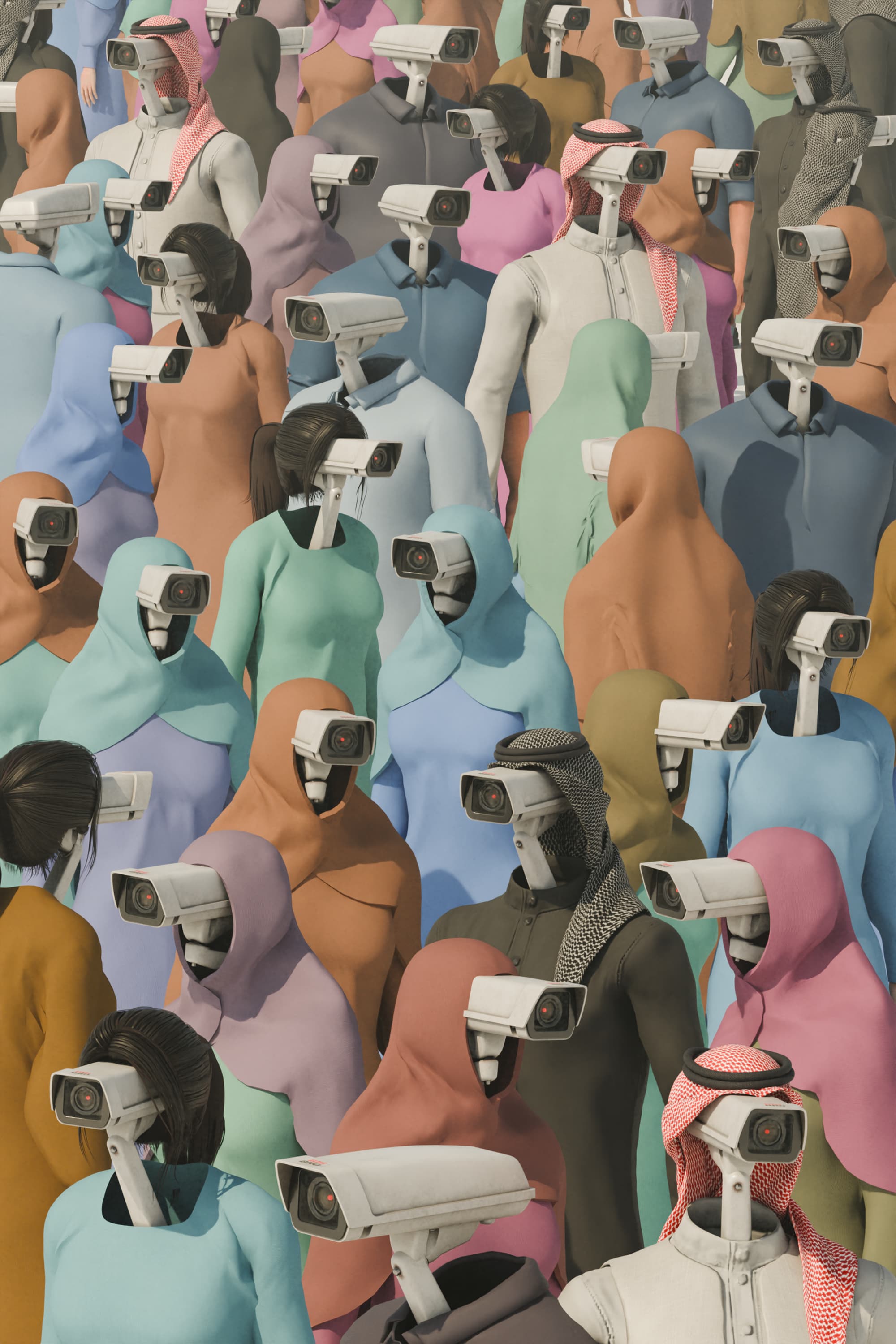
There is a familiar rhythm to how a Muslim woman becomes a target online. The friction starts discreetly—an uploaded clip saved and trimmed down to focus on its most combustible seconds, followed by a slow trickle of discerning language delivered with the cadence of care and concern. Before long, however, there are more opinions than can be reasonably managed by any one person, and the dialogue quickly moves off one account or platform until it is propagated without context via endless threads, duets, stitched videos, and anonymous comments. What was initially framed as communal responsibility has rapidly devolved into a spectacle of communal punishment, where the internet plays judge, jury, and executioner for the nebulous crime of daring to be publicly Muslim on the internet.
This phenomenon is not simply a matter of bad actors within Muslim digital communities or poor adab. It is the logic of surveillance capitalism doing what it does best: slipping into the soft tissues of social life, such as faith and morality, and teaching us to watch one another for free. And increasingly, Black and brown Muslims have become willing participants in the panopticon, informally deputized in the tactics of data capture and monitoring.
Within the ummah, this practice has a name that is often used jokingly but is quietly revelatory of its social function: the haram police, which both in name and logic reflects an explicitly carceral approach to digital interactions, from copies saved to hard drives to screen recordings floating through group chats. It is discipline carried out by peers that is rationalized as “care” amplified by platforms that reward outrage and certainty.
The phrase is usually said with a laugh, but this is where social media’s most insidious work takes place. It is not merely in the obvious arenas of state monitoring or corporate data extraction, but in the everyday dynamics of interpersonal life. It turns attention into currency, morality into content, and community into an unpaid labor force tasked with monitoring itself.
The political implications are not abstract. We have already seen how commercial data systems can be weaponized through infamous cases such as Cambridge Analytica’s exploitation of Facebook data to influence elections. But these forms of social engineering take on a familiar pattern to the tactics used by enforcement and state authorities to triangulate marginalized Muslim communities. It is hard to look at these digital pile-ons and not recognize how they mirror state surveillance tactics of identification, extraction, and destabilization through isolation. These tactics echo the same mechanism of counter-extremism programs like CVE (Countering Violent Extremism), which framed Muslim community monitoring as prevention while eroding trust and civic life.
In the panopticon, the genius of power is not force but uncertainty: you behave because you might be watched. Over time, surveillance is internalized, and the guard becomes unnecessary. On social media, the guard is everyone. In this sense, social media is not just compatible with surveillance capitalism; it is its most mature form.
***
Surveillance in the United States did not begin with apps or algorithms in Silicon Valley; it was forged through racial control. Long before the concept of an algorithm became common parlance, there were slave patrols—systems designed to monitor movement, enforce visibility, and extract labor from racialized bodies. In Dark Matters: On the Surveillance of Blackness, Simone Browne traces how branding, passes, and lantern laws formed an early architecture of surveillance, one that treated Blackness itself as a problem to be managed. These are some of the earliest technologies of monitoring and movement control in America, where surveillance implicitly functions as a practice of sorting and disciplining.
Technology does not correct inequality; it refines and automates it. That racialized logic did not disappear with emancipation; it served as the bedrock of the modern surveillance framework, as it continued to entrench itself in the carceral panopticon and modern prison system, and in advanced policing tactics. As Ruha Benjamin argues in Race After Technology, modern systems inherit old hierarchies.
After September 11, 2001, surveillance underwent a rapid and intense cultural acceleration, anchored and motivated by the twin bigotries of Orientalism and Islamophobia. The Patriot Act and FISA courts expanded state authority and authorized secrecy; The NSA amassed data at a scale previously unimaginable. ICE was created and quickly transformed into a domestic surveillance apparatus. As David Lyon articulates in his canon of work on Surveillance – from 2007’s Surveillance Studies to 2018’s “The Culture of Surveillance" – not only was the apparatus normalized as part of everyday life, but increasingly rationalized using the twin lens of security and risk as its animating premise.
Slowly, the target of these advancements was not the state, but consumers themselves. Products such as Ring cameras, nanny Cams, and location monitoring services not only became ubiquitous, but standard elements of modern-day life. Into this climate stepped social media platforms, offering connection while quietly perfecting extraction.
Social media accelerated this shift by turning interpersonal life itself into raw material. Every like, follow, private message, voice note, pause, and scroll became extractable. Emotional expression was suddenly valuable not for its meaning, but for its predictive power. Social media did not invent surveillance, but it made it intimate and anonymized. The data scientist Cathy O’Neil identified these systems as “weapons of math destruction” precisely because they operate with devastating consequences and little means for accountability, actively reproducing racial hierarchies while claiming neutrality.
What makes surveillance capitalism so effective is not coercion, but inevitability. Platform destruction is not realistic in the short term, particularly for younger generations whose political education, social lives, and spiritual exploration unfold online. Apps reward provocation, outrage, and emotional intensity because these behaviors generate engagement. Under surveillance capitalism, moral performance becomes profitable. Calling someone out feels righteous, but it also feeds the algorithm: metrics spike, accounts grow.
The most profound consequences of surveillance capitalism are not abstract or theoretical. Interpersonal conflict online has increasingly begun to carry real-world risk. Screenshots become weapons. A disagreement can escalate into job loss, doxxing, family harassment, or physical danger. It is rogue vigilantism masquerading as justice, with limited means of recompense of forced accountability. After all, the haram police do not wear uniforms or issue citations. They operate through screenshots and stitches, through public reminders of adab and private messages framed as concern. Their authority is informal and amorphous, with a wide berth of jurisdiction. Their evidence is whatever the platform is willing to surface. This is the ultimate digital manifestation of what Foucault labeled as the carceral archipelago—a society where control is dispersed and normalized, and surveillance is internalized as a moral duty.
***
To be online as a Muslim today, particularly as a Muslim woman, is to move through a landscape shaped by this quiet expectation of scrutiny, not just against state authority, but within your own digital community. One is not simply speaking or sharing, but performing under watch for strangers and peers alike, anchored by algorithms optimized for outrage and certainty.
The sociologist George Herbert Mead argued that the self is formed through social interaction—that we come to know who we are by seeing ourselves reflected in others. Social media distorts this process. The “generalized other” becomes an imagined, infinite audience. Every post is haunted by its future extraction, influencing people’s behavior in anti-communal ways. People lurk; they create finstas, retreat into private groups and Discord chats. They post less, share selectively, speak cautiously—not necessarily out of spiritual discipline, but out of fear. Spaces once imagined as sites of fellowship begin to feel brittle and porous, as the function of community increasingly feels conditional. Most notably, visibility—a pivotal tool on social media for groups to mobilize on critical issues—becomes a liability, where the boon of increased social capital is outweighed by the persistent fear of being scrutinized into oblivion.
Social media remains a primary site of interpersonal life, and with AI-generated content and deepfakes accelerating, the stakes are rising. If social media is the operational arm of surveillance capitalism, then resistance begins with recognition. It means naming how the language of harm and boundaries can be conscripted into carceral logic. It means refusing the reflex to document, archive, and circulate as a first response. It means remembering that not every call-out is care, and not every visibility is liberation. Michel Foucault’s panopticon was a prison design; left to its own devices, social media is its social evolution. We don’t need guards when we watch one another.
Resignation to this reality is not neutrality, however; it is participation. Survival has always required discernment: knowing when vigilance protects life, and when it quietly teaches us to police ourselves. The question is whether we allow social media to remain a site of surveillance and extraction amongst each other as individuals, or whether we are brave enough to insist on something more human.

