
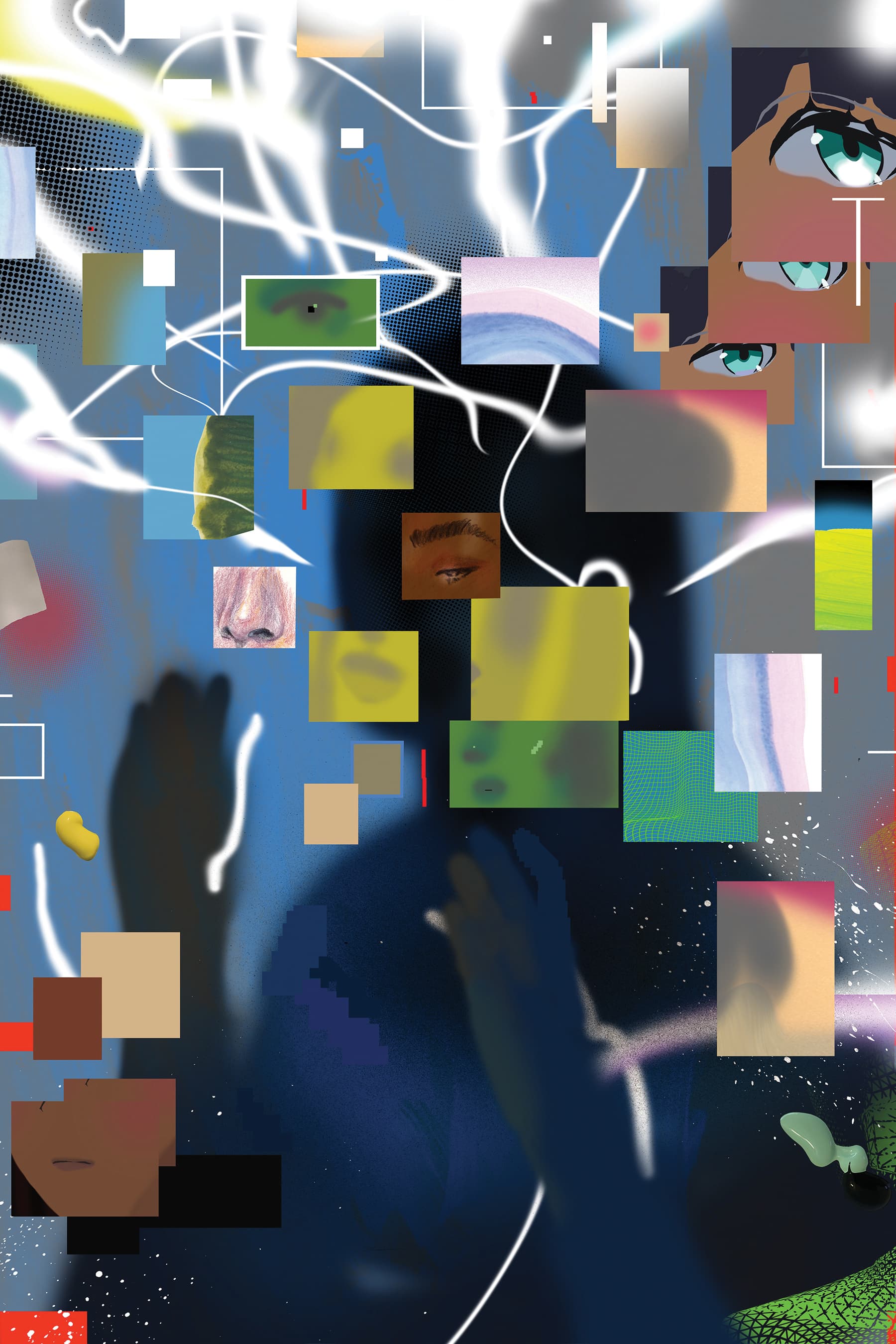
In a spate of cases, Muslim women arrested at protests have had their hijabs removed by law enforcement for booking photos that get posted online. Many of these women have sued and won settlements that included money to the victim, deletion of the image from internal and public records, and a city policy limiting hijab removal. But after months of litigation, even the best settlement can be too late; every image uploaded to today’s internet becomes raw material for the data economy.
Within minutes, web crawlers may have supplied the image to a company like ClearviewAI, who will use it to train the facial recognition platforms operated by ICE, the Pentagon, and local law enforcement; the platform then becomes better at identifying the woman in the image, and everybody who looks like her. The image may also have been scraped to train generative AI programs such as Grok, a chatbot that created three million nonconsensual nude images over the course of eleven days last winter (the Pentagon has a $200 million contract with Grok, too).
Each forced mug shot enters a swelling surveillance infrastructure that puts it to work long after any settlement is reached. In all these cases, the state violated a woman’s privacy, but each image may have helped put many more people in harm’s way. The legal system at its best interprets this as an affront to each woman’s autonomy, offering back some control over her photo. But privacy means more than just control over information. Because the Muslim ethical tradition values privacy for different reasons than the American legal system does, a Muslim vocabulary around privacy can provide the basis for imagining better resistance to surveillance.
Muslim ethics frames privacy as relational: sitr, or virtuous concealment, involves maintaining the privacy of oneself and others. Covering is an ethical response to the condition of being watched. Surah al-Nur commands “cover yourself” in the same verses it commands “lower your gaze,” coupling responsibility for one’s gaze with responsibility to respond to the gaze of another (Q24:30–31). These verses explain how practices that maintain sitr vary according to differences in gender, economic power, and the capacity for desire. Regardless of the relationship, however, sitr is an axis upon which Muslim ethics operates: actions can be evaluated based on how they demonstrate the actor’s awareness of a gaze.
Talk of “the gaze” tends to accompany critiques of power. Social theorists connect the gaze to the way power relies on knowledge production, but also dictates the terms of knowledge production toward its own ends. In this way, “gazing” is “watching” as a productive act. A male gaze positions men as viewers and women as the viewed, producing women as objects; a colonial gaze sees, defines, and controls the colonized, producing populations to manage. Alternatively, bell hooks describes an “oppositional gaze,” a subversive “looking back” employed by Black women against the gaze of subordination, producing the oppressor on one’s own terms.
Some classical Muslim scholars recognized a dynamic similar to the oppositional gaze in the Qur’an’s treatment of tajassus, which can mean surveillance or spying. Surah al-Hujurat condemns what has been called “negative tajassus”—seeking out people’s information for the sake of power. But scholars recognize a “positive tajassus,” the ethical production of information, in Surah Yusuf. The Surah describes how Yakub weeps until he goes blind, separated from his son Yusuf by the betrayal of Yusuf’s brothers. Despite the betrayal, Yakub sends his sons to “Go and find out about Yusuf and his brother, and do not despair of God’s mercy” (Q12:87). Blind Yakub cannot gaze, but he trusts God to orient his sons’ gaze in an act of righteous knowledge production.
Echoes of Yakub’s positive tajassus appear in a 2019 op-ed written by Maria Domingo Garcia, which explains how ICE arrested her at work, separating her from her still-breastfeeding baby. Writing while detained, she bears witness to horrors experienced by thousands of mothers like her. As an immigrant and worker, Domingo Garcia’s position in systems of production rendered her vulnerable to violence, but she also sits within a data economy built on systems of information production that created new vulnerabilities. The anger in her op-ed isn’t directed at ICE or her employer but rather at Palantir, a firm that specializes in merging large datasets. Domingo Garcia argues that Palantir enabled the workplace raid by providing information ICE would not have legally had access to. Like Yakub’s reliance on his sons’ gaze, Domingo Garcia’s testimony is a subversive form of knowledge production, a public record of the forces that conspired to separate her from her children.
The American deportation machine continues to produce a catalog of interrelated horrors. ICE has since separated thousands of children from their parents with the help of private sector surveillance. Alongside the violent raids, DHS’s “alternatives to detention” program (ankle monitors and phone check-in apps) quietly tears at the fabric of immigrant communities: even immigrants with legal residence status avoid seeing friends and family wearing ankle monitors, reporting workplace abuse, and applying for Medicaid or SNAP out of fear data about themselves will reach deportation authorities. To interrupt the production of these horrors, we must interrupt the production of information. We must take privacy as solidarity.
This liberal logic of privacy-as-autonomy has a genealogy. A canon 19th-century law review article defined privacy as “the right to be let alone.” Talk of “private property” and the “private sphere” within American secular liberalism emphasizes privacy as an individual right and basis for personal autonomy. This sense of autonomy is foundational to American capitalism, which constructs the market as a sphere of sovereign individuals exchanging goods and making choices. The private sphere isn’t supposed to be free from observation but rather free from interference. Markets are carefully constructed by property law that favors wealth accumulation and corporate law that limits liability for economic harm. America’s private sphere is never truly “free” of government interference but it protects some kinds of autonomy for the sake of participation in markets.
That’s why in the data economy, violations of privacy can only be taken as violations of individual sovereignty. Those looking for redress end up seeking out better privacy settings on their phone, stronger rights to sue, maybe a property right to one’s own information. By importing market ideology into the word “private,” privacy warriors end up replicating the logic of an industrial complex intent on naturalizing a data economy: if data production is inevitable, the best you can do is try to control where that data goes.
Privacy is about the step before that: the preservation of spaces where no data is produced. Privacy refers not to control over some finite and definite knowledge (that’s secrecy), but to a state of affairs free from knowledge production, what the philosopher Lowry Pressly calls “oblivion.” We don’t follow our friends into bathroom stalls. This is not because our friends might have secrets in there, but because the bathroom is a place where people want to be free from their friends’ gaze.
There, between two people, sitr tends to come easy: just cover yourself and lower your gaze. But sitr also implies an awareness of the Divine gaze. Because God is all knowing, God’s gaze operates differently from the social gaze. Muslims who cover themselves in prayer (even when praying alone) are not trying to prevent God from seeing them but rather demonstrating through their bodies that they know they are seen. This insight doubles as a critique of secular liberalism’s relegation of religion to the “private” sphere: Sherman Jackson argues that Islam makes space for an “Islamic secular,” institutions and areas of life outside the sphere of Islamic law but within which Muslims still operate with an awareness of God’s “adjudicative gaze.” The Islamic secular doesn’t impose sharia on public life but rather extends Muslim ethical reasoning into political and economic activity.
Sitr can help us imagine privacy within human power relations, bringing Muslim ethics to the political economy of the surveillance state. The idea that there is ethical merit in concealing aspects of ourselves and others provides grounds for solidarity in resistance to being seen. There’s a resonance here with the Martinican poet and philosopher Édouard Glissant’s concept of opacity, a refusal by individuals and cultures to be fully legible to colonial systems of knowledge. This is especially key because surveillance today is a communal harm that calls for collective response. When Customs and Border Protection collects a migrant child’s DNA and stores it in the FBI’s genetic database, it makes the entire system better at sorting that child’s family tree. Data about any one person has economic value today because it helps produce knowledge about everybody else.
This is why privacy, today, is solidarity. Labor solidarity is instructive: there, “solidarity” is the development of mutually supportive relationships among workers, based on their shared position within systems of production. When workers strike, they leverage that position as collective power to interrupt production. Within the data economy, shared resistance to surveillance similarly leverages our position in the production of information. So, to pursue practices of opacity, we must build relationships with the intent of disrupting exploitative forms of information production. But what does a data strike look like?
One way to resist might be to develop practices that interrupt the gaze. The Sunnah justifies active forms of resistance to surveillance. One hadith narrates that when the Prophet (PBUH) found out about a man peeping into his dwelling, he said, “Had I known you were looking, I would have poked your eye …” (Sahih Bukhari 74:258). Perhaps by organizing boycotts of social media platforms or other services, we might find a way to poke tech oligarchs in the eye. But as Domingo Garcia teaches us, it may be even more productive to gaze back.
Positive tajassus like Domingo Garcia’s aligns with what technologists sometimes call “sousveillance”: watching from below rather than above. Documenting and publicizing direct state violence is crucial and sometimes incredibly dangerous work, as the immigration agent murders of Renée Good and Alex Pretti have once again reminded us. But the Minnesotan observers, with their whistles and their group chats, found community in knowledge production, in “watching the watchers” to protect the vulnerable. They created a public record that quickly exonerated Good and Pretti of the government’s lies.
Sousveillance practices can create opportunities to exercise tactics of opacity: over the past few years, a company called Flock Safety has placed AI-powered cameras on roads across the country that photograph every passing car and log the license plate, make, model, and color into a searchable national database. Police have accessed the database to track the movements of protesters. Texas sheriff deputies searched Flock’s network for the car of a woman who had obtained an abortion. Despite Flock’s claims that they don’t work with immigration enforcement, local police officers frequently conduct searches on behalf of ICE.
One Colorado activist responded by building DeFlock.me, a crowdsourced map that shows the locations of more than 76,000 license plate readers (Flock’s CEO called this act “terroristic.”) DeFlock.me brought widespread attention to Flock’s presence in some communities, and since early 2025, at least 30 cities have canceled their Flock contracts due to public pressure. DeFlock.me raised awareness of the gaze through sousveillance, and people have been coming together to resist being seen on Flock’s terms. Collective knowledge creates collective power.
Sitr, a sense of privacy constructed by, through, and for relationships, can lead to victories beyond the rights of the sovereign individual. Today’s data economy constantly produces information about us as individuals to control us as populations. The ethical call to cover ourselves is thus a political demand for solidarity in resistance. The tech oligarchs ruling this economy fear our gaze will interrupt theirs. They won’t lower their gaze because their power depends on it. We must keep finding new ways to stare back together.

