
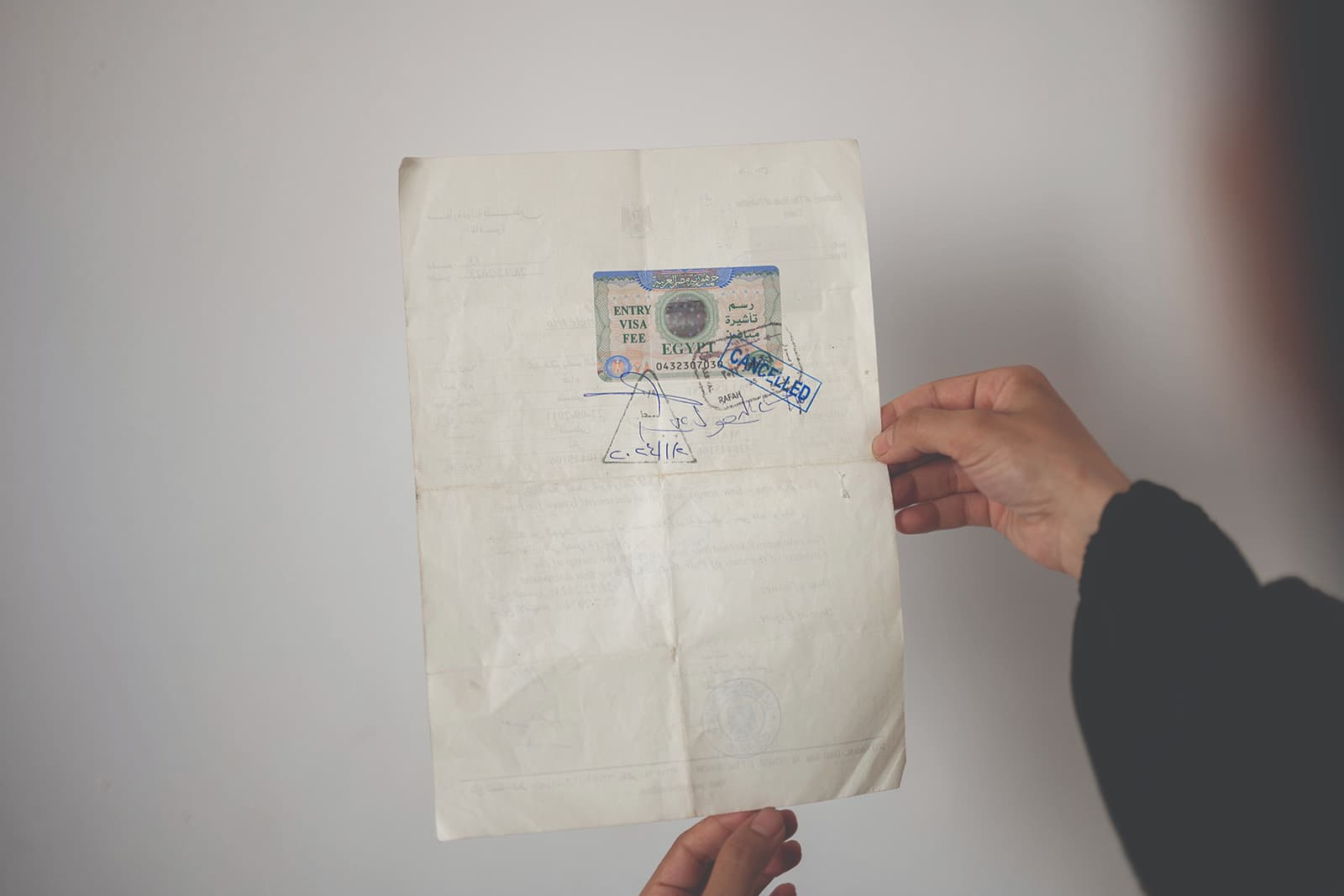
Outside, there are young boys playing football in the crammed alleys; street vendors holler “Robabekya!” (old stuff), making their daily rounds as they tirelessly trudge wheelbarrows of knockoff goods—anything from worn socks to tools or spare parts. There are far too many goats in the road; chickens, rabbits, and ducks are in spindly wooden crates. Some hawk sugarcane and hibiscus leaves; others fan smoke-scribed maize. The black lethargic dogs know hunger just as well as the people. Scattered garment sweatshops hire men whose passions never attempted realizing, who find themselves pressed by circumstance into menial day labor. Evening disputes have already erupted in bursts of gesticulated rage—over parking spots, unpaid debts, and over everything and nothing, alas.
Ain Shams is a madly struggling district on the east bank of the Nile, where informal, squalid settlements sprout like huddled weeds. Marked by chronic disinvestment and cut off from any semblance of basic living services and located just east of the capital, Cairo, it is here where Sami and Leyla (pseudonyms), a displaced Palestinian couple from Deir Al Balah have found themselves. They are only two of hundreds of Palestinians confined in this part of town. Most Gazans displaced from the ongoing genocide have clustered in Egypt’s humbler quarters—Faisal, Imbaba, Nasr City, El-Arish, Ismailia, and the 10th of Ramadan district where Cairo thins into the desert. Sudanese refugees, too, have staked their claim along Sami’s block. Each populace moves like their own shadow city within these streets: self-contained, heedful of their unspoken limits, and partitioned by an overreliance on covert “underground grassroots networks,” and a whole bunch of state neglect.
A handful of men in these most congested, unkempt alleyways look for employment outside the area or work in craft sweatshops, open-air shawarma stands, or informal food dens that line the pitted streets. We spent billions on infrastructure and shiny new bridges and the slums got nothing but potholes and dust-caked alleyways.
At Egypt’s doorstep arrive the nearly 200,000 Palestinians displaced from Israel’s ongoing genocide. They aren’t, by any means, the full story. Nor are they monolithic. Many got lost in the shuffle after decades of cyclical exile (the Nakba, Naksa, and every unjust war after) and some were never registered at all. Or, though far less common, some arrived through marriage to an Egyptian and assumed legal citizenship, says Maysa Ayoub, the associate director at the Center for Migration and Refugee Studies at the American University in Cairo.
Those who arrived after the 1948 Catastrophe and before the Six-Day War of 1967—an estimated 15,500 Palestinians—were mostly placed in camps near Qantara, northeast of Cairo, forgotten areas that lacked U.N. assistance, not for lack of showmanship, by any means.
Cairo’s Abbasieh district became a first harbor for Palestinians displaced from Jaffa. As their numbers swelled, the Egyptian High Committee of Palestinian Immigrant Affairs established what it termed a “city of refugees”—a provisional camp in Qantara—followed by a second site, Mazaritta, near Port Said. But the three camps that were created in 1948 were dismantled within just four years.
“The U.N. had actually offered help,” Ayoub says, “but it was Egypt who declined, insisting it would manage things itself, to preserve the Palestinian identity, they claimed, and to avoid the ‘slippery slope’ of permanent resettlement.”
“They didn’t want to create the [livable] conditions for permanent resettlement. They did not want to abide by the UNHCR [United Nations High Commissioner for Refugees] planting its encampments on Egyptian land,” she adds. “Same with signing the 1951 Refugee Convention, even though Palestinians weren’t technically included at the time. Egypt feared it may imply a kind of acceptance to [displaced] Palestinian conformity. And that was seen as politically intolerable. So, they stalled. The right of return had to remain.”
“Instead,” she adds, “Egypt created its own flimsy committee to manage them—an aid system built on economic need, not refugee status, and always with the unspoken hope that their displacement would only be temporary,” says Ayoub.
This, Ayoub argues, is a policy that stretches back to 1948. And still, it holds. “There’s empathy, of course. But structurally? There’s never been a system built for them.”
Egypt only acceded to the 1951 Refugee Convention belatedly, in 1981—three decades after its adoption—and remains one of the few Arab states to have done so. Whether coincidentally or by design, Egypt had ushered in the Palestine exception: a form of exile entirely immune to urgency, one that called itself “temporary” yet reeked with indefiniteness. It was a lazy arrangement conspicuously devoid of any foreseeable remedy or even a working knowledge of Israel’s less-than-benign intentions across the border.
I first met Sami, forty-one, through passing mention. He and his wife, Leyla, evacuated Gaza to Egypt in April of 2024, with the hopes of having a child. His name had been bandied around by a woman mired in the city’s low-profile mutual-aid circuits for Gazans. She let on that he was not faring well in exile, not before broaching that she could no longer bear the expense of keeping him on his feet. After a long run of WhatsApp exchanges, it became clear that a screen was no way to keep Sami company. Soon enough, I was at his door each week, arriving with an Egyptian companion I suspected might make for a genial friend.
Inside the couple’s modest home, golden threads of morning light grazed Leyla’s face, diagramming her sallow cheeks. I traced her eyes to the dirty mullioned windows where her attention settled for long stretches of time during our conversations. Sami pushed open the punky wooden door, his pace lagged and shoulders already slumped in surrender. Another morning in exile, another half-hopeful interview for the former electrician—this time at a Syrian shawarma stand just a block away.
That morning’s docket of disappointments had begun at the crack of dawn. For weeks now, Leyla had awoken to her husband’s absence. Sami, for his part, saw the first wash of light as a crack in an otherwise bolted-shut window for employment. In Cairo, the city that never sleeps, the early hours often find no audience. But today there was Sami, combing through the streets of old Heliopolis trawling for work.
Except he never made it past the second question: Where are you from? The minute “Gaza” left his mouth, the interviewer’s face would shift—tighten, soften with pity, then close, like clockwork, said a despondent Sami. The problem wasn’t his hands and what he could accomplish with them. He had years of experience spanning electrical installation and repair, surface finishing and general construction work across the border in Gaza. Egyptian employers nodded curtly, even very solicitiously at times, but their minds were already elsewhere. I waited for it now, the tongue click chased by that abrupt cant of his chin. By the time Sami reached the end of his oft-repeated spiel on Egypt’s particular talent for failing him, the small repertoire of sour expressions his face and body drew from arrived on cue.
“Tsk, leave it,” he flicked his head toward the shoddy ceiling as if to rid the day. “I will try again tomorrow, of course. But trust me, each day, there is no new answer.” he grimaced, looking down at his torn socks.
In that overstuffed flat of theirs off El-Eshrein Street, wedged between honking microbuses and the smell of fried eggplants and “magic” cigarettes where he and his wife now lived, was a man who wore Cairo like a borrowed coat. Sami felt quite like a guest who’d long overstayed his visit, yet somehow never unpacked, suspended in that absurdly awkward no-man’s-land between intrusion and impermanence. He greeted each day the way one greets an unexpected landing, relieved to be alive, I suppose, though mildly offended by the method of landing. And to the couple, Cairo never really stopped feeling like some crappy layover.
One sultry fall morning I was inside their home with my friend Mahmoud, sixty-five (pseudonym), a professional Arabic tutor and translator who tagged along each time I visited the couple. He isn’t the most gregarious person, but I have known Mahmoud for years and very little seems to escape him. His mind works like a bilge pump, sucking the sense out of situations before anyone else has a thought to call their own.
I’d asked Mahmoud to help Sami learn this country that he never chose.not without the hope that by the end of my reporting journey, Sami would have found a friend here. After all, Mahmoud lives just a few miles and some change from Sami, in the neighborhood of Al Obour.
Mahmoud belongs to the vast middle of the city, or at least what remains of it. He is the Egyptian everyman incarnate. Today, the yawning gulf between those cushioned from the debt-hobbled economy and those crushed by it is tectonic—enough to be legible from Mars.
Mahmoud studied the floor, abashed, as Sami walked us through his morning of closed doors. The man always overbooked himself. With two boys and a wife to provide for, amid a treadmill of running bills, Mahmoud left no slack or idle hour in his calendar, not even on weekends. His days were a series of appointments that sent him snaking across Cairo by session, often into plush, heavily barricaded compounds that left him dumbfounded. Shellacked real estate he’d never otherwise set foot in if not for the foreign students and upper-middle-class Egyptians he taught—his black Fiat 128, vintage 1970s, still earning its keep. Like his car, the man has outlived several regimes—and roads.
I missed Egypt’s glory days, the ones Mahmoud speaks of so brazenly, when the local pound could still flex, wheat and cotton flowed, and Cairo still carried enough clout in Arab markets to choke Israel in national boycott. There were days our grandparents so ebulliently swore life felt generous, mellifluous even—the ’70s as it lingers in popular memory. But all my generation knows is what the shape and texture of misery in this land that’s ours all the same looks like. Betrayal doesn’t carry very many aftertastes. It only burns.
“The headlines stopped printing us,” Mahmoud bursts out. “Only when there are uprisings do they care about this part of the world. But there are spiritual deaths in Egypt all the time. Real ones, too. Active starvation. Violence. Economic desperation causes people to do mad things they wouldn’t otherwise,” he rumbles on.
He speaks like someone who accidentally swallowed a library. But if you ask, he’ll shake his head and say he never really earned a proper education to comment, never read enough to speak on anything. Yet for all his contradictions and sardonicism, his refusal to coddle anyone—least of all himself, I saw him as the only man fit to walk beside Sami and guide him through what ought to be the most lonely chapter a man should ever know. After all, Mahmoud knew these streets better than anyone.
I watched as a few tears broke loose through his dark eyes, always so full of pep and fire. It’s an isolated impulse for Mahmoud, but Sami was giving voice to his martyred mother, Rajaii, the woman who kept the family gelled together. Sami had lost her just a few weeks back to a stroke. Al-Aqsa Hospital, bombed and besieged into dysfunction by Israel back in October 2024, had proved futile. Sami hadn’t been the same since.
Gazans in Egypt face a uniquely capricious legal status. Parastou Hassouri, an Iranian-American scholar of refugee law and a former consultant with different UNHCR operations told me, “They are denied refugee paperwork, work permits, pathways to stability and any means of income.” She added, “and if bearing children, those newborns will be stateless, undocumented, and as a result, unable to travel or attend public school or university here.”
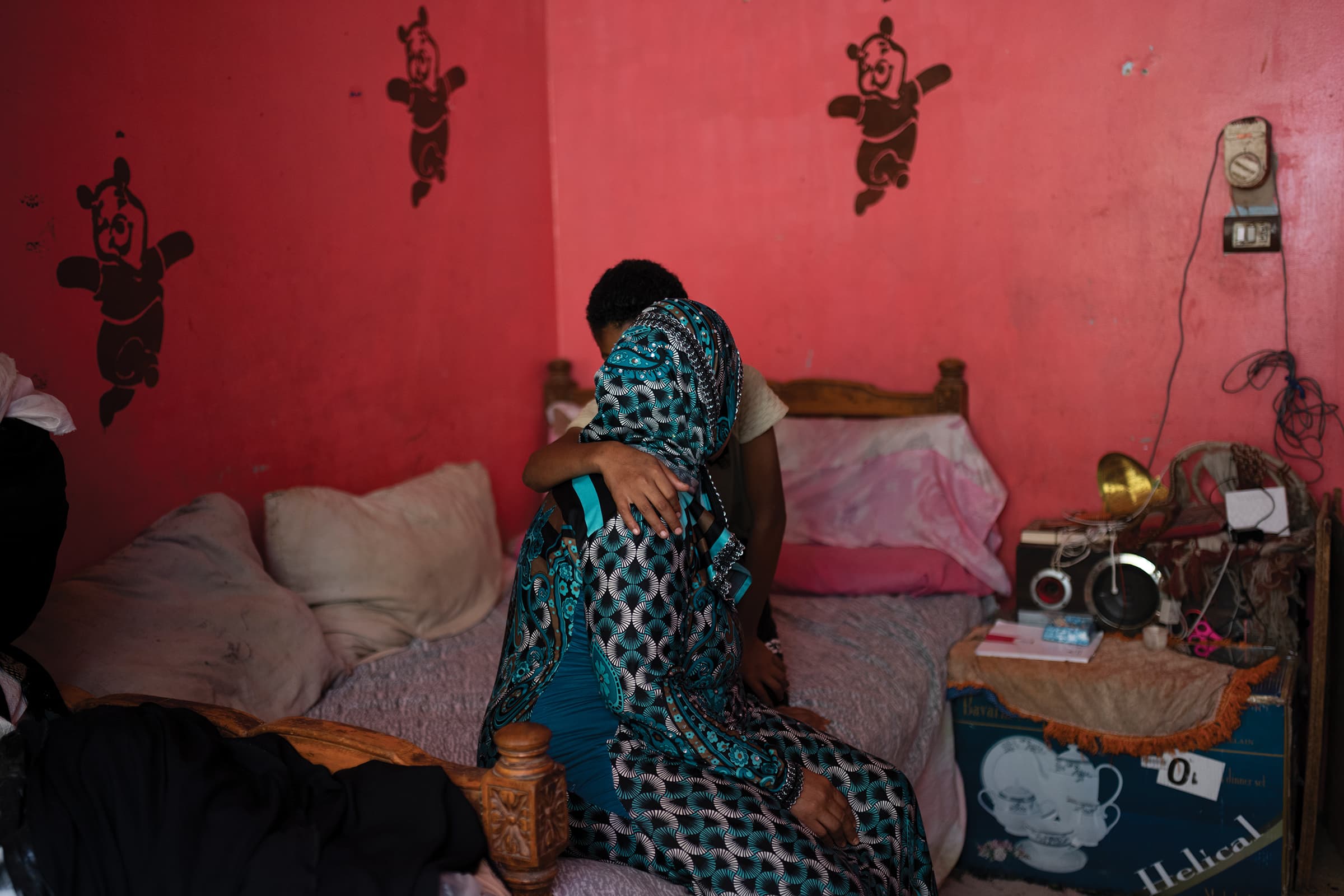
As the sole group of refugees excluded from the mandate of the UNHCR in Egypt, Palestinians are relegated to a life in legal purgatory. Absent official refugee cards, displaced Palestinians are ineligible for the state’s threadbare, subsidized safety net of social welfare programs and public services. They cannot enroll in the public schools opened to Syrians, Lebanese, and Sudanese refugees and cannot secure the recognized asylum status that unlocks humanitarian cash assistance—allowances that are afforded to some 200,000 Syrians and nearly two million Sudanese nationals in Egypt.
Egypt allows a mere shuffle in vocabulary to do the dirty work. Palestinians filing through Rafah are classified as “displaced peoples” not accorded the rights that a “refugee” classification would have granted them under the 1951 Refugee Convention. In that narrow linguistic lacuna, Egypt consigns Palestinians to the far side of the velvet rope.
“Egypt and many other countries in the region do not see themselves as countries of Palestinian integration or resettlement,” Hassouri told me. “They often point to their limited resources and capacities and the needs of their own citizenry as a way of showing that they are not in the same position to be countries of resettlement as countries of the Global North,” she said. “The [Palestinians] lack of rights in Egypt has been firmly justified over the years with the argument that it would only delay or compromise their right of return.”
“In practice,” Hassouri said, “this has only further punished them, creating a kind of [second] exile.”
Adopted in 1965 at a League of Arab States summit in Morocco, the Casablanca Protocol—formally, the Protocol for the Treatment of Palestinians in Arab States—was conceived to offer shelter to the Nakba’s influx of displaced persons without ever quite offering a home. Its aim was never generosity but rather control tempered by concession: a regional scheme that managed Palestinian life spatially without allowing exile to curdle into permanence. The animating logic, as Hassouri explained, was always strategically hedged.
Under the accord—whose earliest endorsement came from Cairo—Palestinians were to be bestowed a baseline of civil and economic protections in host countries—“basic rights,” as she put it—while remaining, by design, “refugees,” guaranteed under law the irreducible entitlements of asylum.
To that end, the protocol enumerated a set of guarantees that, on paper, read like a promise of dignity without “absorption.” Palestinians were to enjoy the right to work, access to travel documents, and the rights to entry and residency within signatory states of the pact, alongside explicit protections against discrimination in employment and residence. But the framework was hardly embraced without a punitive caveat.
And though no formal withdrawal was ever declared, “as political tides turned and shifted in different signatory countries, adherence to the protocol also lessened significantly,” said Hassouri.
*
We ate breakfast together at a wobbling trestle table, the kind that will remember every elbow it has ever supported. The city was still clearing its throat that early morning—vendors were lifting metal shutters, engines were coughing awake. There was the sonorous hiss of falafel oil coming up to heat. I looked out and found the world still at its post. The Ahram daily paper, a Cleopatra cigarette and Arosa tea in hand—the majority couldn’t start the day without them. A regular propped up in his sun-bleached plastic chair, half-moon glasses slipping down his nose, gave the paper a good rattle after each turn. Without fail and within seconds he’d find a story that would set him off on a rant to the nearest loiterer who’d listen, and in those moments of pink-cheeked rage, I could be no happier. If anything was killing him, I was glad it wasn’t the cigarettes.
Mahmoud ate fast, not rudely, just efficiently. He was already counting the one hour he had left. Sami ate slower, almost liturgically.
The soon-to-be father peeled the warm bread from his fingers and handed me the za’atar, but instead of showing me with glee how finely the Shami herbs had been ground, as he would have done only last month, his face remained wrung out in a way that unnerved me. Mahmoud told Sami not to let the day beat him before noon. That he had to think of his newborn-to-be. That the “pouty look” wouldn’t do. Somehow “your daughter will have to survive this ache of indefinite exile, and she needs more than a shell of a father to do so …”
“Bread’s worse than yesterday,” Mahmoud said, testing a joke before the silence got comfortable. He ended up releasing a sentence that summed up our state-of-the-art economy. He chuckled, but it was the laugh of a man who had audited his life and found only deficits. “Even bread has standards now.”
Sami smiled, thinly. “At least you can still buy it. Thank God for your successes.”
Without the class rank or social connections for private or international schools—a first-class ticket in Egypt into the self-replenishing world of opportunity—or the deep pockets to send his sons overseas, Mahmoud knew his sons’ academic and athletic talent was just as dicey as the dream itself. In Egypt, high-quality education and societal connections (wastas) are not just a matter of cachet. They are a class marker. He was petrified his boys might have already lost the race to rip free from the economic rut he himself could never escape.
Sami watched him speak, careful, of course, not to look like he was watching. Exile sharpens manners. He had learned to make desire a private matter, how to make himself small enough to avoid offense. His Arabic still carried thick traces of Gaza in its vowels. Cairo had not sanded that out of him. His Levantine lilt betrayed him long before the interviewers had a chance to even look at his CV.
“Gaza felt much safer for us,” Sami said timidly, gauging how much to leave unsaid before an avowed Egyptian patriot. “I won’t let Leyla go out in these streets alone.” He shook his head. “Especially not while she is carrying our daughter.”
The gradual retreat of hiring companies has smothered any promise of even informal work in Ain Shams and left the youth to loiter under flickering streetlights. Mahmoud, a former long-term resident of the town, speaks of what now fills their hands in the absence of opportunity—knives, more magic cigarettes, raucous mouths. Just last week, there was a stabbing on Sami’s street.
For all the highs—and the very many lows he has been dealt, Mahmoud loves this ancient city the way poets love romance—with both tenderness and teeth. He told me, without irony and with a great deal of sadness, that you’ll never find the same city twice. Not even in the same city. I presumed he was speaking of Cairo’s glory days. The young did not inherit this history so much as its vacuum and entente with Israel. Yet it is they who absorb its flotsam, and all our nation’s unrealized oaths.
Mahmoud told Sami it isn’t distaste—not in the slightest, just survival shrinking the field of concern. “Tomorrow’s dinner, Sami. That’s all we’re thinking about,” Mahmoud croaked, matter-of-factly. He cupped his neck, not choking himself so much as locating the pressure—a visual enactment of what the hours coaxed out of him daily.
Mahmoud is plagued by a fear of the ominous Egyptian state. He moves as though an Orwellian telescreen were tuned to him at all hours with no blind spot, not even here, within these four desolate walls. It is a fear of the absent paperwork—the work permits Palestinians are not granted. The state’s ambiguous red tape. It is a fear of arbitrary confinement, with no due process. Of asset freezes. Of abductions in the dark. Of travel bans. For Mahmoud, it is the fear that what feeds his children can be taken from him in the blink of an eye.
Each attempt to deliver assistance to displaced Palestinians, as I’m told by many involved in the covert process, feels like a transgression against the Egyptian government, with aid itself moving under trip wires of suspicion, crossing red lines that exist everywhere and nowhere at once. It is a cobweb-thin line, perforated by doubt. Few could trace where it began or ended; they only knew where it was safest not to approach. Step wrong, unknowingly, and they’d unleash a blitzkrieg through the invisible fine print of a system they themselves barely comprehended.
The scarcely spontaneous public “outcries” against mass Palestinian displacement are indeed meant to inoculate against what is most feared of all: that Palestine, if “cleansed” enough or if taken root too firmly among us, might become a mirror for Egyptians’ own self-determination. And mirrors, once raised, cannot be legislated back into glass.
To the casual observer—and even to many Egyptians themselves, like Mahmoud—it may appear as though the state is already doing more than enough; that Palestinians who have crossed into Egypt are somehow provisioned by way of proximity, buffered by international or local grassroots attention, folded into a humanitarian apparatus that renders any further concern excessive, even indulgent, perhaps rather treacherous when set against the precarity affecting millions of working-class Egyptians. The result is a false moral competition—care for them or care for us—when in reality the same political economy has starved both, prematurely classifying Palestinian need null by suggesting it has already been addressed by a state fluent in rich declarations and illiterate in action. This belief is not born of malice so much as distance. It leaves Palestinians to rot in a system that appears generous from afar but withholds the very forms of support that would make survival anything close to intelligible, for those who have seen their conditions up close.
In such an expedient sump, the Egyptian state gets to recite its litany of bureaucratic pressures (acute overpopulation, a regime of rationed welfare, a local currency perpetually one shock away from capital flight) and slip away from any Gaza audit; the Egyptian public is blindly herded and lulled into a counterfeit calm, while the plight of Palestinians, disempowered to the point of total supplication, becomes digestible so long as the entire fiasco keeps to the periphery. For most Egyptians, it does. They know hundreds of thousands of genocide survivors walk among us. They also know their hands are tied so tightly they might as well not have hands at all.
Yet, in this absurdly crooked world, it falls to the masses of a bankrupt and bungled country to absorb the impact of wars on every flank. Gaza is burning in the north, Sudan is caught in a ghastly maelstrom of foreign-backed “civil war” to the south. To the west, Libya lingers in the long ruin of NATO’s intervention, while to the east, the Red Sea churns with a Houthi-claimed front against American and Israeli-backed naval power. The warship ballet has bled Egypt’s Suez Canal of billions in tolls, carving fresh deficits into an already asphyxiated economy. Egypt, which once served as the linchpin between the East and West, has been reduced into spectatorship mode. Boxed into an escrowed compliance with the West, which bankrolls Egypt’s military and controls the off switch when necessary, the tariff sinkhole stemming from the maritime flare-up has rerouted the artery of global trade around Africa’s horn altogether. There has been nothing coy about the balance sheet; when Suez dollars evaporate, it is the Egyptian masses who pick up the tab through a gimcrack pound that buys less and less by the week.
Egyptians, already reduced to scavenging, have been conscripted into an impossible guardianship: to receive millions clawing their way out of a continuum of organized conflict, only to offer them nothing more than frostbitten stasis. The masses are left with an intolerable choice: care, no matter how materially depleted, or de facto consent to a slower execution that only finishes what Israel’s imperial appetite first set in motion.
When the wreckage is endless and the state has long abdicated its covenant, local closet organizations inherit an impossible role as the moral heads of damage control: performing triage without a map, scrambling to arbitrate which ache from which war gets sutured first. All of this unfolds inside an Egypt already flayed by economic immiseration, where existence itself for the average Egyptian has been pared so close to the bone that it has shed all politics of care for newcomers.
*
Five floors up, where Sami lives, I peeped outside his windows, yellowed like old teeth, to find clusters of gaunt young boys who should have been at school. They’d learned to draw lines in smoke instead. The crowd outside had a life of its own. The Egyptian people moved like bonny shoals of fish, as if unseeing hands dragged them this way and that, lolloping their stride to one thing, then suddenly another. There was chatter between sellers and buyers, old friends catching up between puffs of cigarettes, cars honking slogans. From the brusque, slightly aggressive “Move,” to the familiar “Hello, old friend,” to the sheer absurdity of cars slowing to a crawl against the flow of oncoming traffic—the car horn is Cairo’s second language. Even the women here know the staccato rhythm. Over the years, the notes have resolved into something legible, almost musical for me.
Egyptians react and respond in predictable ways that needn’t take anyone long to get familiar with. Nobody waltzes to work per se. No one exactly does the tango to the cramped microbus or the prosaic, life-sustaining kiosks, but inside, one can hear the music that belongs to the people, the slap of rubber-soled sandals against the concrete and the overhead white and silver pigeons that strike a chord with their inner child, and seems to keep even our elderly young at heart for all their days.
When I look at it from Sami’s view, it all collapses into nonsense.
“They say nothing can save a man in exile, that’s true, but Mahmoud, I’ve seen a phone call, a couple of connections, and a rolled joint do a lot more in Egypt than prayer ever did for me on these streets. I tell people I’m from Gaza, and they look at me with perturbation. Some cry. But most often, people are wary of my presence wherever I go. And my accent gives me away before I ever even have a shot.”
Sami had his arms and legs crossed like someone bracing, endlessly, for bad news. “I can’t stay here forever. If I die here, who will even notice?”
Mahmoud interrupted with a waspish fidelity to the land that made him, not to contest, but to protect the city embedded in his flesh, whenever the exiled voice pressed too close.
“When the belly grumbles louder than the soul, Sami, our kindness can seem brittle. Many of us are not even able to afford a basic meal for our children. Let alone ourselves. This is what many people in Egypt are experiencing now. They have been neglected for so long.”
He repeated it, over and over, as if he were trying to spit the poison from his mouth while it was still hot. “Our boiling points are much lower and our true warmth cannot be shown because of the extent to which we are feeling the excruciating level of poverty,” Mahmoud barked “These times are terrifying. They have dragged the worst of Egyptian society into the daylight.
“If you traverse certain streets, you will watch rows of people who are practically dying, Sami.” The Egyptian’s leathered features drew inward the way men do when speech threatens more than keeping quiet. “For me, it is the worst when my son asks for a small gift that his friends have, and I can never afford it. What should I tell him?
“This is the quietest form of violence for a parent,” he added, “the kind that lives inside your ribs and never lets you rest.”
The tuition Mahmoud paid for his degree never got his foot in any doors. There would be no retirement, and his two sons were set to follow along just the same downtrodden path, no matter how intellectually bright. He had every right to be enraged. “Your best bet,” Mahmoud conceded, “is getting out. Go to Canada. Take your wife and newborn and leave.”
But Sami bore a serious belief in returning and rebuilding that resisted extinction. Every whisper about Rafah reopening reached his heart before it ever did his reason. This sort of irrational, defiant faith, maintained even as each passing day made less room for it than the last, was entirely alien to Mahmoud.
“I’m not asking for much,” a demoralized Sami murmured. “Just a wire, a fuse box, something I can fix. I know this work—I know it very well.” His eyes were gleaming, I’m not sure why.
“I know it’s just electrons flowing and not something fancy or magical, but I’m still amazed by electricity and all it does for us. The six hours that we got to use it each day in Gaza were filled with joy. We ate, danced, loved, and enjoyed each other’s real company in the light,” Sami said, stupefied at the endless supply of it here in Egypt.
Mahmoud harangued Sami relentlessly, despite the walls around him. “Ma3lesh,” he’d say reassuringly, “you need to keep trying, Sami. You will soon be a father, with lots of bills. And the bills will only accrue as your daughter grows. You can’t have the easy way out, taking cash from strangers each month,” he briskly snapped, “none of us did …”
But no one wanted the burden of a man without documents. No one wanted to explain why their new hire had no “official” right to thrust forward and rebuild. A Palestinian from Gaza was a liability many simply could not print on their records. The wound of any form of “dissent,” following the 2011 revolution was national, and its postpartum symptoms were showing in real time.
I never asked Mahmoud why he wouldn’t take Sami out for a simple roadside ahwa between rounds of lessons, or perhaps a promenade at sunset, skirting the Nile corniche. I only wish he had tried more. It is a profoundly lonely thing, this brutal insistence on assimilation.
“I don’t have time for friends,” Mahmoud would retort each time I committed the error of raising the issue “I barely see my children … this, you must understand.”
*
“Word travels.” Mahmoud was eager to soothe Sami’s spirits today. He trusted that the slow climb mattered. That’s how he built himself up, after all. But while Mahmoud had the right to knock on doors, make his pitch, call up folks and tell them he was an Arabic teacher who had transcribed and translated at even the diplomatic level (U.S. embassy), Sami, legally, wasn’t even allowed to ask.
Each time we sat down together, Mahmoud cajoled him some more. He saw work as a naturally ascensional arc—perseverance followed by prayer and opportunity, it led to great things! He held tight to the conviction that Sami had to claim some kind of labor or paycheck or he would soon lose even the nothing he couldn’t enjoy in peace.
Still, Mahmoud kept at him—incessantly so, like someone doggedly defying the physics of the place and insisting on motion where the system had simply engineered total stalemate. It was to no avail. And I think it made Sami feel worse.
The man had already made the rounds enough to map the area blindfolded. He had gone up and down each block, running the gauntlet of doors across the century‑old suburbs of Heliopolis and Nasr city. He spent day and night dialing the very few cell phones that still answered, scribbling numbers passed from neighbors and faithful men who congregated at his nearby mosque for Friday prayer. He even entered a home or two, but before he had even set his toolbox down, he was rejected on the pretense that he lacked paperwork.
Eventually, Sami stopped counting the rejections. What he hadn’t stopped doing—couldn’t stop—was pretending a path might open for him here. His trade was no longer about electricity or fixing things. It was about the unfair drag of staying upright when his entire world was hinged right from the root.
A visible pang struck Mahmoud just then: how even here, the Palestinian man carried confinement like a second skin. Exile did nothing but rename the violence already strong-arming them into submission.
“I am sorry for being slow,” Mahmoud blurted out, meekly. “It’s a very heavy topic … It’s very sad. When they say Egyptians are cowards … I want you to know I feel guilt. I didn’t feel angry, I felt guilt. I want you to know that.”
Sami shook his head ruefully then patted Mahmoud’s back before rising to pray: “God is sufficient for us, my friend.”
This polite depression lined Sami’s very posture as if he were not yet accustomed to its shape. The world had schooled him in the art of shrinking. Each morning, at the close of our weekly meetings, he’d stand up from the couch as if the hours had aged him by years. His back curved like a question, his head always bowed in advance. His hands fidgeted relentlessly, worrying at whatever seam they could find—the armrest crease, his watch strap, his own sleeve.
“What does it mean when you put your head down to pray and do not think of others, the oppressed, as God has asked us to do in the Holy Book of Qur’an?” Sami’s was asking me now, as Leyla brought to boil a bronzed cezve of Turkish coffee.
Mahmoud and Sami volleyed patriotic opinions again. This time, Mahmoud was offended at the subtle digs about Cairo being no fun. He was adamant that Sami and his wife visit Upper Egypt’s countryside—Minya, a coptic-dense village on the western bank of the Nile, where Mahmoud had roots.
“Listen, I’ve told you this already,” Mahmoud said, waving a hand as if the matter were long closed. “You have to give up the idea of going back. They’re not opening the border. And even if they do—what, you want to return just to die? They will not spare anyone, those monsters.”
His chin dipped, and he lifted his eyebrows, entirely unconvinced by Sami’s show of silent protest. “Yabny (man), YOU made it out alive! Thank God for that. Thank God for your family. Count your blessings that you no longer live in a war zone!”
Then, pushing it—because Egyptians push and because silence feels like rudeness—he added, suddenly jovial: “Listen, I understand your situation is hard here. Cairo’s too loud; that is why you feel lonely! Try living in Upper Egypt,” he pried “The homes are much cheaper, too. You’ll forget Gaza in a week after you try our delicious mangoes! The countryside is the best part of Egypt!”
It wasn’t a great line. But Mahmoud—Egyptian to the bone—hasn’t yet learned how to comfort a city suddenly swollen with genocide survivors. Our sarcasm, while berserk and easily digestible, sounds totally inappropriate and unhinged to those who have so narrowly evaded mortality.
I wondered often about the loneliness in Sami’s head. The scanty envelopes of cash, cobbled together by Egyptian strangers who forewent the luxury of looking away, were few and far between, used only sparingly and always with the knowledge that they’d soon run out. Each terra-cotta two-hundred-pound bill was earmarked for rent, electricity, food, and medical emergencies. After all that, I don’t know what is left for the couple to remember of their time here.
For dinner, Sami latched onto the city’s castoffs: paper cups of ramen swimming in chili oil from the corner kiosk and boxed shawarma plates with turmeric-yellow rice from mosque-affiliated kitchens or pushcarts. Under Mahmoud’s practiced hand, I had hoped that Sami would absorb the trade and ways of the land. I wanted him to see that Egypt always gave. But never more than it could spare.
I reached for my camera, hungry to capture the espresso-colored backpack the pair had traded between them for months on end. They possessed almost nothing and called the deficit enough. It was all they brought with them from Gaza, thinking they’d give birth and return. Oh, the ebullient birth they hoped for and the home they had reserved for her first footsteps! Weeks earlier, a neighbor’s footage had settled the matter: their home in Deir Al-Balah had been razed into the subterranean.
Mahmoud jolted upright, fleeing toward the door in half-steps. He kept his eyes trained downward, my camera still dormant inside its case. His body moved ahead of him, meaty and skittish.
My mind returned to his first admission in Ain Shams, uttered before we even Sami’s door. “Just so you know,” Mahmoud had stammered, “I don’t like how I look in photos. I swear, I don’t even take them with my own family,” he said, arranging the excuse carefully. His sorry gaze begged me to leave him intact. As the weeks passed, I saw how the mere sight of my camera gave him the jitters. Only later did I recognize the request for what it was: trepidation passing as reluctance. He wasn’t preening; the man was terrified to the bone. A single image of him shoulder to shoulder with a man from Gaza would mark him as compromised. You don’t trip the wire if you’ve learned to locate it, remember …
His work had already slipped into informality after the American University in Cairo cut him loose years prior—a group of students had accused him of slinging mud at the apartheid state after he’d walked his students through a history predating Palestine and Egypt’s contemporary borders. He could not sustain another loss.
I knew that he needed to believe Egypt to be gentler than it really was, and so I held my tongue. I held it even when he spoke what I could scarcely conceive—that he wished no one to think him “aligned.” But as he stood far from my camera, hands bound together like a prisoner of circumstance, clasped with the timid muscle memory of caution. I felt it.
With Mahmoud, I was coming to understand that Egyptian patriotism arrived as a heavy heirloom, one that insisted on impeccable posture even as he shouldered his own measure of state-imposed grief. Otherwise it very well felt like treason. And no one wanted to be tried for that.
The memory of the state’s ruthless campaigns of “restoration” in Sinai, Tahrir, Rabaa, Al-Nahda, and Al-Manassa during the years that followed the 2011 Arab Spring—and the political housekeeping and hyper-militarization that followed, lives not in public discourse, but in the encrypted hard drive of national security. To stand loudly with Palestine in Egypt now, Mahmoud said, was to be made a stranger in your own country. Jailed, if they’re accounted for. But more often, the state prefers no record at all.
The two men in front of me might not share a “country,” if one entertains the fictional partitions cartographed under imperial mandate. But I think they converge in something far more unforgiving: the knowledge that the means to sustain a dignified life, a right the masses had all been promised, would never come for them. And such a fusion of struggle made Egyptian-Palestinian estrangement unthinkable, no matter how many times border patrols scorched Sinai’s sands, waterlogged Rafah’s underground tunnels, force-feeding them Mediterranean seawater to clog Gaza’s sole arteries to the outside world. No matter how assiduously they labored to extinguish even the faintest intimacies from forming. No matter how viciously the barbed wire—today fortified with twenty-three-foot-high steel pylons and razor-crowned bastions—climbed, ever upward, as if aspiring to the very heavens we invoke in prayer and fail daily to merit.
*
Sami held the newborn to his shoulder, and she was smaller than a bag of flour from the grocery store. Tiny toes peeked out from her blush wool blanket, dangling in the summer breeze. Her egg-shaped head, with a crazy mass of brown curls not yet rubbed bald from lying in her incubator for nine days straight, wobbled beneath his supporting hand. He couldn’t believe how teeny new humans are, how vulnerable, how awe-inspiring. How his.
“I never imagined being separated from our entire lineage. Mine and Sami’s families,” Leyla said hoarsely, her throat working against the thrashing well of grief in her chest, “from the soil that knows all our footsteps. Far from the streets where I once walked as a child with my now martyred sister, before paraplegia took away her mobility at six years old. Far from all the stories I dreamed of telling my child as we strolled through Gaza together. The same streets of our neighborhood that now lies…” Leyla’s nasal voice deserted her mid-word. Her tears traveled slowly, tracing the skeletal contour of her cheek and catching briefly at the corner of her mouth where salt met breath. She let it make its pilgrimage.
A fine sheet of sweat filmed her eyebrows as the wheezing AC unit struggled on without effect. “War and loss changed us so much,” she whispered, “I just wish we could find peace. I wish I could get out of the situation I’m in—I just want a change. My mental state is exhausted. But where to go? All we have, we’re saving for meals, house rent, utilities, my deteriorating health, and my daughter’s diapers. Life is unbelievably harsh. It has worn me out so much. It always takes the people we love the most. But God is sufficient for us,” she conceded “Our struggle only ever continues.”
I glanced at the baby before me, still soft with pudge. She was round and swollen as a sealed plum and busy drafting the world in color and feelings, for these are the first languages of us all.
Yarah, they named her. It was the only legacy of Leyla’s martyred sister.
“This is the phase we call discovering the world,” Mahmoud said, listening to her little cries of sprout. On Yarah’s one-year birthday celebration, he had brought with him limp balloons to celebrate. He was busy fishing them from his pocket, fingers fumbling with the plastic, to inflate them by hand. One by one, he blew into them with a strength that made the colors parade instantly, like soft little planets in the ceiling. Yarah’s chestnut eyes traced them with startled wonder, as though trying to memorize the textures of joy.
“What can I say, except that I wish for your daughter to grow up to become a great person in this world,” he said gingerly. “I want to one day say that I was sitting with this little girl during her first moments on earth, and her father and mother were living in exile then, and to say I was there for this ride. It will be a great source of pride for me.”
The romantic in Mahmoud was out today, and we were all here for it. His words landed gently, like a clean shirt offered in a house still charred from fire. Sami smiled, knowing he had found somewhat of a big brother in Mahmoud. It made the solitary crawl through exile only a tinge easier.
“I wish Yarah’s life will be better than mine. I don’t want her to see what I have seen in my life. I want her to live in dignity,” Sami said sheepishly. “I swear, when I sit alone with myself, I keep thinking: Did I wrong my precious Yarah by bringing her into this world only to raise her in total limbo?”
Today, displaced Palestinian children may attend school in Egypt only through barriers that are torqued to thin the ranks as much for the refugee as they are for the Egyptian poor: international or private schools, accessible solely through fees so grotesquely inflated they mock the surreal poverty surrounding them, remain the domain of a rare and shrinking elite. Entry into public schools—when possible at all—requires the acceptance of a degraded status as “observers.” Even there, academic paperwork is just as political: Palestinian students may sit in classrooms and toil away at their textbooks, but come graduation, they are precluded from formal accreditation in Egypt, rendering all that labor futile and moot.
The sourest cherry on top is the generation of Palestinian children born into this muffled breach who grow up inheriting the previous generation’s state-manufactured quagmire. Newborns are denied birth certificates, or any document that acknowledges their existence, apart from a certificate of vaccinations and a “travel document” issued by the Palestinian embassy in Cairo. As it stands, Yarah’s records are absent from official memory on both sides of this pitiless border.
Egypt follows jus sanguinis (citizenship by blood), not jus soli (citizenship by birthplace). Under Egyptian law, nationality does not descend from the mere accident of birth; without an Egyptian parent, a child remains foreign in the eyes of the registry, even if their first breath was drawn on Egyptian soil.
“And hers is different from mine. Look!” Sami was on his feet before the sentence ended. Apart from a tiny camera icon on his dark blue sheaf, I didn’t notice much of a difference. I discovered just then that baby Yarah held one of the most prohibitive travel documents in circulation—jeopardizing not only her return to Gaza (because she holds no Palestinian national ID number), but subjecting her movement abroad to opaque regimes of approval and denial. Inside Egypt, she is granted neither citizenship nor civil or refugee standing. She has nothing to ensure her the rudimentary guarantees of a child’s life.
In place of Palestinian or Egyptian citizenship, Yarah was given a “yellow passport.” It’s an exceptional travel document issued by the Palestinian embassy in Cairo to Palestinian newborns born in Egypt during the genocide who do not have a national ID number or a Palestinian ID card, and whose ID number begins with “00.”
“Mine is a biometric passport that contains my fingerprint. Yarah’s only claims her origin is Ramallah. It does not secure her future or her identity in this world at all,” Sami said, tapping the double zero seared into her yellow passport.
The travel folio rested in his hand with the gravity of statelessness. All crested and laminated, it was but a tidy surrogate of unbelonging. An artifact too, I thought, of the airless cage we had encased them in on both sides of this unsparing border.
“She can’t claim the subsidized schooling, healthcare, and ration programs that structure ordinary Egyptian life. Like us, she isn’t considered a refugee. Even worse, she has no real identity document. With the way things are looking, I will never be able to afford private school for her,” said Sami, caressing his brow brusquely as the insult registered.
The May afternoon’s merriment—pooled together and shepherded by a network of sub-rosa humanitarians—had been arranged for displaced Palestinian children and their guardians. “We thought it necessary. A recess from the apocalyptic news alerts that perforate their hours in exile,” one Egyptian organizer told me.
We were at Al-Azhar park, with its wide acreage and infinite jacarandas, those gauzy violet canopies that drop soft purple confetti onto the paths in late spring. The park overlooks Islamic Cairo, where the old Citadel keeps its patient watch over the city’s hullabaloo.
Present were a handful of widows; there were mothers of five or six children, their husbands either buried without graves or markers or priced into remaining in Gaza—the exploitative evacuation fee forcing an unimaginable choice. Some were orphans, their guardianship transferred to a bereaved aunt or family friend who evacuated with them.
There were paper cups, kites, sugared cake, a comically disproportionate heap of pizza and rented speakers dotted across the open stretch of grass. But to Sami and Leyla, none of it rivaled the simple fact of being outside with their daughter, alive and well, in a city that was not burning.
Sami had taken off his shoes and left them askew beneath the bench. Today he thought, if even just for a moment, propriety might be briefly excused. Among his own and in the company of those fluent in seismic loss, the man forgot to forecast catastrophe. Instead, he was chasing his eleven-month-old across the grass with an exaggerated solemnity that made her shriek in triumph, then wobble over hysterically. Her laughter arrived in bright peals, inapt and entirely unstoppable, even startling a pair of pigeons into flight!
I prayed, how I prayed, he’d welcome these sparks and fan these flames. For the sake of his daughter. For the sake of his soul.
Sami feigned fatigue, hand to heart, while the youngling circled back to tug at his sleeve, grease glossing her smile. I seeaw tiny little flags of childhood restored. Kids with comet-tails of tomato sauce streaked across their cheeks. Orange cheese dust powdering their padded fingers left and right. I heard bubbles of laughter ricochet off a mother-to-child piggyback ride, the oldest covenant of asylum.
I heard joy.
“She’s going to be a fighter, just like her late aunt and grandmother,” Sami said, chortling with a momentary bewilderment of a man who hadn’t known he still could. “It’s our numbers that keep us from invisibility.
“We are here. The Egyptian paper can say what it wants.”

