
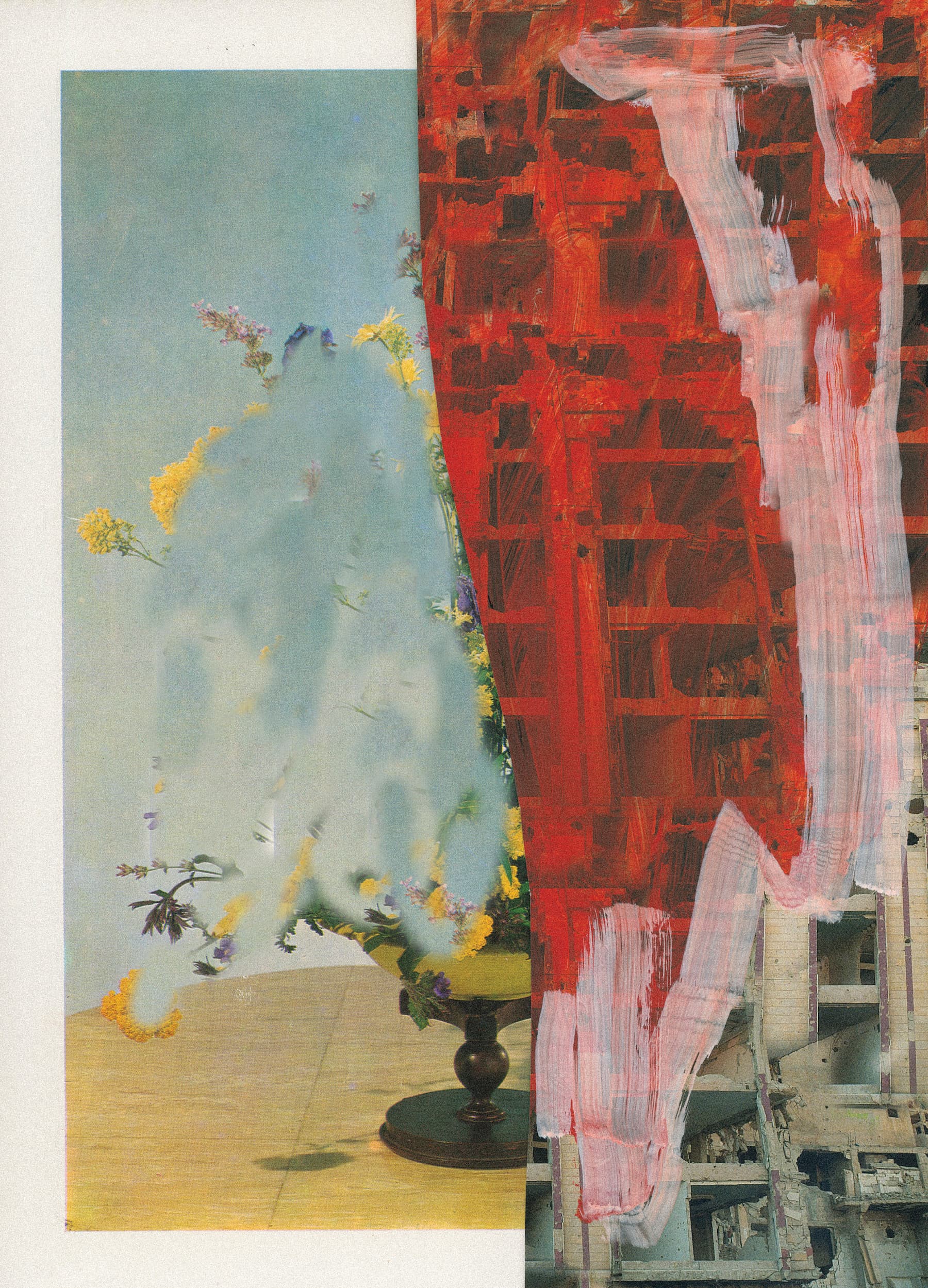
It will cost $9 billion to clear the rubble in Gaza—unexploded ordinances are an expensive problem, littered as they are amid the brick and mortar of living rooms and once wallpapered bedrooms, the dust of schools, cafés, and mosques. The estimate comes from a plan leaked in August 2025 titled The Gaza Reconstitution, Economic Acceleration and Transformation (GREAT) Trust, which promised to transform Gaza “From a Demolished Iranian Proxy to a Prosperous Abrahamic Ally.” The plan’s authors proposed that former residents who “voluntarily relocate” would be offered the opportunity to “place their privately owned land in the Trust in exchange for [a digital] token that gives right for [a] permanent housing unit.” The plan’s success hinges explicitly on the relocation of Palestinians out of Palestine. The Israeli press called it utopian.
***
Per the United Nations, 80 percent of all buildings and over 92 percent of all residential buildings in the Strip have either been damaged or destroyed since October 7, 2023. Israel destroyed more than 2,500 additional buildings after the October 2025 “ceasefire.”
The total weight of the rubble is an estimated sixty-one million tonnes, and the Gaza civil defense administration estimates that around ten thousand people remain trapped under it. The impulse is to reach for an analogy in order to make such sublime figures comprehensible, bring them into human terms, but I worry that anyone who reads that the rubble is thirty-seven times what was cleared from Ground Zero, or equivalent to nineteen million African elephants or 120,000 cumulus clouds would only find the quantity even more abstract, when few things are simpler to understand than shelter and its loss.
Imagine your own home: the bathtub faucet that always drips, the smell of onions, garlic, and spices frying in butter, how it feels to walk in the door, take your shoes off, and reach for the light switch in the dark after a long day of work. Imagine, too, your neighbor’s drafty apartment, where you have to keep your coat on when you visit for a cup of tea on a winter afternoon, and your parents’ home, thirty minutes away, where you have dinner once a month among framed photos of your younger self, a foot of mantle the only thing separating dungarees from graduation gowns. Now imagine them all gone.
***
The November 2025 U.N. resolution declaring the terms for the ceasefire in Gaza included a provision handing “transitional administration” of the Gaza Strip to a U.S. led “Board of Peace.” The board, organized outside of the U.N. structure with an invitation-only membership, is chaired by Trump, and this will continue to be the case even after his presidency. Trump signed its charter in January of 2026 at the World Economic Forum in Davos. At the WEF, Jared Kushner, in his capacity as an “envoy for peace,” presented the board’s plan to the richest people in the history of the world. The plan shares some features of the 2025 plan, though it is notably vague on the question of Palestinian relocation.
Suggestively, the entire coast in the Davos plan will be given over to 180 “mixed used” [sic] towers, while the interior will be built up with “residential areas.” Who those residents will be, and what will be done with what little remains of Gaza’s residential infrastructure is anyone’s guess.
The venue, audience, and presentation made it clear that Kushner and the rest of the Board of Peace do not care about Palestinians, and see Gaza, primarily, as a development opportunity. The Arabic on one slide was incorrectly formatted, the letters disconnected, a mistake so egregious I’m not even sure how one could replicate it on an Arabic keyboard. The administration of the strip will, at first, be handled by “the National Committee for the Administration of Gaza” (NCAG), a “transitional, technocratic, and apolitical Palestinian committee” consisting entirely of quislings and compradors vetted by Israel. This is not Palestinian sovereignty. Following the transitional period, the Palestinian Authority would take over the Strip upon completion of reforms outlined by Trump in 2020, including the disarmament of the Palestinian resistance, educational reforms focused on deradicalization, and economic reforms clearing the way for private investment. They would oversee a Palestine with permanent Israeli occupation, having ceded all but 15 percent of historic Palestine. Neither the Board of Peace’s Davos plan, nor its GREAT precursor make any mention of sovereignty. The Board of Peace is essentially a vehicle for real estate deals, made explicit by Kushner’s plea directed at the private sector at the end of his keynote: “There’ll be amazing investment opportunities. I know it’s a little risky to be investing in a place like this, but we need you to come take faith, invest in the people, try to be a part of it.”
What do those investments entail? Per the earlier GREAT plan, if it is any indication, it would include the construction of mega-infrastructure projects, including an “Elon Musk Smart Manufacturing Zone,” the “Gaza Trump Riviera and Islands,” “The MBS Ring and MBZ Central Highway” and an AI data center—developments that would “increase [the] value of Gaza to ~$324B from $0 today.”
***
Understanding the genesis of the Board of Peace’s reconstruction plan, and its dubious August 2025 predecessor, requires some corkboard, pushpins, red thread, and patience. What emerges is a master class in image laundering, a thin veneer over capital’s predictable and rapacious pursuit of profit—whether it’s killing the hungry or exhausting the world’s fresh water for datacenters—in the narrow gap between state violence and private industry.
The Financial Times reported that two Israeli businessmen, Liran Tancman and Michael Eisenberg, were heavily involved with the creation of GREAT Trust slide deck. Tancman served in Israeli military intelligence for a decade. He then founded CyActive, which was sold to PayPal in 2015, and followed that venture with Rezilion, a cybersecurity start-up. (PayPal is a phantom character in this story, having been a significant source of both Elon Musk’s and Peter Thiel’s fortunes. Thiel went on to become chairman of Palantir, the company that produces Gotham, an “Al-powered kill chain,” which the Israeli military used to select targets in the Gaza Strip.) Tancman was present for a January meeting where NCAG hiring decisions were made and is now an unpaid adviser to the Board of Peace, consulting on the creation of a dollar-backed crypto stablecoin for the Gaza Strip.
Eisenberg runs a venture capital fund, Aleph, out of Tel Aviv. Aleph’s portfolio includes Dream, an AI cybersecurity firm; Spark Beyond, an AI firm “harnessing humanity’s collective intelligence to solve our greatest challenges”; and Fabric, an “AI-powered micro-fulfillment solution.” Eisenberg is, if not responsible for, certainly happy about, the plan’s toxic bloom of data centers in the strip, and also joined the NCAG hiring meeting.
Prior to their work on the GREAT Trust and the Board of Peace, Tancman and Eisenberg collaborated on the establishment of the Gaza Humanitarian Fund (GHF). Established in February 2025, after Israel banned UNRWA workers from Gaza and shuttered its 400 aid sites, GHF purported to be an aid group and, in May,, began operating four mega-distribution sites throughout Gaza to absorb the negative PR Israel was getting for creating a famine in the Gaza Strip by not allowing U.N. aid to enter. GHF aid sites became killing fields. Israeli forces and American mercenaries hired by GHF killed more than 2,500 Palestinians who were either en route to, or in line at, GHF distribution sites.
GHF hired an American company, Safe Reach Solutions, for its security and logistics coordination in setting up aid sites. The Israeli news outlet Ynet reported that Safe Reach was not only involved with GHF security in the Strip, but used the opportunity for intelligence gathering operations as well. Safe Reach is run by Phil Reilly, a retired member of the CIA’s Clandestine Service, who held an advisory role at Boston Consulting Group (BCG).
It was through Reilly that Tancman and Eisenberg connected with the former UK prime minister Tony Blair, whose institute contributed to the GREAT plan, and who sits on the Board of Peace’s Executive Board. As prime minister, in addition to beating the drum for the invasion of Iraq, Blair met with the Israeli-intelligence broker Jeffrey Epstein. Blair himself attended White House talks in August about the future of Gaza, where the deck was reportedly shared with members of the Trump administration. Despite his connection to the plan, the Tony Blair Institute (TBI) had taken steps to distance itself from direct involvement with the GREAT slide deck. A spokesperson for the institute told the Financial Times that “TBI was not involved in the preparation of the deck, which was a Boston Consulting Group (BCG) deck,” the firm where Phil Reilly was an adviser.
But BCG also denied direct involvement, issuing a statement that “the work was not a BCG project, and BCG categorically told the lead partner not to do the work. We fully disavow this work. BCG swiftly exited both partners involved in this work.” BCG similarly tried to distance itself from its work on GHF after the massacres at distribution sites, saying the team of BCG consultants who worked on GHF did so outside their capacity as BCG consultants.
The mutation of the plan into the deck presented by Kushner at Davos, it seems, is a direct response to the negative press the initial slide deck received for its descriptions of ethnic cleansing. When publishing it, in August of 2025, The Washington Post did not make clear how they had obtained it, or who its intended audience was.
***
Both Kushner’s plan and its predecessor contain renderings—seemingly AI generated—of what Gaza will look like after reconstruction. In the GREAT Plan, one rendering showsan aerial view of a proposed city in Northern Gaza. In it, boats off the coast stand as tall as the skyscrapers, while natural gas rigs are docked in shallow water. (In June of 2023, Israel approved plans to begin development of a gas field off the coast of Gaza that is estimated to contain a trillion cubic feet of natural gas). The buildings are scattered among a patchwork of solar panel fields and farm plots, while what is presumably a high-speed train bisects the city. A separate rendering shows an electric vehicle lot. In it, thobe-clad men stand in the foreground, their too-many fingered hands melting, while in the background, behind a cornucopia of Teslas, loom mosque-dome-capped metallic skyscrapers.
There are fewer images in the Board of Peace plan, and they are less detailed, simply showing green balconied glass skyscrapers stretching down the coast, though they form a stylistic continuity with the GREAT plan’s renderings. The primary aesthetic is a combination of Persian Gulf–style frictionlessness and solar-punk beauty. Everything that isn’t glass or metal is washed-green, luscious abundance. Both the images themselves and the accompanying text promise a life without conflict or poverty. They seem to say that the suffering of the Palestinian people was not meaningless, that the Nakba and Genocide will find their redemption in profit generation, luxury seaside resorts, and on the blockchain. If ever there was something called history, or a place called Palestine, they were either stepping stones or an impediment to this, the blooming desert of the old Zionist myth, radiantly cracked, now, through a Khaleeji-Muskian kaleidoscope.
Whether or not the plan materializes in any of the forms presented is beside the point. Its primary function is to lay out the fantasy of a Palestine without Palestinians, a fantasy meant to soothe whatever is left of the world’s conscience, and allow Israel to complete its ethnic cleansing of the Gaza Strip. Responding to an earlier, leaked version of the plan, the historian Adam Tooze wrote that “Once there is a train and a train that runs on time, the hope is that other questions will seem like irrelevancies. So powerful is this idea that the promise itself has effects. You don’t even have to lay the train lines.”
***
At the turn of the 20th century, the Jewish National Fund, a nonprofit founded at the World Zionist Congress, began collecting donations for the purchase of large tracts of land in Palestine from Ottoman landlords, to be exclusively leased to Jewish people. On many of these plots, the JNF planted non-native species “to make the desert bloom.” The JNF remains active today, having been absorbed into the state of Israel, where it manages public green space. Almost half of all Palestinian villages depopulated in the Nakba, many of which were the site of massacres, now sit below JNF parks and forests.
Through the decay and reconstitution of organic matter, Palestinian corpses now provide shade to the descendants of their killers. This is what is meant by the term greenwashing. The function of these parks and forests is not only to provide Israelis and tourists lush recreating grounds—a crucial aspect in Israel’s image as an ecologically minded democracy in an otherwise backward and barren region—but also to eliminate every material trace of Palestinian collective memory and to constrict, even further, their hopes of return. In “The Ethnic Cleansing of Palestine,” the historian Ilan Pappé writes that Palestinian refugees are “up against an organization—the JNF—which claims that there is only barren land under the pine and cypress trees it has planted there.”
Whatever is built over the rubble and ruins will serve to deny that there ever was a genocide, a Palestine, or Palestinians. It will be repeated, not only in Palestine, but in all lands destroyed by climate calamity, austerity, and state violence, and to whichever people are deemed surplus. Should they be built, the skyscrapers, data centers, and industrial zones will be an inscription burnt into the earth, a prophecy for the rest of the century—the work of a consultant class crafting plans for the rich to wring profit from mass graves.

