
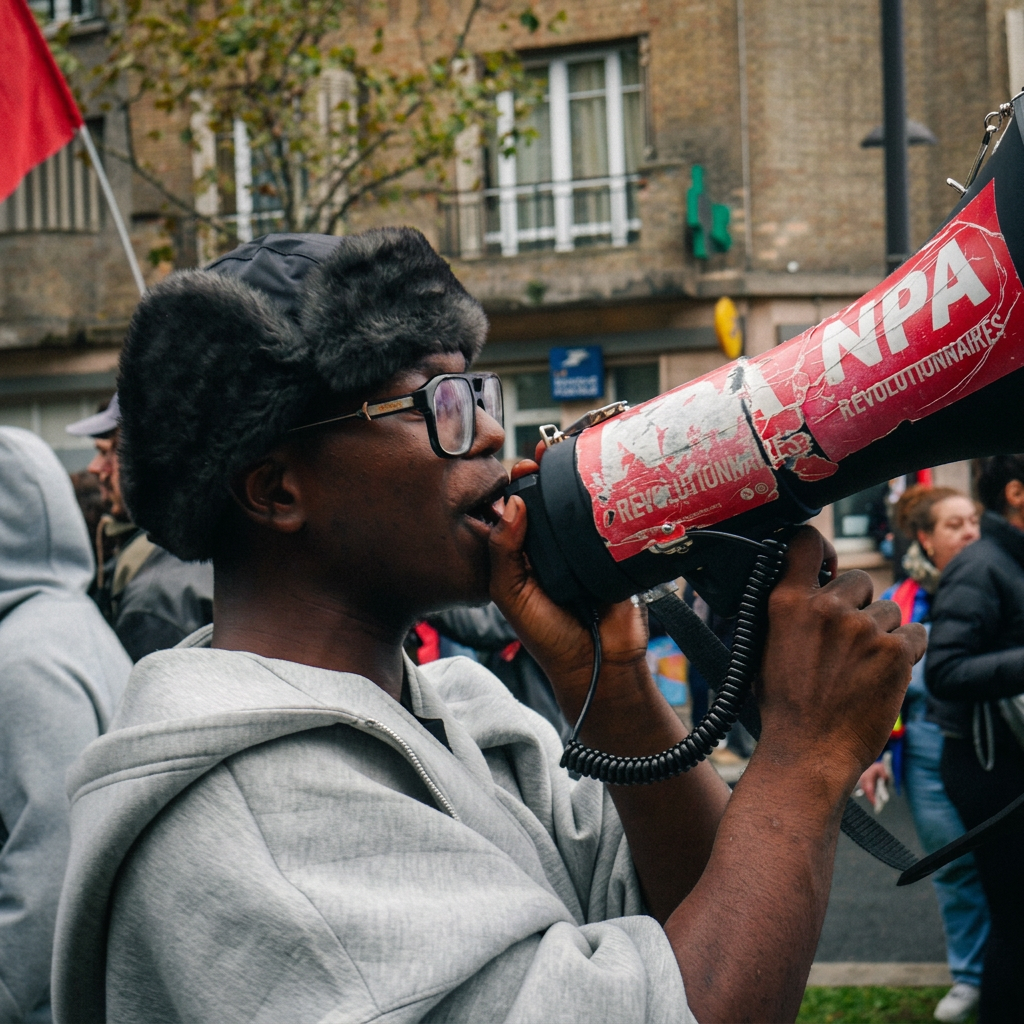
PARIS, October 24, 2026, Châtelet-Les Halles, 1 PM.
At one o’clock on Saturday afternoon, the demonstration had yet to begin. But in the heart of Paris, the city was already bracing itself. At Châtelet-Les Halles, one of the capital’s busiest shopping and transit hubs, police vans were arriving one after another. Officers from the BAC, France’s anti-crime brigade, stood alongside gendarmes, a militarised national police force, and members of the BRAV-M, a police unit that uses motorcycles to move through demonstrations and intervene on the ground. Shops were closing early. Some had lowered their shutters and others were boarding up their windows.
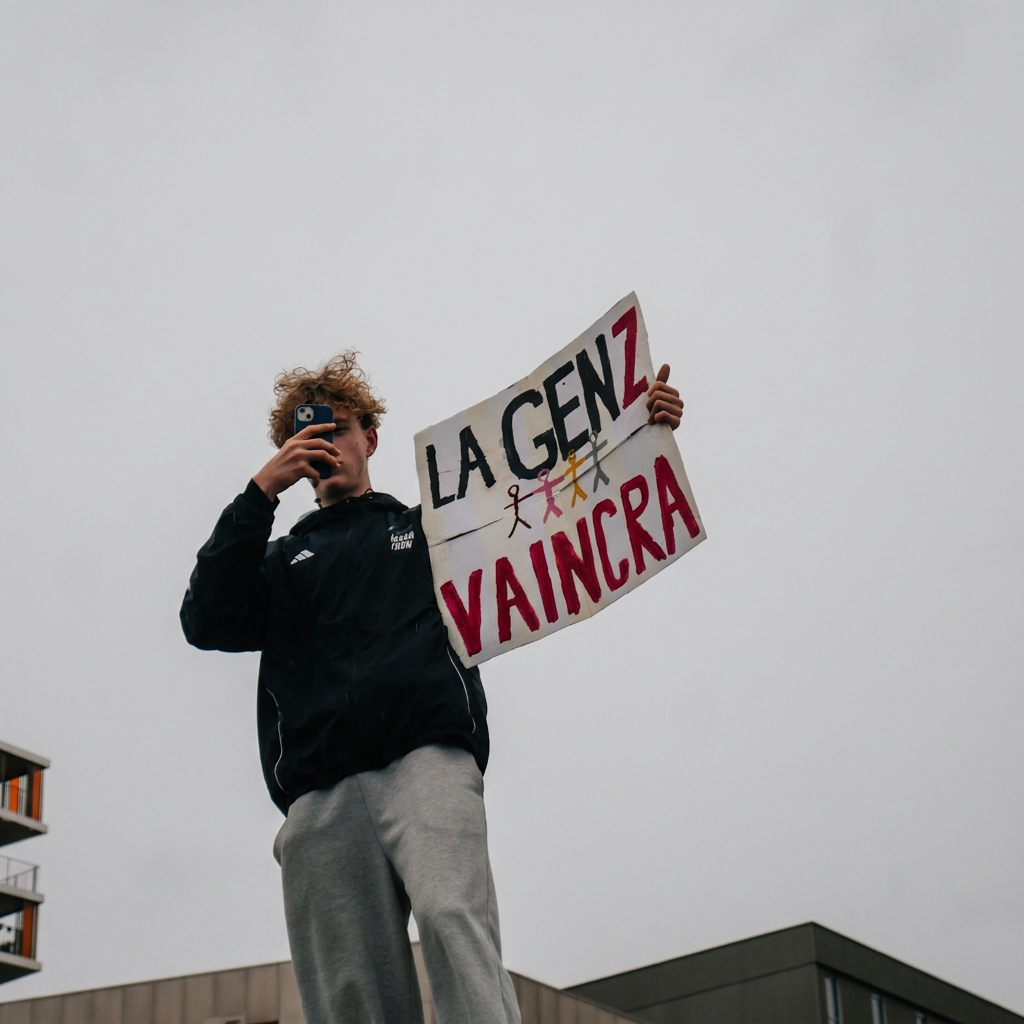
These precautions were taken in response to protests that took place a week earlier. On October 17, hundreds of thousands had taken to the streets across France; initially the rallies had been in support of high school students who were protesting over staff shortages and deteriorating school conditions since late September. The movement has since widened into a broader uprising over the cost of living and insufficient public services, drawing in trade unions, university students and workers.
Soon, looting, clashes with police, and fires in several cities shifted the focus away from the demonstrators' demands. Videos of burning vehicles and smashed storefronts flooded TikTok and X, turning the violence into a story of its own. On October 18, Emmanuel Macron took to television to condemn the violent acts. The protesters’ grievances got a mention, but the message was unmistakable: restoring order came first.
For the protestors I spoke to, Macron’s priorities were revealing: if the destruction had become impossible to ignore, why was the anger behind it so easy to dismiss?
PARIS, October 24, 2026, Porte d’Italie, 2 PM.
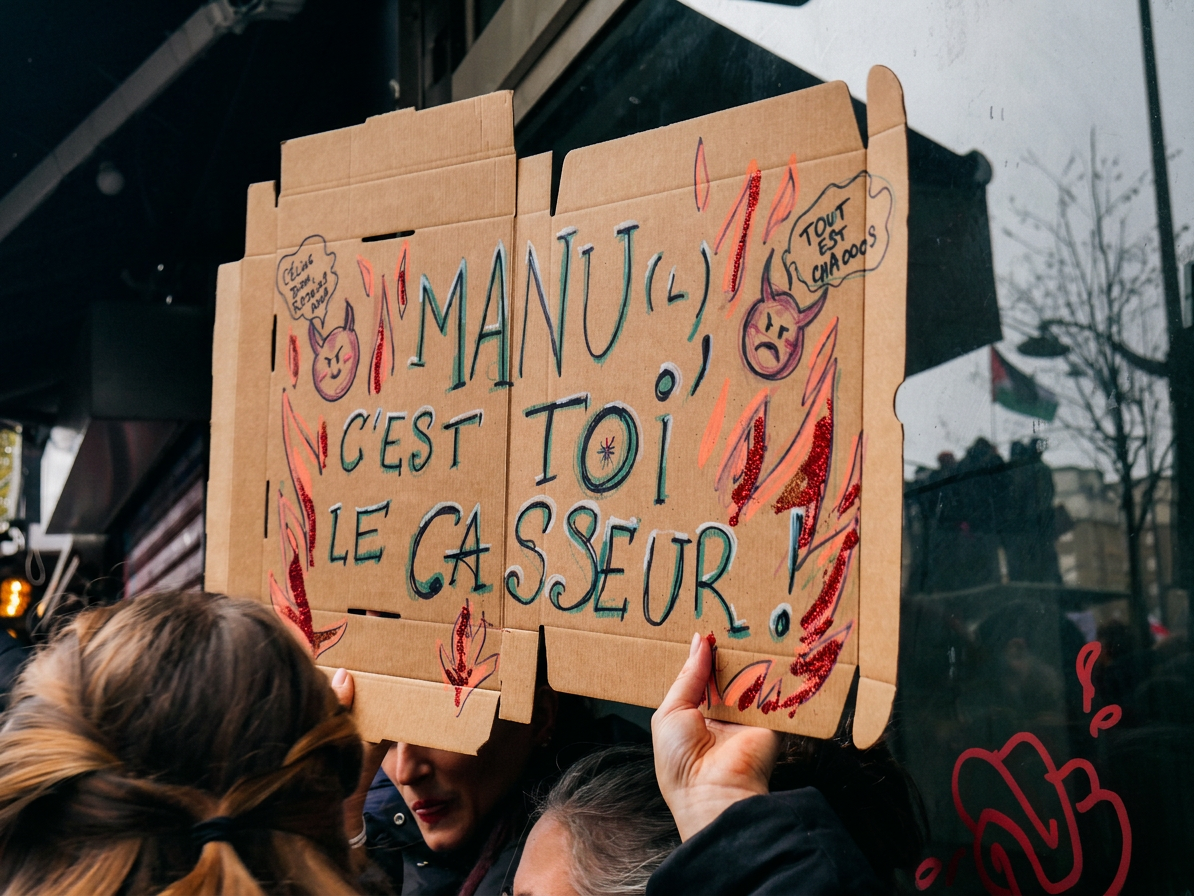
By 2 PM, at Porte d’Italie, on the southern edge of Paris, the second round of demonstrations was getting underway. Camille, a 42-year-old social worker, held her sign above the crowd: “Manu, you’re the vandal!” She turned the accusation of property destruction back on the president himself, using Macron’s nickname: if anyone was breaking things, her sign suggested, it was the leader of the country.
Camille was not denying that shops had been looted, but she questioned the outrage those scenes had provoked in a country that still celebrates its revolutionary past. “We’re a country that’s proud of storming the Bastille, proud of our revolution,” she said. “And now, all of a sudden, we’re going to cry over three burned garbage bins?”
Porte d’Italie was an unusual starting point for a Paris demonstration. Organizers had planned to march from Bastille to Nation, a well-established protest route through the eastern part of the city. But a day before the march, police scrapped the plan, citing fears of further looting, and redirected demonstrators to the city’s far outer boulevards. The unions challenged the decision, but the administrative court rejected their appeal on Saturday morning.
Elise and Lucie, both in their thirties, work in the arts and social sectors, respectively. They saw the rerouting of Saturday’s demonstration as part of a broader pattern of state suppression. They linked these tactics to the previous Saturday’s protest, on October 17, when police clashed with demonstrators at Place de la République. An investigation by Mediapart later challenged the official account of how the violence began, documenting the role of police in escalating the confrontation. For Elise and Lucie, the two events showed how simply turning up to demonstrate could mean facing police force. “You can’t even demonstrate anymore, even though it’s a right,” one of them said.
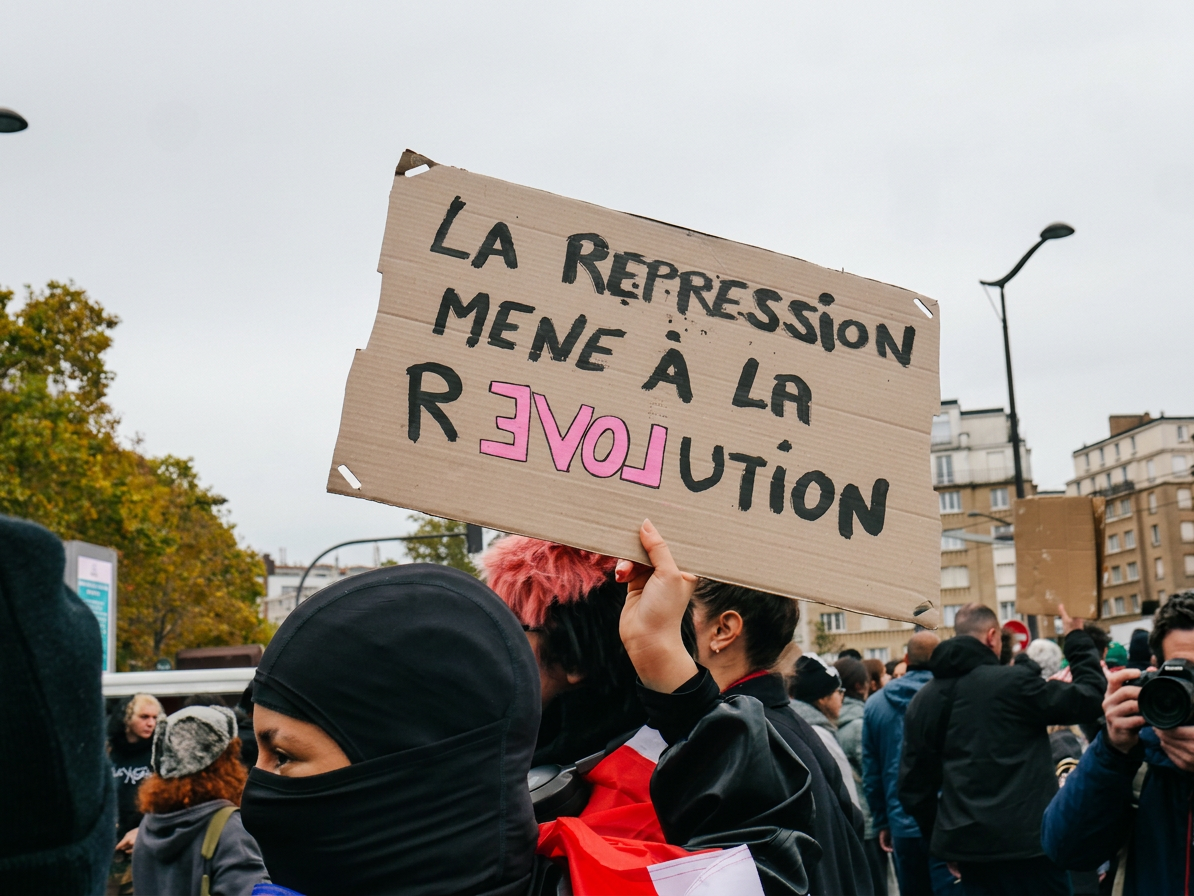
Nearby, Rayan, 25, carried a warning of her own: “Repression leads to revolution.” She referred to November 1990, when more than 100,000 high school students took to the streets of Paris to demand better-funded schools, improved facilities and more resources. Those demonstrations were also followed by looting and clashes with police. But the government’s response was different: it announced an emergency funding package for high schools. For Rayan, the episode was a reminder that unrest does not have to be met with force alone. Authorities can choose to address the grievances that bring people into the streets.
She saw little of that approach in the government’s response to the current demonstrations. Instead, she viewed the government’s reaction as part of a broader authoritarian turn. “The government is becoming more and more authoritarian. It’s not shocking, but very scary.” Her concerns are not unfounded. An investigation by the French outlet Blast revealed that, on October 22, Prime Minister Sébastien Lecornu had asked France’s four major telecom operators to prepare to suspend access to TikTok, Instagram, Snapchat and X if violence flared again over the weekend. The measure was never implemented, but the request suggested that the government had considered restricting access to some of the very platforms protesters use to organise, share footage, and document police violence in real time.
Further along the march, a sea of high school students chanted in unison: “We want, we want, a strike!” On the sidelines, five students talked about what it meant to keep turning up, day after day and the risks involved. For weeks, footage of teenagers being tear-gassed, struck with batons, and chased by police vehicles had been circulating widely online. In one of the most serious cases, a 15-year-old lost a hand when a police grenade exploded during a demonstration. Other incidents prompted investigations into officers’ conduct. But the crackdown extended beyond the violence captured on camera. “Bismillah, c’est les ténèbres”, roughly, “In the name of God, it’s darkness”, was picked up by protesters as a way to mock the police, after allegations emerged that undercover officers had used racist caricatures of Arab and Muslim youth to infiltrate student Snapchat groups.
“We’re out here hoping to be heard, and they send in the riot police,” one student said.
With the possibility of police brutality enacted against them, they struggled to agree on whether violence had a place in the movement. One of them put it this way: “It’s sad. Honestly, it’s something we don’t understand. But it’s a consequence of what the state is doing."
Whenever protesters were asked about the use of violence, the same tension surfaced: how do you make yourself heard when taking to the streets risks becoming criminalized as a threat to public order? And what happens when a state determined to restore order pushes people who already feel unheard even further to the edge?
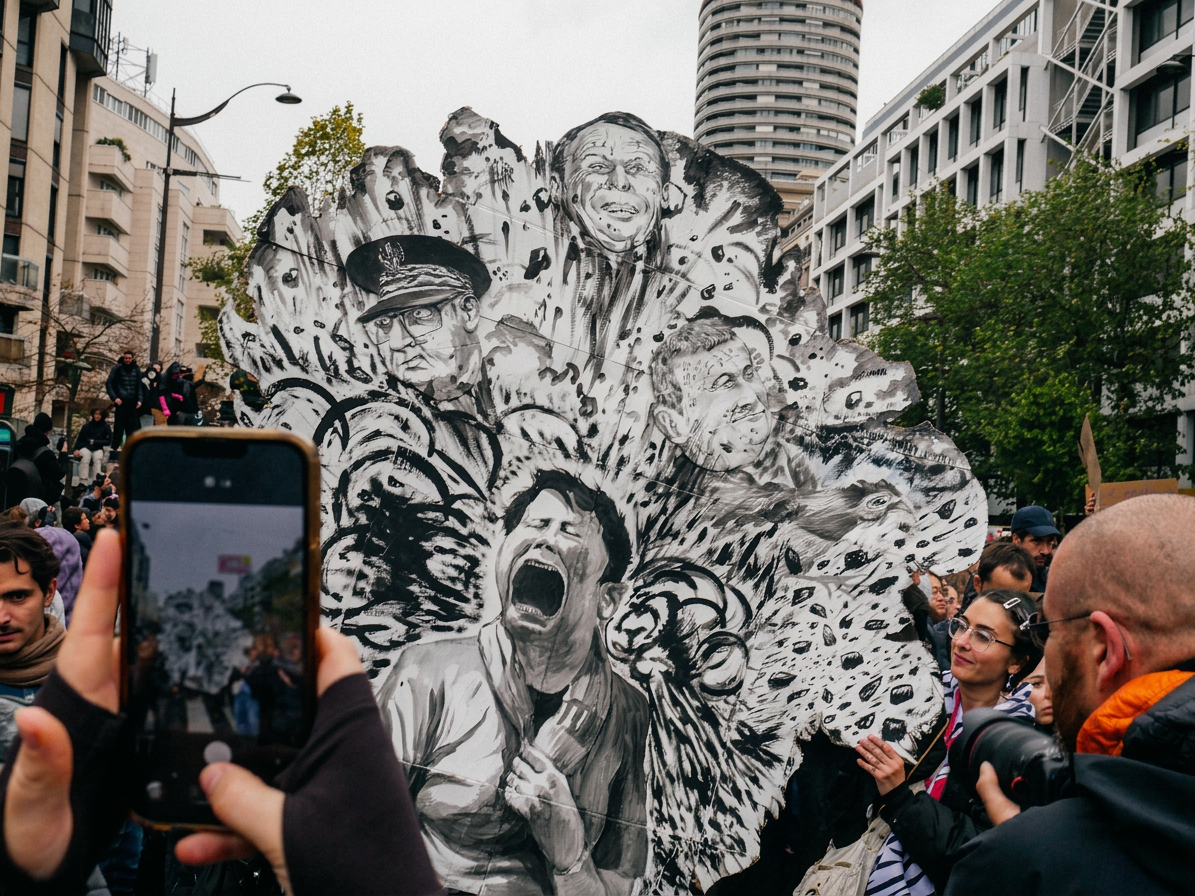
Philippe, 64, had been here before. He joined the Yellow Vest movement in 2018, and today, he was back in the streets. Retirement, he insisted, had offered little protection from the rising cost of living. His monthly pension was €1,948, he said, and its increases had failed to keep pace with inflation. Could peaceful protest still make a difference?
“At a certain point, the crowd becomes aware of its strength,” he said. “Frustrations manifest themselves through violence. At some point, you reach the breaking point.” He also questioned how the cost of violence was assessed. A shop window could be replaced, he argued. An eye lost to a police projectile could not. Nor could the damage caused by underfunded hospitals, where staff shortages leave patients sick and waiting, or by neglected schools where inadequate conditions make it harder for students to learn.
Yacine, 20, had arrived at a similar conclusion from a different starting point. Unemployed and not enrolled in higher education, he said he had been rejected through Parcoursup, France’s university admissions platform. The system has become a source of frustration for many young people. Where Philippe spoke of years of accumulated pressure, Yacine spoke of a future that already seemed closed off.
“People have to break things to be heard. It’s not just a stupid act,” Yacine said. For him, destruction could force attention onto people whose demands might otherwise be ignored. The disruption was part of its purpose. He argued, if ordinary or “peaceful” demonstrations could be contained, managed and eventually forgotten, breaking things could interrupt that cycle.
In France, images of unrest have long been used to redirect public sentiment around immigration, policing and the banlieues, the often-marginalized suburbs surrounding big French cities, where many working-class and immigrant communities live.
The current protests have generated similar arguments, with some commentators portraying the unrest as the work of particular racial or religious groups.
One of the defining features of these demonstrations has been, indeed, the diversity of those taking part. Charif Elalaoui, a political sociologist who specialises in the Yellow Vest movement and observed the October 17 demonstrations, said it was refreshing to see the mobilisation of young people from minority backgrounds and working-class neighbourhoods. These actions have become a site of convergence where people who do not necessarily share the same background or demands recognize something of their own frustrations in one another.
But these shared grievances should not be mistaken for a unified platform. The protests were undeniably political: they challenged government policy, economic inequality and, for some participants, the legitimacy of state authority itself. However, that doesn’t mean the hundreds of thousands who took to the streets agreed on what should replace the existing order or acted under the direction of a single political force. In the days surrounding the demonstrations, government officials (including President Emmanuel Macron himself) blamed the violence on the “ultra-left,” while other political narratives sought to associate the unrest with Islamist influence or immigration. And in Trappes, a suburb west of Paris, that framing recently took on a deadly dimension.
On Friday, October 23, a gunman killed a 26-year-old man and wounded several others in the Paris suburbs. President Emmanuel Macron described the attack as a racist terrorist attack. According to Le Monde, the suspect allegedly told investigators that he wanted to avenge shopkeepers affected by the looting and vandalism of October 17. As of writing, investigators were still examining evidence that he had deliberately targeted Black people and Arabs. If confirmed, the alleged motive would expose the deadly consequences of turning anger over property damage into hostility towards entire communities: a danger that France’s audiovisual regulator, Arcom, the independent authority overseeing television and radio broadcasters, had itself flagged, urging news channels to exercise greater vigilance in their coverage of the protests amid concerns over discriminatory rhetoric on air.
As the march reached Cours de Vincennes, the boulevard in eastern Paris where the demonstration was scheduled to end, the atmosphere shifted. At around 6:30 PM, just as the march was drawing to a close, clashes broke out between protesters and police. Officers once again fired tear gas and deployed a water cannon as projectiles flew toward them. This time, the remaining crowd eventually dispersed.
Around 8 PM, Interior Minister Laurent Nuñez was already congratulating his forces. Nearly 1,000 people had been arrested nationwide, he announced, after the government deployed 70,000 police officers and gendarmes to prevent a repeat of the previous weekend’s unrest. This time, there had been less looting and property damage. By the government’s measure, the day had been a success. But once again, the government seemed to be mistaking the end of a demonstration for the end of the anger around the conditions that gave rise to it.

