
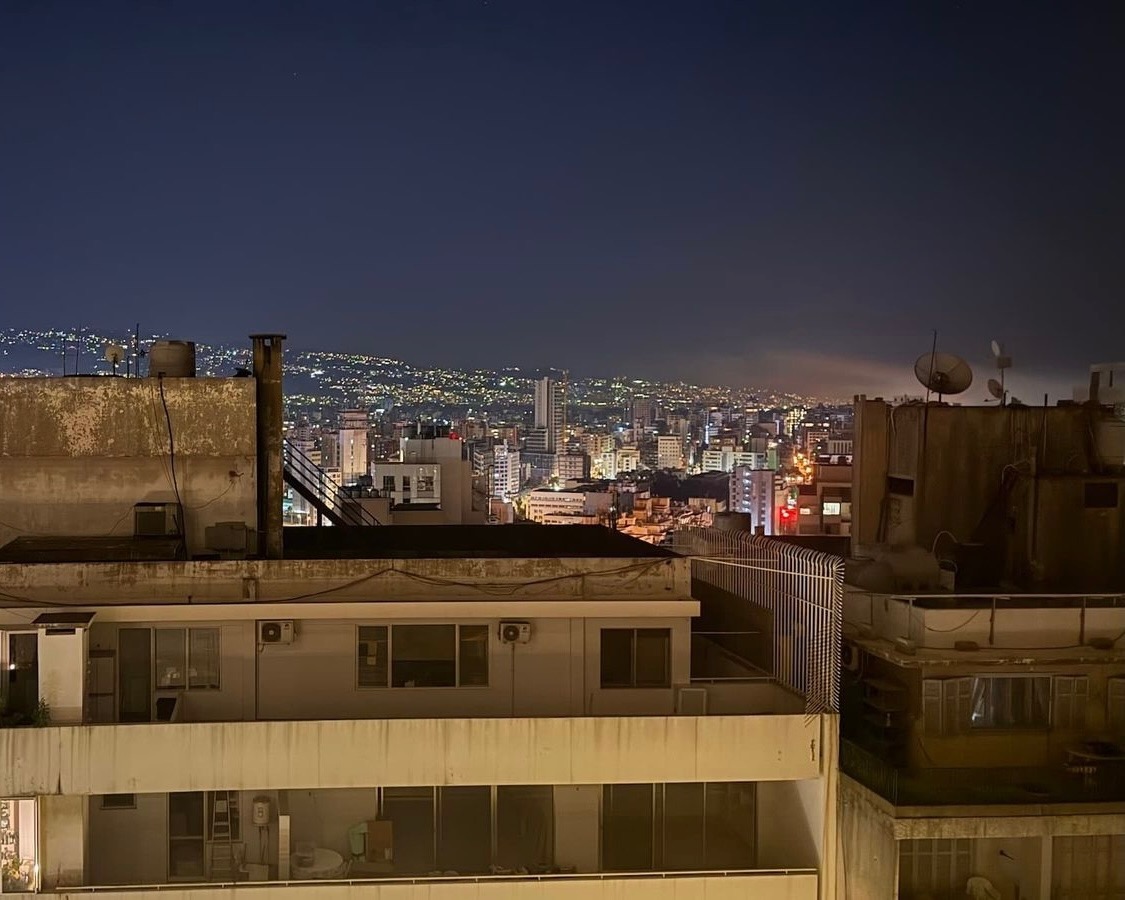
It is 8:24pm on March 5th, and I write this from a friend’s house in Hamra, Beirut, Lebanon. Around 3 o’clock this afternoon he called, yelling for me to get out of the apartment I’ve been renting this winter. I walked about three and a half miles to get here from southern Beirut, among seemingly tens of thousands of others making a run for it on foot, motorbike and car. The streets are packed with panicked people.
I come to Beirut because I have family and friends here, because it is the most beautiful place in the world. Although my family house is in Mar Elias, which is on the West side of the city, I decided to sublet an apartment from a friend in Tayouneh while he runs his bakery in Damascus. I’ve spent the last few months reporting for The Intercept on USAID cuts.
The last few days have been very loud. A few days ago, the Zionist army started striking buildings close enough to shake my apartment, causing displaced people to escape onto the main road outside. In the southern parts of the country, strikes have been ongoing since the so-called ceasefire that was brokered in November 2024. The UN has recorded over 10,000 Israeli violations of the Lebanese ceasefire agreement. But, in the last few days, the Zionist army has entered and ordered the complete evacuation of areas south of the Litani River, a region encompassing about 8 percent of Lebanon and around 200,000 people. They have also intensified their strikes in the southern suburbs of Beirut. I have awoken several times to sounds that make your life flash before your eyes. Lebanese authorities report at least 102 people killed across the country in the past four days, with dozens of fatalities from strikes specifically targeting Beirut’s southern suburbs.
I was in the middle of reporting when my friend and colleague Saleh called. Minutes before, I’d received several texts from my dad and different friends saying the Zionist army had issued evacuation orders close to where I was staying. They included a huge swath of southern Beirut; evacuation orders that are frankly incomprehensible in scope. Dahiye, Beirut’s southern suburbs, are densely populated, housing over 400,000 people. They are residential neighborhoods full of Muslim civilians fasting during the Holy month of Ramadan. Horsh Beirut, a large, lush park, sits across from my building and nearly every morning I take my morning walk there among covered women and their children, joggers and armymen stationed outside the park. Each morning, the drones have gotten louder.
As of right now, over 80,000 people have been displaced. This morning, I had decided to take pillows and blankets to different sites where displaced people were sleeping on the street. I had interviewed them the previous day, and they told me their kids were cold at night. After that, I planned to go to Mosaic, an LGBTQ+ advocacy organization that had turned itself into a shelter for displaced queer people who had nowhere else to go. In fact, when Saleh called, the director was simultaneously WhatsApping me, canceling my reporting visit because of the evacuation orders coming through. The queer shelter was just south of my place.
At the same time, another local Lebanese journalist and friend, Jehad, started telling me I should get to his house as soon as I could. He was traveling back from a day spent reporting with his Sky News team in the southern parts of the country. Saleh noticed I had gone quiet on the other end of the phone. “You are hundreds of meters away from Chyah, get out, get out, get out, now, now, now. Please don’t be silly, don’t be stupid, come over now, khalas,” he repeated over and over. He sounded frenetic, loving, and worried as hell. I had never heard his voice this way. We had done stories from Ain al Hilwe, Sabra and Shatila, and even from Yarmouk in Syria. He was not always so worried for my safety. I checked the evacuation orders again and saw the areas they had listed, and I was dangerously close to where the Zionists plan to strike. It was clear that I needed to pack a bag as fast as possible and get out of the apartment.
In a haze, I gathered clothes, my computer, my medications, both passports, money, some audio equipment, and my keys. When I got outside, the streets were jam-packed. Tens of thousands of people were screaming, honking, and trying to make sense of what the hell they were supposed to do while nearly stuck in place. They, alongside their kids, the elderly, and the sick, were being forced to leave the comfort of their own homes, having no guarantee that they would have anything to return to. As I incessantly updated the news on my phone, I saw that far-right Zionist Finance Minister Bezalel Smotrich was threatening to turn the southern suburbs of Lebanon’s capital into Khan Younis. About a year ago, I was in Khan Younis volunteering as a humanitarian aid worker in Gaza with Glia, a medical organization, and as a reporter for The Intercept. The reality of what this Zionist zealot was trying to convey suddenly sat heavy in my bones. A pang of incredible pain hit me. It felt unbearable to imagine Dahiyeh covered in tents; it felt worse that my friends in Gaza and Southern Lebanon had been enduring so much for so long.
As I weaved through traffic and the crowds of people, the reality on the ground prevented my mind from ruminating about the existential. I had to help a man lift his bike onto the sidewalk, watched one woman yell at another woman for God knows what, and witnessed multiple kids confused and scared. One group of women saw me going live on social media and screamed: “Tell them, tell them what Israel is doing to us” in Arabic. I turned back and yelled, عم قِلُّن “I am telling them.” We were all experiencing ourselves being reduced because of colonizers.
It took me a clean 45 minutes to make it to Saleh’s place. I had been nearly jogging as the panic of loud humming drones above me kept me present, no matter how much my brain begged to disassociate. I remember clearly passing a spray-painted, multicolored portrait of George Floyd on a destroyed and dilapidated home’s facade. It also kept me present. It ran through my head that the U.S. Embassy in Beirut had urged American citizens to depart Lebanon immediately while commercial flights remain available, citing a "volatile and unpredictable" security situation. I thought about the hypocrisy of that statement. My government was theoretically urging me to take the one road through the southern suburbs that their money and weapons were about to destroy. I thought about how state-sanctioned terrorists operate, and how their accusations are confessions. As I walked and walked and walked, I thought about how successful the gangs of the elite have been at barbarizing so many of us for their own delusional ends. What the Zionists and the U.S. regime are doing is terrorism. I witnessed my fellow Lebanese citizens get terrorized. It is now nearly 10 PM in Beirut, and we wait with bated breath for the bombs to fall. I feel terror. Still, I am incredibly privileged. It is the people of the southern suburbs and of southern Lebanon who are being tortured and who deserve our solidarity and our dua. Resistance looks a lot of ways. The people of southern Lebanon, like the people of Gaza, and those in so many other places suffering under the heel of Zionist and U.S. imperialism, deserve to maintain their resistance. And they deserve our resistance.
Every step I walked, I imagined what more I could do to show up in a world where I have been given so much. The answer I always come back to is to communicate like this, to report on those who continue to have everything taken away, even when I am scared and stressed and pissed off, just in case someone is listening.

