
In 1910, Mohamed Juda arrived at Ellis Island from French Algeria and was photographed by Augustus Sherman, an immigration clerk. Juda’s immigration story was short-lived — he was deported days later after being denied entry to the United States. A Muslim, Juda was charged with being a “believer in the practice of polygamy.” The 1891 Immigration Act barred “polygamists or persons who admit their belief in the practice” and was used by authorities to turn away Muslim immigrants. It was, in a way, America’s earliest “Muslim ban”.
Sherman’s photograph, simply titled “Algerian man,” eventually found its way into the New York Public Library’s collection, among a number of items belonging to the Ellis Island Immigration commissioner. It would be decades before researchers restored Juda’s identity to the portrait.
This image and other ethnographic portraits like it form the starting point for the New York Public Library’s Niyū Yūrk exhibition, which narrates the long relationship between Middle Eastern and North African communities and the city of New York stretching across three centuries. Like Juda’s, many of these historical photographs lacked personal identification, miscategorized ethnic and national origins, or relied on essentializing descriptions.
Hiba Abid, the Library’s first-ever curator of Middle Eastern and Islamic studies, chose to display the erroneous labels and acknowledge the interventions that have been made in the historical record. The exhibition is as much a story about the Library and its collecting practices as it is a narrative about MENA communities in New York, naming the institutional gaps and prejudices.
Abid was particularly interested in shifting the way these communities are represented within institutional spaces. The early ethnographic portraits exhibit the ways in which MENA communities have long been subjected to a certain gaze. Drawing on the Library’s collection, however, their cultural production flips the narrative in the exhibition, looking to them as authors of their own experiences, how they perceived themselves within New York City and how they perceived Americans and the city around them.
Through print materials like literature, local newspapers, and zines and audio-visual media like films and music, and other ephemera, the exhibition traces how MENA communities have negotiated their relationship to the city. Syrian Christians from Ottoman-ruled Greater Syria immigrated to New York en masse in the late 19th and early 20th century, fleeing economic and political crises or seeking employment opportunities. Their citizenship guidebooks and Arabic-English phrasebooks offer a glimpse into their efforts to make sense of the immigration process, often leaning into their Christian identity and associating with whiteness in an attempt to secure their immigration under the strict legal apparatus of the time.
Throughout its history in New York, the community would draw on a diversity of influences and establish wider networks of solidarity. The Syrian Ladies Aid Society founded in 1907 to help newly immigrated women learn skills, improve their English, and find jobs and housing, collaborated with American social workers and took inspiration from both the Arab tradition of worker education and the mutual aid practices of Italian laborers in New York.
Decades later, the Organization of Arab Students, founded in the 1950s to support newly immigrated students in the U.S., shifted all of its efforts towards Palestinian liberation following the Israeli occupation in 1967. Their yearbooks, featured in the Library’s collection, document their political education and their connections to movements that inspired them, including the Black Panthers, the Algerian liberation movement, and other leftist struggles in the Global South.
“When a diaspora forms, it doesn't become an insular community of people,” Abid said. “They make New York even more interesting and more global. They amplify the importance of New York around the world, and they bring those ideas and thoughts here as well.”
Archival photographs show us early immigrants who incorporated themselves into the fabric of American culture and entertainment—even leaning into a self-orientalizing exoticism—from Hassan Ben Ali’s troupe of Moroccan acrobats to Eddie Kochak’s fusion of American jazz, mambo, and pop with exaggerated Arabic melodies into the Ameraba genre and the Middle Eastern nightclubs that played host to these performances.
The Library holds a vast array of Arabic newspapers and periodicals printed in New York dating back to the late 1800s, like El Huda, one of the first Arabic newspapers in the United States. These papers were part of a larger transnational conversation, commenting both on their immediate contexts but also engaging with politics back home. They were read by their local communities as well as in their home countries and among other Arab diasporas across the Americas. Al Funoon, New York City’s first Arab literary magazine, brought together writers in the Pen League, a literary society in New York including writers like Khalil Gibran and Ameen Rihani. Influenced by their encounters with Western literature, these authors broke free from the conventions of classical Arabic, experimenting with new forms and subject matters. Their innovations had global implications, helping spark a literary renaissance across the Arab world.
In the essays and novels on display, Arab American authors explored the breadth of emotions that defined the immigrant experience, their identities, hybrid culture, and new home. They also contended with the difficulties and disillusionments of immigrant life. Syrian socialist Niqula Al-Haddad’s 1908 text, A Painful Sight in New York: A Disgrace to the Modern City is a scathing critique of the ills of American society during economic recession.
“It’s all the same things that people struggle with today,” Abid said. “I don’t want this exhibition to be a love letter to New York. It’s more realistic.”
Many of the experiences captured across this long history continue to echo into the present. In 2001, weeks after 9/11, Jennifer Jajeh and Nikki Byrd interviewed five young Arab women about their experiences in New York City for a documentary. “It really captures the rawness of the moment,” Abid said. “ But I was struck by how things didn't really change as an Arab and a Muslim woman, especially this last year.”
The exhibition's materials are inflected with a vernacular quality, speaking to the nature of a public library’s relationship with its community. Zines, pamphlets, everyday materials and print culture that most cultural institutions wouldn’t collect record life as it was lived. These materials were donated by the community or collected concurrently with their production, and the library has served as a space where the community could continue to access them. “In the early twentieth century, we have bulletins talking about Armenian and Syrian patrons coming to read newspapers in their own languages. Immigrants could access the citizenship guidebooks and English phrase books here.” Surfacing these works, Abid hopes, will be an invitation to not only researchers, but community members at large, to access and use the materials the library has collected.
Across the Hudson, this past summer, Muslim Newark, particularly the city’s historic Black Muslim community, was at the center of a series of exhibitions and community activations organized by Express Newark around their 2024–2025 theme: Ritual.
Unlike a public library, inherently participatory in the way its materials are made accessible to visitors and the local community, Express Newark used a series of direct engagements with community members to bring them into conversation and collaboration with the exhibitions. The show focused on the nonsecular, exploring the role of spirituality in the artists’ practices and how their works can mediate devotional acts.
“[A number of artists] had expressed frustration with the art world and an impossibility to foreground the spiritual dimension of their work,” said Wendell Marsh, one of the exhibition's curators.
The prayer rug, as both an aesthetic object and a contour of devotional space, was a recurrent motif throughout the galleries. Under the guidance of artist Dahlia Elsayed, fourteen Rutgers students designed and created their own prayer rugs, using them as a medium to express the relationship between devotee and the act of devotion.
Brooklyn-based artist Nzingah Oyo’s “Woven Prayers” series wove individual rugs into a massive quilt-like tapestry, creating both a backdrop and a space. Oyo invited members of Newark’s local Muslim community to participate in portrait sessions in front of and within the woven work. Participants were required to remove their shoes to enter the space and backdrop of the prayer rugs, which Oyo said evoked the feeling of stepping into a masjid. She recalled that one woman felt an instinct to cover herself. “The environment itself made her want to feel more modest. A lot of people said they felt at peace when they stepped into the space,” Oyo told me.
Although the participatory project was open to anyone, the vast majority of those who attended came from Newark’s local Black Muslim masjids and families. Having grown up in Brooklyn among an African-American Muslim community with deep ties to the continent and the African diaspora, Oyo appreciated the opportunity to meet, photograph, and honor a community she felt connected to. “It was nice to have that microscope on the Black American Muslim community. Their history is not as often heard or celebrated.”
Oyo met community members with deep roots in the United States, such as Dr. Kalenah Witcher, whose family has been practicing Islam in New Jersey for seven generations. In June, Express Newark hosted the Muslim Voices Festival as part of the programming for Ritual, screening documentaries by local community members. Witcher presented her own film, “Muslims of Hunterdon Street,” documenting the historic Muslim community of Newark’s Central Ward with roots going back to the Moorish Science Temple, founded in Newark in 1913 and a precursor to the later founding of the Nation of Islam.
The exhibitions not only brought the community into the gallery space but also brought the show into the city. Moroccan-born Younes Baba-Ali’s sonic performance-installation, “Carroussa Sonore,” is named after the “sounding carts” that define the urban soundscape of Morocco and North Africa, from which recordings of the Quran or popular sermons are sold. The cart made its way through the streets of Newark, emitting an array of sound pieces created by local and international artists touching on migration, identity, politics, and diverse cultural histories. Through Baba-Ali’s site-specific mixing, twenty four artists redefined what a devotional urban soundscape could be, simultaneously capturing and intervening in the fabric of Newark’s streets.
Ritual’s central exhibition, Powers of the Unseen, engaged contemporary representational politics through the lens of visibility, which, for marginalized people, has long been shaped by structures of violence—from scientific racism and the orientalist gaze to surveillance and policing. Works of photography by thirteen international artists explored the tension between a desire to be understood and the political act of deliberate opacity. The curators sought to shift the burden of representation from these communities onto the viewer.
“A photograph or a film or a story by itself does not render the subject visible. We have to insist that the viewer struggle to understand. And that requires transformation,” curator Wendell Marsh said. “Understanding the other requires that the self is open to being touched and fundamentally changed.”
The exhibition looked to the idea of the ghayb, central to Islamic understandings of faith, to unsettle our preoccupations with visibility. “God describes the Qur’an in Baqarah as the Book for those who believe in the Unseen,” Marsh said. “We were inspired by this Muslim insight about the limits of knowledge, transparency, and exposure.”
The subjects that appear on the gallery walls span histories and geographies. Moving beyond documentation—as we often conceive of the photograph—the works are invitations to consider broader histories, beliefs, and communal experiences.
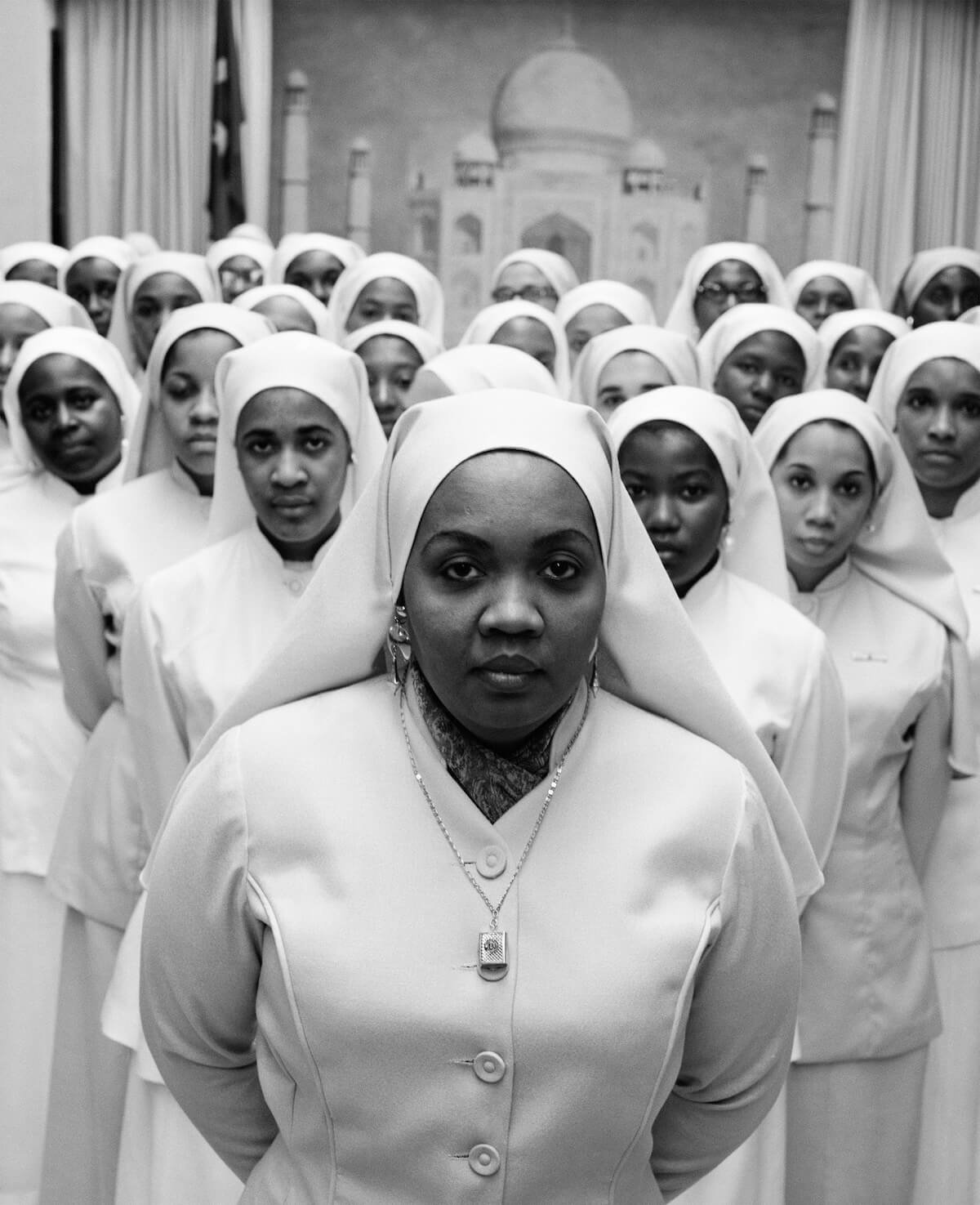
Gordon Parks’s 1963 photograph of Ethel Sharrieff with a group of women from the Nation of Islam, dressed in identical white hijabs and uniforms, staring directly into the lens, is a stunning reversal of the individualizing portrait, presenting a collectivity of practitioners unified in their faith. Malick Welli’s untitled portraits from his Idol series represent Black Muslim identity, evoking iconographic references like the Prophet’s companion Bilal, Malcolm X, and Senegalese marabouts through the posture, position, and dress of his subjects, at once capturing an individual while also allowing them to stand in for a broader constellation of cultural and spiritual influences.
Chester Higgins’ “Door of No Return,” taken on Gorée Island in Senegal, a notoriously significant node in the Transatlantic Slave trade, creates a temporal and geographic portal. The doorway becomes a site for reflection and memory; the figure, anonymized in silhouette, engages the contemporary act of looking back in time and encountering their historical counterpart—violently stripped of their identity and separated from their homeland, on the precipice of their world looking out into the future unknown.
The works also experiment with the medium itself, using photographic techniques to obscure and transform. Bruno Hadjih manipulates exposure and color in his photographs of Sufi practitioners of Wird, a set of incantations, prayers, and breadths that enable a state of transcendence, creating ethereal images that evoke the intangible affective experiences of these rituals. Amina Kadous’s photography of historic tombs in Egypt demolished to make room for large-scale urban development projects, is printed directly onto a pile of bricks, a medium that is both concrete yet feels susceptible to the very same destruction faced by the photographed sites.
The representational politics that the exhibition seeks to destabilize have surfaced increasingly tangled questions in a moment of heightened visibility for American Muslims—a community by no means a stranger to existing under the scrutinizing eye of American society. Amidst a surge in Muslim storytelling, the casual entry of Arabic into the popular American lexicon, and, of course, the election of New York City’s first Muslim mayor, this cultural renaissance has felt less like taking a seat at the table than actively shaping the entire room. But hope and optimism scrape against the anxieties around a state intent on repression, utilizing visibility and exposure in its regime of surveillance and data collection.
Across Newark and New York, Ritual and Niyū Yūrk turn to the local, deeply rooted historical communities who remain vibrant parts of their urban fabric. They intervene at both the curatorial and community levels, challenging the way these communities have long been viewed as subjects by the state and its institutions, whether by shifting the authorship of community narratives or by turning the act of viewing into an empathetic rather than an interrogatory one. Through different forms of community co-creation, from the access a library offers to community-produced materials to inviting community members directly into the works in a gallery space, these exhibitions envision a practice that resists extraction and creates openings for co-creation, narrative agency, and curation that offers something back.

