
The Muslims I came of age with are the type to stop drinking during Ramadan or not eat pork. The most observant fast. But hardly anyone I know prays. The practice had once been very ordinary to me. In Egypt, where I was raised, I saw strangers pull off busy highways, a few feet from traffic, to stop alone and pray. I had seen it up close, too. My parents pray. They taught me how. But at the age of eighteen, when I left home for Qatar, Scotland, Turkey, and then America, the household rhythms faded away.
I didn’t miss the ritual very much at first. I took it for granted that I had a strong inner compass, and my life was rather nice. My parents and friends loved me. I worked at The New Yorker. I was satisfied with my romantic life. I never stopped being spiritual, but in my enclave in Brooklyn, it would have felt more natural to attend an ayahuasca ceremony than to pray five times a day.
I should have known better. I had dreams that guided me since I was a child. In my late twenties, I had one in which I was having carefree fun jumping from roof to roof in Cairo. When I stopped to look back, I was lost. I could not remember my way home. I didn’t like what the dream implied, so I distracted myself. I went out a lot. I worked harder than I had to. Years passed like this, until, days after my thirty-fifth birthday, I had another dream. I stepped off a stage where I had been performing and went looking for my grave. Once inside the mausoleum, I looked at the patch of ground beneath which I would be buried and wondered what that would feel like. “Would it be lonely?” I asked. “It would be only me and me.” I woke up sobbing. I was afraid I had drifted from who I wanted to be.
Three weeks later, my body brought me to a halt. A long-simmering burnout I had been pushing through became impossible to ignore. I found myself unable to write, lost all interest in reading, lost interest in socializing. I quit my job, found easy contract work, and spent much of my free time staring at trees.
Not long into that burnout, I dated a man who repelled me in an unusual way. I felt great tenderness towards him at first. Then I began to see how hard it was for him to be honest with himself. On the night of our breakup, he was so lost in his own lies. I didn’t know how he would find his way out of them. His self-deception jolted me with recognition. It felt like seeing one of those severe cases of the flu that makes you scramble to book a vaccine appointment. The next morning, I woke up, went online, and express-ordered a prayer mat.
I took to praying very easily for someone who hardly practiced before. Its rhythm was easy to fall into. It brought me into time with the earth. The five daily prayers follow the movement of the sun: dawn, noon, afternoon, sunset and night. When I started to pray, I soon began paying attention to the length of the days, tracing the daylight as it stretched and receded between solstices. I began to imagine that the earth had a magnificent chest that I rested my head on as it rose and fell with every breath. Two of the Muslim names for God are The Contractor (Al-Qabid) and The Expander (Al-Basit). Prayer soon started to recall me to the rhythms of everything that expands and contracts, from the ocean to the moon to gravitational waves.
Still, I find it hard to answer when people ask me whether I believe in God. I never know which god we’re speaking about, but mine is not a man in the sky. A Muslim name for the God I worship is The Truth (Al-Haqq). When I pray, I wish to align myself with The Truth, and to live according to it. I try not to imagine God very much, but the closest image that I have of what I turn to when I pray is the Kaaba, the House of God in Mecca. This is the direction every Muslim faces when they pray, no matter where they are in the world. Seen from the sky, with rings of worshippers around it, the Kaaba looks to me like a nucleus surrounded by electrons. When the congregants prostrate themselves towards it to pray, it looks like a world that has bowed to its center.
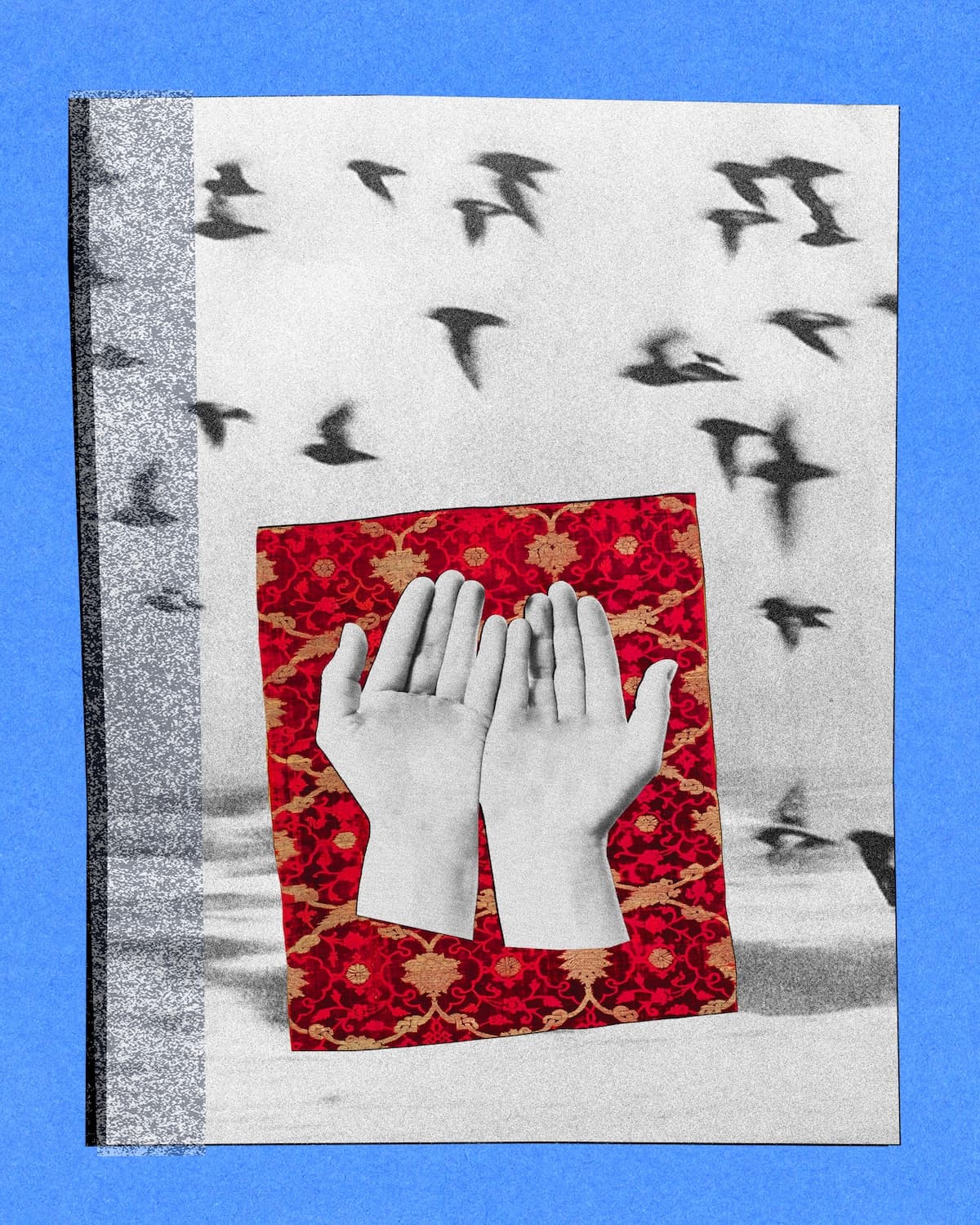
A Muslim parable about God that expresses what I believe in goes like this. All the birds of the world go on a harrowing odyssey looking for God. Each bird on the journey represents a human failing (fear, greed, attachment). Most fall away on the road, undone by their weaknesses. Only thirty birds make it to the end where they find a mirror and see their own reflections. The God they were seeking turns out not to be a separate entity, but a presence that is revealed once they have let go of their ego.
If this journey sounds like what a heroic dose of psilocybin feels like, that’s because it can be. But the longer I practiced the daily prayers, the more I started to see that having a spiritual experience and living a spiritual life are two very different things. God turned out to be something you seek, not something you believe in.
I had started praying on an instinct, when the breakup reminded me how easily I could deceive myself. I wished for The Truth (Al-Haqq) to guide me through my own fog. But then my life got difficult in other ways. The contract job I had found ended, but my burnout had not. I never had much money to begin with, and now I was financially precarious, exhausted, and professionally unmoored. I had been unable to write since my burnout, which left me with a sense of loneliness that no love could comfort. Then a best friend who I’d considered a life partner got swept up in a relationship and grew absent.
That winter, while I was home for the holidays, I asked my father where he gets his resilience from. He always struck me as someone who takes life’s ups and downs in a great stride. He tried his best to explain how it works to me. He repeated old spiritual teachings about courage that I learned when I was a child, but they didn’t help very much. They didn’t seem to work for me the way they worked for him. I pressed him for a better answer. He glanced around the room, as if searching for something that would satisfy me. Then he looked at me. “Faith,” he said. “It helps.”
I wished to be like him.
There is a verse in the Qur’an where God says “It’s easy for me.” The prophet Zakaria asks for a child, but he is old and his wife is barren. When he is told that it will happen, Zakaria is astonished. How could it be? And God answers, “It is easy for me.”
I had a dream about this verse once when I was younger. I was discouraged at the time, but I didn’t recognize it. In the dream, I told myself I needed to write the verse down. The next morning, when I told my father what had happened, he had the verse calligraphed and framed for me. I put it up on my wall and, for years, it startled me out of a dejection I mistook for sensibility.
I later found that praying regularly snapped me out of such delusions. When I prostrated myself in front of The Truth (Al-Haqq), I remembered how small I am, but that everything is possible despite how small I am. I liked having an audience for my hopes and wishes. Yes, I want things. Yes, they’re possible. And when I heard my own prayers, I worked harder towards them. I found praying to be life-giving.
And yet, as the seasons passed, burnout felt interminable. The friend remained absent. Darkness felt without end. Then I had a dream in which an older friend, whom I sometimes turned to for spiritual advice, was teaching me how to turn the desert green. He showed me how to irrigate the sand and said I already had the seeds. When I later told the friend about the dream, he suggested that the desert was a spiritual wasteland. The seeds, he said, were the teachings. Everything is already in them. But they could not remain in the mind. They must take root in the heart.
He told me that the first half of the Shahadah, the Muslim declaration of faith “There is no god but God” cuts through the mist of illusion. I repeated it under my breath in idle moments of the day, eager for it to sink into my heart. I thought repeatedly of the Qur’anic counsel to not grieve what we miss and not rejoice in what we are given. I wished to become like that. I wished to be someone who neither gets fooled by good tidings nor crushed by their absence. I longed to anchor myself in something immovable, not my family, not my friends, not even myself. I wished to fear nothing but God.
Soon, I had another dream. I heard voices asking my father for proof that God exists, but he answered in arcane Arabic I couldn’t understand. I speak Arabic, too, but no matter what he said, all I could hear was the lyricism of his words. He pointed to his chest. “It’s in the heart. It’s in the heart.” Then he turned to me. “I know the past few months have been difficult,” he said. “I could not have helped you. You had to find it on your own.”

