
In the heart of East Harlem—known as El Barrio (literally, “the neighborhood” in Spanish)— stands a Dominican barbershop whose storefront once carried the name “Alianza Islámica, Inc,” printed in white bold letters on a pine green background. The Alianza Islámica (“Islamic Alliance” in Spanish) was once the largest and most influential organization of Latino Muslims in the United States, founded by four Puerto Rican activists who embraced Islam in the 1970s.
Ten blocks south, the El Barrio’s Artspace PS109—a public school-turned-arts center and affordable housing complex—recently featured an exhibition titled “One Ummah, One Barrio,” curated by Maia Villalba. The exhibition traced the story of the Alianza through the lives of its co-founders: John “Yahya Abdul-Latif” Figueroa, Ramon “Umar Abdur Rahim” Ocasio, Mark “Abdus Salam” Ortiz, and Freddie “Ibrahim” González.
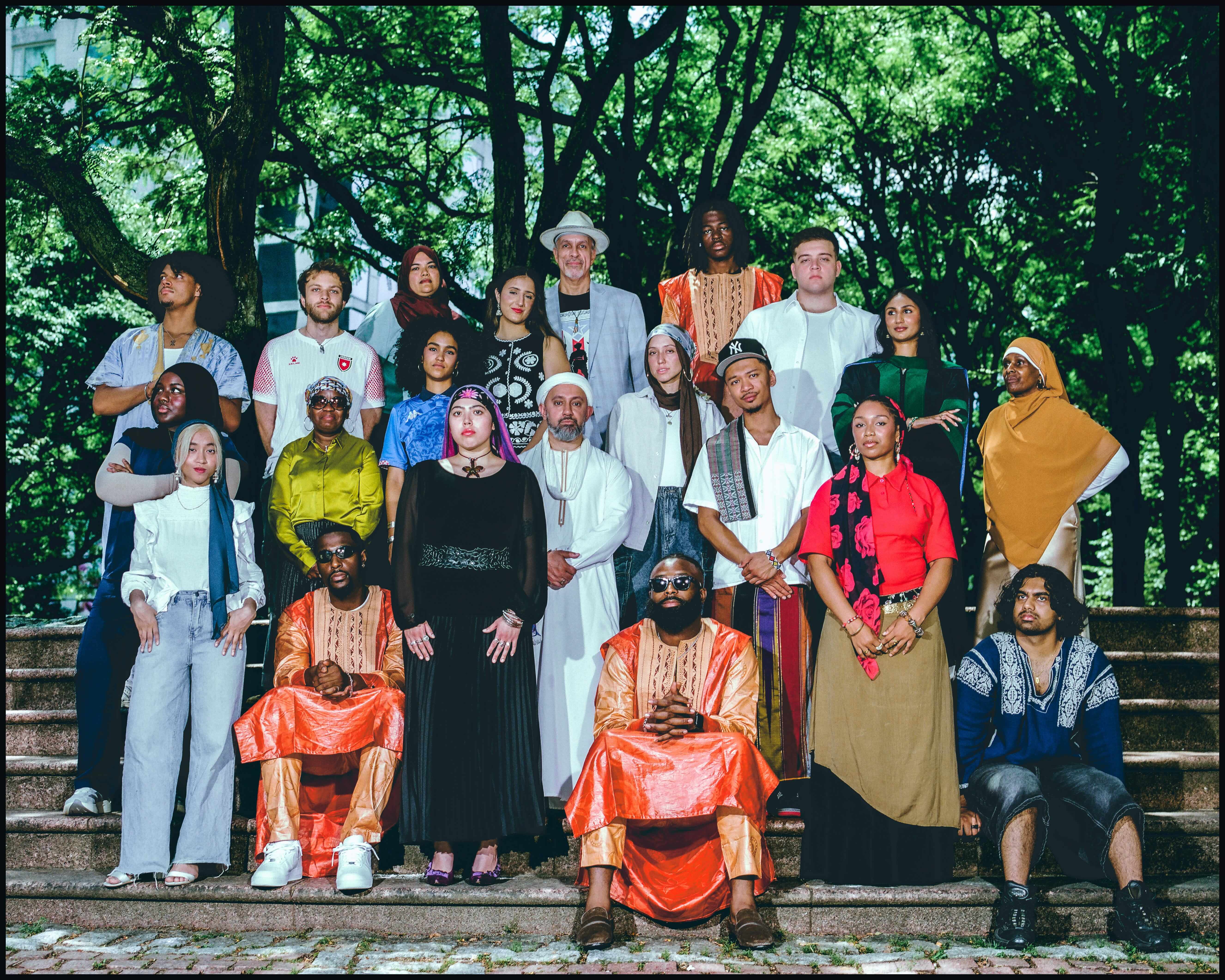
Upon entering the space, visitors were greeted by two parallel images: an enlarged cover of a 2007 Newsweek special report titled “Islam in America” and a reproduction of the cover shot by the production company, 1405. The two images portray the diversity of the Muslim community in the U.S., and both feature members of the Alianza: the late Ibrahim Gonzalez posing for the Newsweek cover and Jorge Pabon (Brother Shukriy), Gonzalez’s daughter Sultana, and Villalba for the contemporary portrait.
The intention of the first paired images—to present the Alianza’s history as a “mirror” to the present, Villalba told me—followed throughout the exhibition. Poetry, paintings, and textiles from contemporary artists were presented opposite to archival photographs, da’wah (proselytization) materials, and insignia from the Alianza’s origins to its heyday throughout the 1990s and early 2000s.
“One Ummah, One Barrio” began with the genesis of the Alianza in civil rights-era organizing. As teenagers in Spanish Harlem, the Alianza’s co-founders led cop-watches, organized striking tenants, and marched against imperial intervention in Vietnam and Latin America with organizations like the Young Lords Party and the Puerto Rican Student Union.
However, internal division and state repression led to the dissolution of many of the organizations that first brought the Alianza’s co-founders into political struggle. Rahim Ocasio wrote in his book Alianza Islamica: Spanish Harlem’s Islamic Odyssey, that after the decline of the Young Lords in the 1970s, the co-founders were “adrift, pursuing different paths, passing through different phases. It was a time of soul-searching and marching inexorably toward a destination we’d only know once we go there.”
Eventually, they were introduced to Islam through the fortified networks built by a generation of Black Muslims in New York. For the four young Nuyorican (a portmanteau of “Puerto Rican” and “New York”) teenagers at the center of the Alianza’s story, Islam renewed their commitment to struggle and offered a body of ethics that enriched their organizing.
The founders would go on to work with institutions like the Islamic Society of North America and the now-defunct Islamic Party of North America. But, after several failed attempts to convince mainstream Islamic organizations to translate da’wah (proselytization) materials into Spanish and to take seriously the propagation of Islam among Latinos, they formed the Alianza Islámica.
In the 1987 editorial of the first issue of the organization's eponymous, bilingual newspaper, Rahim Ocasio wrote that the Alianza was not interested in “starting a new cultural phenomenon of halal tacos and Islamicized aguinaldos [carols sung on Christmas]" or “the parochial, chauvinistic rise of a subject people to dominance and superiority at the expense of others.” Rather, the Alianza’s stated purpose was to “make Latinos aware of their birthright as vicegerents of the Lord of the Universe.”
Asad Dandia, a local historian who hosts a walking tour highlighting the Muslim histories of Harlem with his company New York Narratives, told me the Alianza’s community programs “filled the gap” in social services provided by Islamic institutions at the time. They were among the first Muslim organizations to perform ritual washing (ghusl) for Muslims who had died of HIV/AIDS. They ran GED and skills workshops, set up food distribution services, advocated for incarcerated Muslims, and established programs for Muslims recovering from addiction. In coalition with the Masjid At-Taqwa in Brooklyn, whose members led patrols in the late 1980s to shut down drug houses in the neighborhood, the Alianza contributed to a security force that provided protective detail for the likes of Fidel Castro.
The wealth of archival material presented in the exhibition made clear how the Alianza affirmed that there was no inherent antagonism in their identities as Muslims and as Latinos. The Alianza repeatedly referenced the history of Andalusia (al-Andalus)—the Islamic kingdom that governed the Iberian peninsula for some seven centuries—to “make Latinos aware of their glorious Islamic heritage” in order to “remove the stigma of Islam as a foreign element in our culture.”
When I sat down with the exhibition’s curator, Maia Villalba, in the gallery space, she told me that she wanted exhibition-goers, particularly members of the growing Latino Muslim community, to “see their realities reflected in real time.” For Villalba, the research process was intensely personal—conducted around the time that she was considering reverting to Islam. “The story of the Alianza was my da’wah,” she told me. In those four teenagers from El Barrio, Villalba, a Cuban-Chinese organizer, saw herself, particularly in her work against Israel’s genocide in Gaza and urban displacement in New York City. In a similar fashion to the Alianza’s co-founders, Villalba came to find that Islam offered her a "meaningful path for continuing my liberatory praxis.”
In the mid-1990s, the Alianza established a physical space in a storefront building in the heart of Spanish Harlem at 107th and Lexington Avenue, La Mezquita del Barrio (lit. “The Mosque of the Barrio”), likely the first Latino-centered Islamic space in the country.
Ocasio writes that from the beginning, the Alianza “made the conscious decision not to mimic the traditional masjid model prevalent in the city at the time.” Then, most mosques in the city, as they do now, operated out of converted bodegas and apartments like the Alianza’s storefront. However, Dandia said that unlike most mosques of the time, La Mezquita was not simply “a place to fulfill your obligation of prayer.” Instead, it functioned as a hub for the Alianza’s programming, hosting self-defense and ESL classes, lectures on Islamic ethics, and cookouts.
Dandia told me that the Alianza’s specific relation to the impoverished neighborhood that birthed many of its members offers a “a vision and a model for an urban Islam grounded in ethical ideals and social consciousness.” If the history of the Alianza, as Villalba intended, is to be a “mirror,” then the organization's foundational approach towards the disinvested urban neighborhood offers an important critique of ideas about contemporary Muslim organizational and institutional life in the United States.
As Samee Ahmad argues (in “Dreaming EPIC in Texas,” published in Acacia), the idea of “citadel-like comfort and security” represented by an “exclusive, luxury” housing project proposed by a wealthy, suburban mosque in Texas, runs antithetical to the vision of Muslim life developed by the Alianza. Rather than a hermetically-sealed utopian ideal of Muslim community, funded by and largely built for wealthy, suburban Muslims, the Alianza developed a spiritual and social program that directly addressed the structural needs of its neighborhood.
But the city and El Barrio of the Alianza’s time is not the same as it is today. Dandia told me that decades of neoliberal economic austerity shepherded by mayors Ed Koch (1978–1989) and Rudy Giuliani (1994–2001) have transformed the political potential for the emergence of an organization like the Alianza in Spanish Harlem today. Much of the Alianza’s foundational demographic has been displaced by the housing and affordability crises—a structural difference from the 1990s that makes it “much more difficult for working people to organize when they’re too busy trying to pay their bills.”
Predatory landlords were one of the contributing factors to the decline of the Alianza. In an ironic episode typifying the fragmentation of the Muslim community along lines of capital and ownership, Ocasio writes that in the mid-aughts, the organization was handed an eviction order to vacate La Mezquita by their “Indian-Muslim” landlord—the same landlord that first invited them to move into the storefront to combat drug-peddlers in the area. The eviction forced the Alianza to relocate to The Bronx, away from the neighborhood they had served for over a decade. Then, in 2005, a fire destroyed their Bronx location and led to the Alianza’s eventual dissolution.
While the Alianza is no more, “One Ummah, One Barrio,” reinvigorated a history that Dandia said “has been central to the New York City Muslim story.” In a moment when some cultural critics attribute the "renaissance" of the city’s Muslim diasporas to the proliferation of social clubs, “One Ummah, One Barrio,” invited reflection on the stakes of identity-centered organizing. The Alianza employed their dual-identity as Muslims and as Latinos to organize and spiritually embolden a neighborhood suffering from municipal disinvestment and ghettoization.
As the title suggests, the exhibition offered a conception of community that is at once hyper-local (“One Barrio”) and global (“One Ummah”) in scope—an affirmation of the contingency of internationalist solidarity on local material struggle. Villalba told me that she conceived the title to reflect the vision of community she, and I, read in the story of the Alianza—that Muslims “are not tied to one nation, to a particular language or geography, class, race.” Rather, “we’re just one Ummah, one Barrio.”

