
I often think about the fears we experience in travel. A forgotten passport. A missed flight. A lost suitcase. But I think perhaps the most haunting fear is our desperate need to see and experience everything before we leave. What if we never return here? What if we never see these monuments, these people, these places again?
I feel this anxiety every time I travel. But I particularly feel it whenever I leave Palestine. Each departure follows the same ritual. The taxi driver waits as family members stand in tears, knowing that tomorrow, we will no longer be a door away. I carry the same questions into the car with me: Will I return? Will I see my grandparents again? Will I walk this dirt road, visit our favorite shops, and sit at this same lunch table? They define the texture of my departure, a liminal grief, in which the full weight of what leaving means slowly makes itself known. Not just for me, but for the relationships I cherish, and for this home that is mine.
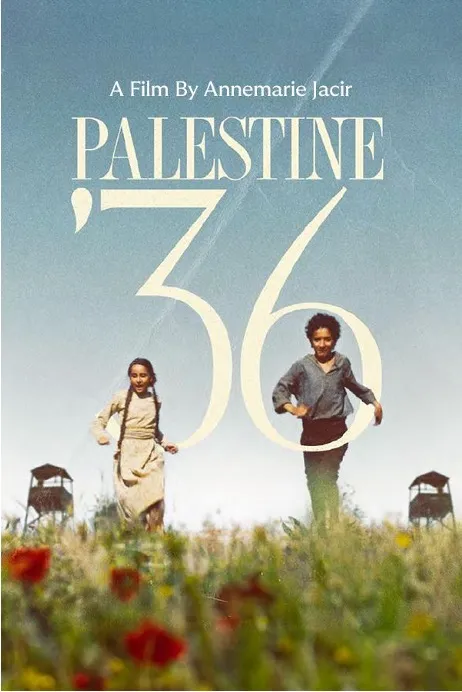
It is within this emotional landscape that I encountered Palestine 36 by Annemarie Jacir, a film that captures this grief and situates it within the broader frame of collective Palestinian identity. The film chronicles the transition from British colonial rule to Israeli statehood and the communal grief Palestinians experienced. To situate the history: the Arab Revolt of 1936–39 was a nationalist uprising led by Palestinians against British colonial rule. The revolt began with a general strike and escalated into an armed rebellion for Palestinian independence. It was suppressed by British forces and left Palestinian society weakened on the eve of the Nakba.
The film, in both its topic and construction, exercises what Teshome Gabriel calls “Third Cinema,” a decolonial filmmaking practice that refuses the logic of Hollywood’s individualist storytelling by positioning the community as the primary subject. For Gabriel, colonial cinema centers the heroic individual, a figure whose personal arc becomes the vehicle through which history is understood. Third Cinema rejects this structure and centers the “trans-individual” or the “collective subject” as the legitimizing function of cinema. Therefore, telling a story through a “collective subject” is a political act: it refuses to reduce historical struggle to a single protagonist and insists that communities are the engines of historical change.
Palestine 36 centers this community. By distributing the narrative weight across the ensemble, Jacir insists that each character’s experience is central to the story. In an interview, Jacir explains this model through tatreez, with each thread being sewn to reveal a bigger picture. Jacir frames this as a way to understand how 1936 impacted the daily lives of all community members and the interrelatedness of their stories.
Jacir’s use of the “collective subject” in her film, through the ensemble cast, reaches deep within the Palestinian logic, fostering an intimate collective understanding: people are not solely individuals but are part of al sha’b. The cast then stands as a metaphor for al ahl/al sha’b. These terms, translated as “the people”/“people of,” do more than denote a group. They describe a way of belonging that is layered, relational, and rooted in both social and material life. In the Palestinian understanding, a person is not simply an individual who happens to belong to a community. They are constituted by that belonging. To be Palestinian is to exist within a web of relations—to family, to villages, to land—all which shape and define one’s identity.
This structure is not merely an aesthetic choice but an ethical one. The cast becomes a metaphor for al ahl—the family, the community, the collective body. They are distinctly embedded in social and material structures. This framing of social life is essential to grasping the catastrophe of displacement. When a home is lost, or a town is emptied, it is not simply a property that disappears: it is an uprooting of a whole system of social relationships and belonging. This is exemplified by Hannan (played by Hiam Abbas) when she asserts to her granddaughter, “Your land is where your ancestors are buried” and dies when her home is destroyed after the British invasion of her village.
The framing of al ahl as the “collective subject” of the film helps us understand how grief and rupture are experienced by the film’s characters. The film draws on a framework developed by Wassila Abboud through her reading of Douglas Crimp’s “Mourning and Militancy.” Abboud argues that Crimp’s militancy means refusing to defer to reality as it is. Grief does not resolve, but rather reorganizes the conditions of living. Rather than accept the British Mandate’s terms, the Palestinians’ “militant” mourning is the active refusal of disenfranchisement. Abboud weaves this understanding of mourning into the Lebanese Marxist Hussein Mroueh’s discussion of grief. Mroueh understands there to be two types of grief: al-huzn al-qatil (the grief that kills) and al-huzn al-muqatil (the grief that fights). The grief that kills ossifies and accepts the present as fixed, while the grief that fights transforms loss into grievance and becomes the ground of resistance. Mroueh’s fighting grief is the framework Palestine 36 maps onto its “collective subject.”
One scene in particular concretizes this understanding of “fighting grief.” As the revolution begins, militiamen board a commuter bus to ask for financial support. Men search their pockets, women take off their jewelry, and the viewer settles into an understanding of the collective cost of revolution. Grief thereby erupts into the Palestinian experience, cementing the film as not simply a historical epic, but a communal chronicle of grief and loss. What we witness is not simply generosity, but the internalization of loss—the recognition that the revolution belongs to everyone, that its costs are borne collectively, and that the smallest act of contribution is an act of revolution. The film does not present this as exceptional, but rather as a communal norm.
This reconfiguration of daily life is the heart of the film. Mourning becomes the new grammar of existence. Thoughts of whom to invite for dinner or which road to take home transform from ordinary calculations into questions tinged with fear, the survival instinct, and the pressure to maintain one’s humanity under dehumanizing conditions. In this sense, Palestine 36 goes beyond the structure of a historical epic to a portrait of how people learn to carry loss.
I move through these losses each time I leave: the safety of my relatives, navigating grief, and finding rootedness. These questions are not only mine. They are a thread in the larger tapestry of people who have asked them; who have reconfigured their grief, mourned through resistance, who have left and longed to return.
Aya Nimer is a staff member at Pillars Fund, which provides grant funding to Acacia.

