
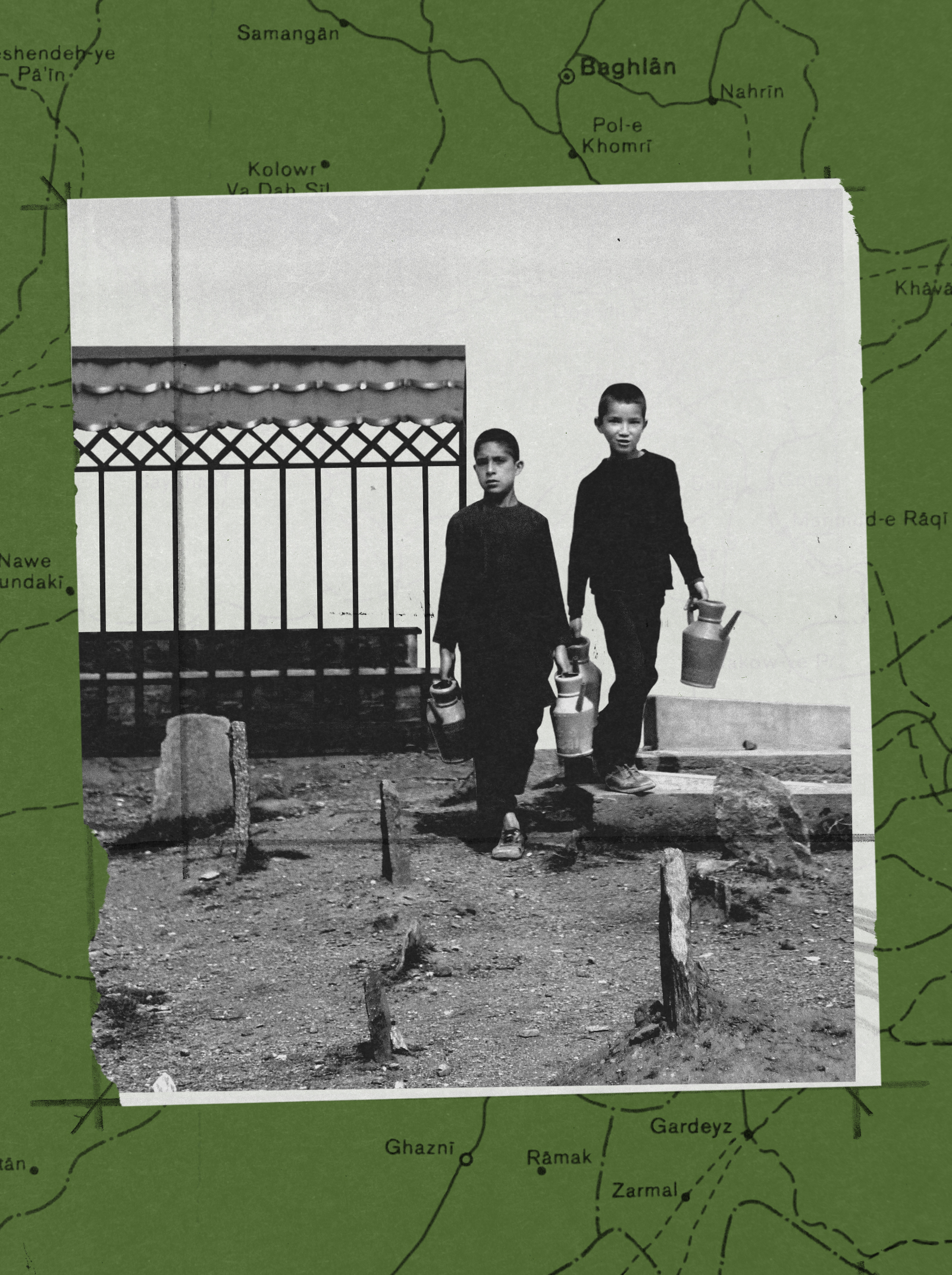
In the summer of 2021, a little more than a year after the 2020 Doha Agreement (a peace accord between the Taliban and the US—but not the Afghan Government), Taliban fighters conducted a major offensive throughout Afghanistan and made unprecedented, sweeping advances on government bases and major cities. In Sacramento, meanwhile, all the Afghans in my community were glued to their phones, reading and watching and spreading contradictory reports on what bases had fallen, how many soldiers had been killed or taken prisoner, and which politicians were preparing to flee the country.
As the Afghan government and the US military tried to downplay Taliban victories, the Afghan National Army was rapidly collapsing. Commanders abandoned their regiments, and others cut deals with the Taliban. Entire bases surrendered without firing a shot. Taliban fighters posted videos on Twitter and Facebook of their flags planted in Nimruz, in Kunduz, in Herat. Within weeks, they were knocking at the gates of Kabul itself, and after Ashraf Ghani and his cronies abandoned their country, the Taliban took the capital without having to lay a siege on the city. Shortly afterward, the evacuations began, and thousands of Afghans descended upon Kabul Airport, where they were penned in like cattle by US military personnel, or slaughtered by Afghan special forces, or blown up by ISIS, or shot by the Marines, who, in the wake of an ISIS suicide bombing, killed dozens of civilians in an onslaught of gunfire. As one of their final military operations in the country, the US conducted a drone strike that murdered humanitarian aid worker, Zemari Ahmadi, and his family members, seven of whom were children.
Ten months after the collapse of the Afghan Government, in June of 2022, my family and I returned to Kabul to check up on our relatives. Four years had passed since my last visit, and so much violence had been wrought upon the country that we spent our entire first week offering duas for the dead.
A few days later, my cousin Hashmat picked us up in Kabul for our first trek back to my parents’ home village in Logar. He was a handsome, broad-shouldered, 24-year-old taxi driver, farmer, carpenter, mechanic, and merchant. On our way to Logar, the generally cheerful Hashmat described the horrors he’d witnessed over the past four years. He gestured toward a mountain pass where government militiamen had beaten him and smashed the windows of his car. Further down the highway, Hashmat pointed out a key base that had been captured by the Taliban during the takeover last fall. Taliban fighters and Logari locals had rushed the building, searching for supplies and food, only for a missile to fall on their heads. Hundreds of corpses, Hashmat recalled, littered the roads. No one buried them for hours. The sheer scope of the carnage he witnessed that day haunted his dreams.
“Fortunately,” Hashmat joked, “I don’t sleep”.
Every day, Hashmat woke at 3:00 in the morning to drive produce up to Kabul, only to return home at seven in the evening to finish his chores and duties on the farm. Usually, he didn’t fall asleep until midnight.
“How do you manage?” I asked him. “You don’t get tired?”
“I can’t get tired, Jamil Jan,” he said, smiling. “I’ll sleep when I’m older.”
Passing the old market village of Waghjan, we approached the bridge above the Logar River. A prime location for ambushes and assaults, the bridge above the Logar River had been destroyed and repaired hundreds of times since Logar became a battlefield in 1979, at the outset of the Soviet War. The river, itself, had recently flooded, destroying crops and further intensifying a food crisis in Logar. We crossed the bridge and eventually entered Hashmat’s village. Though the sun was beginning to set, the roads were still packed with vehicles and villagers. At Hashmat’s home, we were greeted by his entire family just outside the gates of their compound.
Marijan, Hashmat’s mother and my eldest aunt on my mother’s side, led us up to the guest room on the second floor, apologizing for the state of her home, which, of course, was immaculate. A large, clay compound with bedrooms on one side and a tandoor khana and beranda on the other, my aunt’s home revolved around a lush garden and grape arbor that made up its courtyard. As its matriarch, Marijan ran her household with an iron fist, assigning her children a hundred different tasks at once in a lifelong battle with the infinite to-do list in her head. She gardened, slaughtered chickens, baked bread, cooked and cleaned, arranged parties, advised her sons, administered medicines, and acted as the matchmaker for her four unmarried children.
Marijan grew up in an Afghan refugee camp in Peshawar, Pakistan, without any access to a girls’ school. Unfortunately, her daughters were resigning themselves to the same fate. Her eldest girl came of age during the American Occupation, but she couldn’t travel to the local high school because of firefights and bombings in the village. But now, in peacetime, with the roads finally free of battles and corpses, the Taliban had shut down the only girls’ high school in the area. Though Islamic scholars and activists have protested the school closures throughout the country, as of this writing, most girls’ high schools remain closed.
It is true. I had returned to Logar for stories. But I have to admit I didn’t expect to receive them so freely. For weeks, I had contemplated how I might go about requesting interviews and asking questions and recording stories without seeming like a pest. Or a spy. But my relatives and their neighbors were eager to share their memories of the war(s). They would seek me out to tell their stories. I listened and jotted notes and tried to make sense of the carnage.
Hashmat had seen so much death and violence in Logar that it was sometimes difficult for him to maintain a single narrative. Once, in the middle of his story about having to move a dead body out of a narrow road to exit his village, he slipped into another story about a different dead body lying near his friend’s home. The second body had been dug up from a nearby grave. The corpse was decomposed beyond recognition. It was unlike anything Hashmat had seen. He froze up and called his friend to warn him and drove no further. I was confused. I thought he had already moved the body. “No, no,” he said and apologized, “this was a different corpse. The other corpse I mentioned I moved months after the corpse in front of my friend’s home. They were different corpses. One had been rotting. The other had died recently.”
One evening, Hashmat, his older brother, and their ten-year-old cousin escorted me out to the gardens and orchards in front of their clay compound. The sun had set, so we lit up the dark trails with phone lights. Between stalks of tomatoes, Hashmat pointed out a short strip of clay where his father had built a brick wall three years earlier, a barrier to protect them from stray bullets. He stressed that the brick wall had saved their lives countless times while they planted or harvested crops. Their little cousin eagerly led me back to the front of Hashmat’s compound, pointing out bullet holes and damage from bomb debris. Hashmat’s home had been caught between an Afghan government militia post and the fields (or mountains) where the Taliban carried out their attacks. Whenever a Talib took a shot at the post, the militiamen would respond with a barrage of bullets, tearing through homes and orchards and villagers. The torrents of gunfire became such a frequent occurrence that Hashmat and his family stopped sleeping on the second floor of their home and only ventured outside to plant, to harvest, to sell produce, or to fetch medicine. It was a suffocating existence.
In general, villagers in Logar described the Afghan militia forces as having no regard for human life. The Afghan government had purposefully recruited militiamen from distant provinces, so that they wouldn’t align themselves with insurrectionary elements in Logar. But because the militiamen were basically strangers to the village, they had no qualms about harassing, robbing, sexually abusing, and murdering anyone they deemed expendable. “Many of our neighbors joined the Taliban because of the militiamen,” Hashmat said. “They were brutalizing us. The government wasn’t doing anything. People felt like they had no choice.”
The Taliban, of course, carried out their own insurrectionary violence: car bombings and ambushes and assassinations. Over the last five years, Hashmat recalled, the Taliban became more brash with their maneuvers. They fought out in the open. They taxed villagers and slept in fields. With time, they became the prominent authority in his village, establishing their own shadow government. The success of the Taliban offensive in 2021 shocked many American journalists, foreign analysts, and Afghan government officials, but Hashmat’s family had been reading the tealeaves for years. The only thing that surprised Hashmat was the incredible speed with which the government collapsed. “Honestly,” he said, “we expected the government to put up more of a fight. Even without the Americans, the Afghan military was better trained and better armed than the Taliban. The fighting could have gone on for years. But it was good that they [the Afghan government forces] gave up their guns. Ghani and them were going to flee anyway, and it was good that Muslims didn’t kill each other for nothing.”
Time and again, I found myself astonished by Hashmat’s evenhanded analysis of the war. He had been severely beaten and robbed by militia forces. His home had been bombed and raided by Afghan commandos and American soldiers. He lived in perpetual fear of the unseen drones in the sky. And he had been interrogated and threatened by numerous Taliban fighters. The war had made his life hell. And yet, he held very little resentment against anyone. When describing the abuse he received from enraged militiamen, he emphasized that the men were in mourning, that they had recently buried their allies, and that he could hear the sorrow in their voices even as they beat him.
Hashmat stressed that many villagers joined the war out of desperation, and he went on to describe an economy of war that had infected the entire province. He knew boys who fought for the Taliban simply because it was consistent monthly pay. Food on the table and a gun for protection. The war had ruined everything else. Crops and livestock would be destroyed in errant bombings and firefights. Transporting fruits and vegetables across the myriad of military checkpoints installed all throughout the countryside would often get you robbed or beaten or killed. Villagers, in general, but especially young men, felt that there was no other consistent way to make money, to buy food and medicine, to look after one’s family besides fighting. Brutalized and often indiscriminately targeted, these young men conducted themselves according to the logic of a war economy that not only seemed omnipresent but eternal.
“We used to say: ‘deny us bread but give us peace’, but now that we have peace,” Hashmat remarked to me one day, laughing, “we realize that we need the bread, too.”
U.S. sanctions, border closures by Pakistan, an internal refugee crisis, environmental disasters, and the Taliban’s policies (namely their refusal to allow women to work and receive a higher education) have crippled the Afghan economy. Though poverty in Kabul has always been severe—the billions that flooded into the country during the American Occupation rarely reached impoverished Afghans—I had never witnessed such wanton desperation on the streets. Entire families lined the roads, some of them attempting to sell household possessions. There were makeshift markets filled with newly impoverished Afghans selling mattresses and furniture and their own clothing. Children were dying of malnutrition in understaffed and underfunded hospitals. The occupation had ended, but the aftereffects of the long, American war were still ravaging the country.
August 15, 2026 marks the five-year anniversary of the Taliban takeover, a humiliating debacle for the U.S. military. Although the U.S. has seemingly buried itself in Afghanistan’s infamous “graveyard of empires”, it is difficult to see how the country will overcome its almost ceaseless history of invasions, massacres, and occupations. To this day, the southern Afghan border established by British diplomat Mortimer Durand in 1893 leads to skirmishes between Afghan and Pakistani forces (and bombings on Afghan civilians). To this day, children are still killed by Soviet mines planted fifty years ago. To this day, there are graveyards where brothers (one a Talib; the other a soldier) are buried side by side. To this day, and perhaps for many years to come, U.S. sanctions will starve Afghan children for the sin of being born under an unfavorable regime.
One afternoon, near dusk, Hashmat and I were driving out of Logar when we passed an empty lot of dirt beside a graveyard. Children (boys and girls) were playing soccer and cricket and marbles and frisbee, a chaotic mishmash of different games colliding into one another in the lot. From time to time, a ball or a frisbee would sail into the graveyard. Two of my mother’s brothers, Ahmadzia and Farhad, and my father’s younger brother, Watak, were buried in that graveyard. Ahmadzia and Farhad were murdered in 2012, and Watak was killed in 1982. Forty years apart. Two different occupations. Two different foreign powers. But my uncles all died within a mile of one another, mere meters away from their homes.
“Won’t anyone be upset at the kids for playing so close to the graveyard?” I asked Hashmat.
He laughed. “If we stopped them from playing near graves, there wouldn’t be any place for them to play.”
It was true. Makeshift graves and martyrdom markers seemed to cover almost every road, every plot of land in my parents’ home village. You had to be careful not to bump into them when navigating the tight alleyways and dirt roads between compounds. They sometimes appeared between mulberry trees, or rows of chinar, or on the edges of golden wheat fields, providing a strange sense of harmony to the village: this comingling of life and death, of decay and renewal.
“Everyone understands the children need to play,” Hashmat assured me. “Even if it’s in a graveyard, the children need to play. So, we let them be.”

