
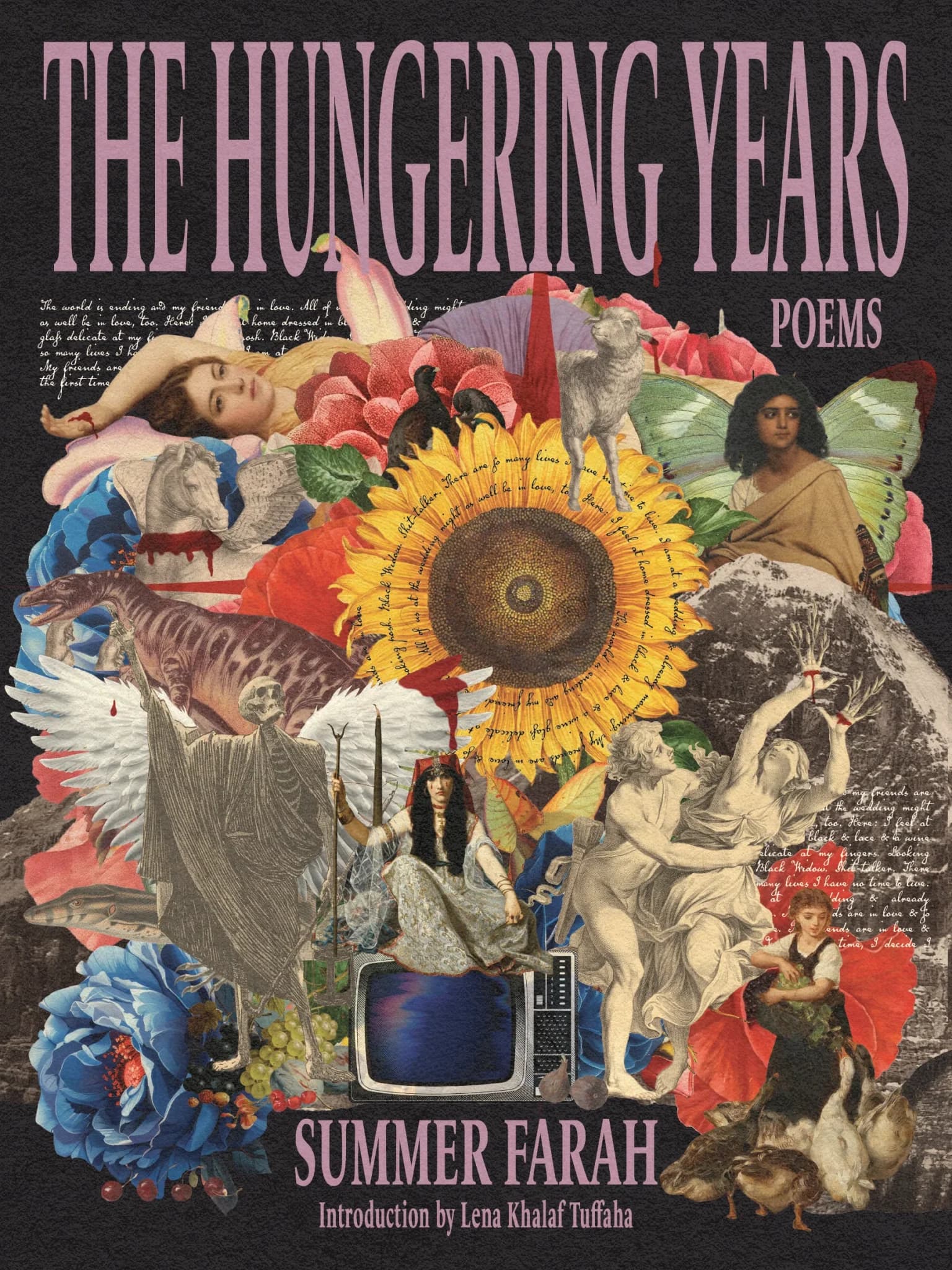
Summer Farah has an itinerant sense of place. The poems from her debut collection, The Hungering Years, pass through Berkeley and Hyrule, Nazareth and the ocean floor, along with obsessions unbound by any border. “At the Met Cloisters” finds her inside the museum of that name, its frosted stasis eliciting strange intimacies:
In the rare treasures room, heads shuffle
closer from across display glass.
People fall in love around stolen objects.
I long to drink out of the cup from
“Somewhere in the Near East.”
I first met Summer through our mutual work organizing against the war on Gaza; we both cherish old photographs and Carly Rae Jepsen. Many of her verses in The Hungering Years address other Arab American writers, asking a question or sharing some enthusiasm, each of them bounced together by empire’s spasms. Another poem recalls a family reunion in occupied Palestine: “i sing to the sea air in akka / the first & only time / i visit palestine / an american song out / of my american mouth / my cousins practice / their english & i memorize no language / but their voices.” She wrote a companion piece when Israeli settlers torched Palestinian homes in May 2021, erasing most of the lines, as if smearing her fingers with ash: “americans / practice / no / voice.”
This interview has been edited and condensed.
Chris Randle: This book is written as a conversation with Etel Adnan, among others. How did that structure inform the work?
Summer Farah: My name in Arabic is Samar, which roughly translates to “evening conversations.” And so, I’ve always had an interest in art as conversation, and the form poetry has often taken for me is this sort of conversation, either with myself or a family member, friends, etc. That conversation with Etel Adnan felt like a natural extension of how poetry functions for me. The series itself comes about from a kind of joke, reading her work and thinking, God, she would love The Legend of Zelda. And feeling a loss that I couldn’t tell her about it, because she’s dead.
I’ve been very lucky in my burgeoning writing career to have access to a wide range of Arab American writers, especially people I perhaps wouldn’t have been able to connect with so early because of their stature, if I weren’t part of a niche, tight-knit community. Etel Adnan is someone I never got to speak to in her lifetime. I saw her read on Zoom once, and it was the coolest thing ever. But there is that kind of [feeling], God, I wish I could have talked to her about Supernatural. There is that impulse when I read her work: what are the things that I’m attached to that I think of when I read about her own attachments?
So that series became a really useful framework for the rest of the collection, as a way of connecting these disparate poems I had already written into something where they were in conversation with each other.
Chris: What was it about her writing that first caught you?
Summer: I really didn’t understand what was going on the first time I read her work. I’d read excerpts, early in my interaction with work by Arab American writers—late high school, early college era, when I started getting more interested in poetry. But it wasn’t until I read Surge from Nightboat, I think in 2018, that I really sat down with something she had written in full, and I didn’t understand it at all. It very much went over my head, and I felt weird and alienated in that insecure thinking, like, God, I just don’t know what this means, I don’t understand how to connect with this artist who is incredibly important in my communities, and I wanted to. So every time I was at a bookstore, I looked for her name and kept collecting her books, thinking that one day I would be in a place where I could access this work differently.
I kept reading and slowly learning the rhythms of her writing, getting a grasp of her philosophical language, the ways she was navigating time and space in this mystical way, and this undercurrent of pushing against empire. And then when I read In the Heart of the Heart of Another Country, which is described as a lyrical memoir, it all clicked for me. There is this thread of guilt throughout the book: guilt of being in a place and not wanting to be there, guilt of being far away from your home while violence happens, guilt of being complicit in the violence that happens to people who you consider your people, and the guilt of mundanity as your life here continues. I was like, Oh yeah, I feel this, I get it, I understand. And it opened up her other work for me in a really beautiful way.
I finished that book the day she died, which was kind of crazy. It was like, finally, I am here, and now she is gone.
Chris: While reading The Hungering Years, I kept fixating on the oblique references to your family’s history, which is also the history of the land. Like that church in Nazareth, or the unmarried woman, or your mother’s maiden name, the sound of a watermelon being sliced. They made me think of how Edward Said once described himself as “a Palestinian trying to give national shape to a life now dissolving into many unrelated particles.”
Summer: I think as a Palestinian, I’m very lucky to have still-standing monuments connected to my family history. It’s a very different experience from many other Palestinians, and that has a lot to do with just my privileged position as a Christian from Nazareth in particular, and the histories tied to that city in relation to occupation. I don’t want to take that for granted. And so, in the ways that I have access to that history, I am interested in playing in that space, and thinking about what I carry with me as a Palestinian who is not there. You know, the church in Nazareth, the Greek Orthodox Church of the Annunciation, my dad’s family, for a time, were caretakers of that church, and my ancestor is buried in it. So there is this hyper-particular connection to the literal land of a holy monument—it’s not just these Holy Land kind of things that we talk about, talking about Palestine in this sort of theoretical, defensive way, but this above-ground, through-the-ground relationship and unsevered tie that I’m incredibly lucky to have.
I think a lot about the places where my relationship to my identity is unsevered—which is that continuity of Christianity and the caretaking and the relationship of placement on the land—and how my identity is severed because of distance, because of my position as a U.S. person, and my complicity in those violences, the literal distances between the lands. And the loss when you are not consistently embedded in a culture, instead recreating a different one in diaspora.
Chris: In your Poetry Project interview with Fargo Nissim Tbakhi, the two of you imagined what you would compose if you were “annoying diaspora writers.” Another Arab American friend joked to me that Zohran’s early work was “diaspora cringe.” And there’s this literary trope of the heroic exile, you know, Nabokov wryly observing Midwestern gas stations or whatever. So, where does the second-generation immigrant’s position diverge from that? We’ve talked about learning more Arabic, and there’s that line from the Akka poem with your cousins practicing their English on you.
Summer: What’s interesting about language is when I was in Palestine, whenever we were in public, people were like, oh my God, her English is so good! And I was like, it is so good! I’m seven years old and American! It was this interesting experience where I was not easily recognized as “other,” you know? It was, like, well, she fits right in with this broader family of Arabs, of natives, right? My parents sometimes ask me, how do you feel about your American identity? And I say that I feel like I have a responsibility to acknowledge that identity, because as messed up as it is, it is a privilege, and it does grant me something that others don’t have.
Generationally, I think recent immigrants from the region might feel a little different. Still, my parents’ generation versus mine has a different relationship to risk because of the naturalization process versus birthright citizenship. I also think of the positionality of ’48ers- their relationship to risk is different.
But when I think about what home is, which is a big question for all of us, I do feel pretty at home in California. I think that it’s a hard thing to say sometimes, that, even if I feel weird and out of place and like an alien who doesn’t belong, it’s not because I would feel correct in my body in Palestine, necessarily. I don’t know if that’s true.
Chris: So much of The Hungering Years is situated in Berkeley, where Etel Adnan also lived. Has moving to Los Angeles altered your practice at all?
Summer: Berkeley is where I started writing in earnest. It was the first place I shared my work with others. It was the first place where my craft was formed, and I learned how to write among other people. I didn’t do academic writing workshops. All of my training was from reading, slam, community workshops, and things like that. The way a poem came to me then was often through the goal of producing something for the stage. And when slam stopped being my main outlet of performance, or my main outlet of writing, it came to me through being in motion, mostly. Going on walks is a big one. I would say, like, 70 percent of the book is written on the side of the road in San Diego County.
A few days ago, I went on a really long walk. There was a reservoir nearby. It was completely fenced off, locked up, with a “no trespassing” sign, but you could see through it, and it had such beautiful, well-maintained palm trees, succulents, desert plants all over, and I was just like, God, I want to trespass so badly! But I didn’t. I just wrote a poem about it instead. That is my process.
Chris: You reminded me of these poems that Bertolt Brecht wrote about his Hollywood exile, which he experienced as a bemusing hallucination. Here’s the first one:
The village of Hollywood was planned according to the notion
People in these parts have of heaven. In these parts
They have come to the conclusion that God
Requiring a heaven and a hell, didn’t need to
Plan two establishments but
Just the one: heaven. It
Serves the unprosperous, unsuccessful
As hell.
Summer: Slay. I love poems about Los Angeles. I love how mean they can be.
Chris: Is there another one that you’re thinking of?
Summer: Yeah. This is by Haas Mroue. It’s from Beirut Seizures. He’s a Lebanese poet. He lived between the Pacific Northwest and Los Angeles. A lot of the poems are LA poems. This is just one stanza:
People tell me
I talk about death too much,
and I tell them
in Beverly Hills supermarkets,
they call hummus “Israeli pâté.”
There’s something so cutting about that, it’s like, yeah, I want to kill myself, because I live in Los Angeles, California. I love the elegance of that, when you are bombarded with the mundanity of Zionism every single day in your life. Like, yeah, man, of course I’m talking like this. Just so elegantly cutting. It’s a collection from the ’90s, and it’s interesting that “Israeli pâté” is now phased out as a label for hummus, even though the erasure of its roots and the appropriation of it as Israeli hasn’t gone away.
Chris: This is maybe a more neutral example, but I told you how uncanny it felt when I realized the origin of Jaffa cakes.
Summer: It’s so funny because the orange is like the symbolic longing of the exiled of Jaffa, packaged as this weird British snack.
Chris: I think you told me once that your great-grandfather studied agriculture at Harvard. Was that his crop, or was it something else?
Summer: I don’t know, actually. I think it was probably olive trees.
Chris: Classic.
Summer: The classic, you know. You have four choices when you’re picking. You can do olives, oranges, watermelon, and figs. Very lucky to enjoy all of those things. Me and Fargo [Tbakhi] talk about the annoying diaspora writer. Sometimes, I do think, God, I’m writing about these stereotypical diasporic symbols of food a lot, but it’s also like, I write about watermelon because I eat watermelon.
Chris: I wanted to end by asking you about the state of Palestine solidarity work in the literary world, especially now that the PEN boycott has been lifted.
Summer: People often ask me how to move and what to do when encountering institutions that were identified as complicit early on in the genocide, where maybe no formal boycott was announced, or there isn’t necessarily an organized movement against them with demands. But then I also see people participating in spaces that I’m like, God, aren’t we over this yet? Haven’t we understood this to be a loser Zionist space that can’t be redeemed? So there are tensions. The work is slower, but I also think that’s good, that the work doesn’t feel as much of a spectacle anymore. I think more serious and more rigorous work can be done in those slower moments, even though conditions in Gaza haven’t improved, and the genocide continues. It is a slower violence.
It feels good to see people second-guessing their attachments, especially to institutions like The New York Times. Early on in the genocide, the poetry editor at the Times, Anne Boyer, resigned in a very succinct way—she didn’t say “fuck The New York Times.” She didn’t say that, but she did. And it’s interesting because in my world of poets, your main relationship to the Times as an institution that may or may not support your work comes in the form of a review, which, as many of us know, is kind of a dying art. It is very unlikely that your book will be reviewed by the Times. So in some ways, it’s a lot easier for a lot of poets to divest from the Times as a prestige-granting institution. But when we think about the spaces that are important to poets, or valuable to poets, it’s harder.
Sometimes distance makes people feel helpless, especially when they see such spectacular scenes of violence happening next door to them. And when we say it’s all connected, sometimes that can become a sort of romanticized mantra, rather than a literal analysis of power. I haven’t necessarily been able to make those relationships evident in the space of a poem. But I hope that in the work outside of my poetry, maybe when people come to me about poetry, they continue to be mobilized and energized with the tools that I’m able to grant after a reading.
Chris: I know you’ve read that Bidoun essay, “House Arab” by Ismail Ibrahim, which is specifically about The New Yorker, another important venue for poets. But I think it crystallized this broader sense of profound disillusionment with a bunch of places that many of us used to dream of writing for, and how corrosive it is to your soul to keep doing so.
Summer: What I like so much about that essay is the kind of exuberant relief that it expresses when you do emotionally divest. And, of course, there are so many other burdensome things, especially when it comes to income and a way to live, but it does feel amazing to look at something that you’ve been told you must value and decide, I don’t care what they think. Prestige is something a lot of us have to unlearn and push against constantly. It’s like an evil little parasite in our brains gnawing at us, and it’s something that I’ve been feeling a lot with having a book coming out. But what feels really good is looking the powerful in the eye, and saying you actually don’t have power over me.

