
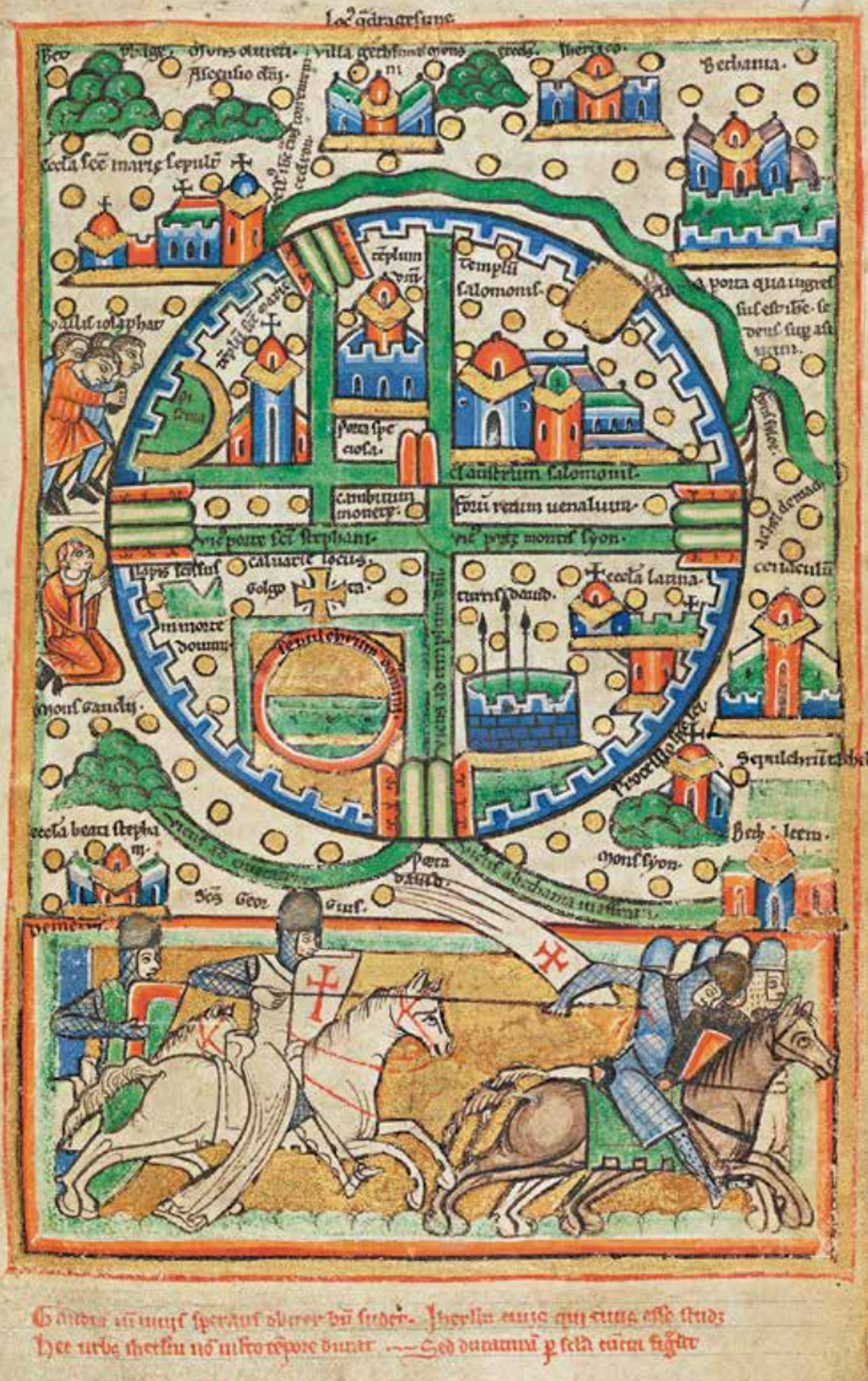
November 2026 marks more than three years of Israel’s ongoing genocide in Gaza. As an activist and a literature scholar who focuses on premodern Islamophobia, bearing witness to this destruction haunts me, and not just because of the abject disregard for human life. Since the 1300s, European Christians fantasized about violence and conquest in their most popular stories. Today, Zionists are actualizing those fantasies. Establishing the state of Israel on Palestinian land not only satisfied the “Jewish Question,” raised by Zionism’s founding father, Theodor Herzl, but realized a dream begun by Latin Christendom centuries ago with the Crusades: liberating Jerusalem from Muslim rulers.
In April, at an “Independence Day” event in a settlement in the West Bank, Israeli Finance Minister Bezalel Smotrich said, “[T]he prophecies of consolation are no longer a dream, but the view from the window…We are not just reading the prophecies, we are privileged to be the generation that fulfills them.” The prophecy he speaks of is establishing Israel on Palestinian land. What fulfilling that prophecy has looked like is the murder of 74,000 Palestinians in Gaza, 21,000 of them children in the last three years alone. Not a single university remains standing in Gaza.
For centuries, the land of Palestine has been tied up in fantasies and prophecy. In the 11th century, the Latin Christian West believed it was God’s will for Palestine to be delivered to Christians. So they instigated “the Crusades.” That failed. Centuries later the Christian West found renewed hope in Zionism as the idea of the Holy Land serving “a country without a people, for a people without a country.” In the 20th century, Herzl, a Hungarian Jewish journalist and lawyer, leaned on the promise of a Jewish homeland as a powerful strategic move in his advocacy. In a diary he kept from 1895 to 1904, he reflected on meetings with world leaders and drafted letters petitioning politicians, generals, and heads of state. In its pages, we can see how Zionism folded Jewish prophecy of a homeland and Christian fantasies of the Crusades into a campaign to replace Muslims as the rulers of the Holy Land.
II.
Herzl was born in 1860 in Budapest to German-speaking parents. At the age of eighteen, he moved to Vienna, where, from 1891 to 1895, he was a correspondent of Neue Freie Presse, a liberal Viennese newspaper. As a journalist, he closely followed the Dreyfus affair, the wrongful conviction of a Jewish captain in France, and he considered it part of a larger pattern of antisemitism in Vienna. In 1896, he published the pamphlet Der Judenstaat (The Jewish State) — a case and a vision for a Jewish state. Just a year later, he organized the first Zionist congress in Basel.
Herzl donned a long black beard with a mustache groomed so finely it curled up and out at its ends. Despite being considered early Zionism’s most well-known politician, in his diary Herzl revealed that he “much prefer[s] literature to politics.” He wrote a novel, travel essays, and plays. Several of his plays were even staged. He wrote in his diary that whenever he would “meet someone whom [he] would like to please” he would “inflict [his] writings on [them].” Herzl died in 1904, well before the 1948 Nakba, but is credited with starting the colonial project of Israel.
For scholars like me— interested in how storytellers and politicians play with rhetoric to motivate colonialism— Herzl’s diary is indispensable. It is nearly 2,000 pages in length and includes the drafts of thousands of letters Herzl sent to world leaders making the case for Zionism. Its length and breadth further proves what Palestinian scholars claim: Zionism did not begin with the Holocaust, but was a proactive project that required incessant petitioning well before WWII. In letter after letter to heads of state, emperors, sultans, kings, foreign secretaries, the Pope, and others, Herzl made the case for a Jewish homeland. He was insistent. In many letters, he asked for introductions to other leaders to whom he could also make the case for a Jewish homeland.
Herzl relied on different strategies to convince his counterparts of the benefits of Zionism— at times describing it as a “lawful movement” with “humanitarian goals.” He also frequently mentioned that establishing a Jewish homeland would offer monetary or financial incentives to his addressee. But perhaps his most strategic, yet most overlooked, rhetorical move was his usage of the Italian phrase “Gerusalemme Liberata.” Jerusalem Liberated.
In a letter to Alexander Kireyev, a commander in the Soviet Navy, Herzl wrote: “ I am absorbed with the misery of my brethren, but not as a chauvinist or narrow-minded fanatic. This is perhaps proved by my plan to extraterritorialize the holy places, to make them res sacrae extra commercium gentium [holy places above the trafficking of the nations]. That would be a great symbol; and very old dreams would be realized. La Gerusalemme liberata.”
With this invocation, Herzl was awakening the medieval fantasy of the Christian West and the “very old dreams” of crusaders. In fact, it is as if Herzl picked up where the medieval texts left off. In 1095, Pope Urban II organized what’s been known as the Council of Clermont, a gathering of nearly 300 clerics. There, he rallied the clerics to start a series of military expeditions we now know as the Crusades. He urged Christians in the West to go East, to defend and support the Byzantine Christians in Jerusalem in recovering the city from Muslim hands. Little is known from this ten-day gathering, but a speech made by Urban II on the last day was recorded over and over again in several clerics’ written accounts; it is remembered as one that galvanized and roused the soldiers to start the First Crusade.
Near the end of the speech, Urban II was reported to have said, “this royal city, therefore, situated at the centre of the world, is now held captive by His enemies, and is in subjection to those who do not know God, to the worship of the heathens. She seeks therefore and desires to be liberated, and does not cease to implore you to come to her aid.” Eight hundred years later, in 1903, Herzl deliberately positioned himself and the Zionist movement in a larger diasporic identity that is shared between Jews and Christians: a shared view from outside of Jerusalem, looking in with longing and concern.
It did not matter who would rule over Jerusalem itself. What matters, Herzl made clear, was that the Jewish diaspora and the Christians are “brethren” in their shared dream to free Jerusalem from Arab, Muslim rule. What matters, was that Jewish Zionists and their Christian brethren had a common enemy. The story both Herzl and Kireyev were invested in started with the Crusades, but according to Herzl, would likely end with Zionism. After eight hundred years, “Gerusalemme Liberata,” Herzl promised. Jerusalem liberated!
The history of the Crusades did not stop with Urban II and the Council of Clermont. It did not even stop with the military expeditions themselves. Between 1095 and 1903 when Herzl wrote this letter, the Crusades had been turned into lore. They were fictionalized and sensationalized. And most importantly, they were subject to historical revisionism. This is why Herzl was able to write about the “liberation” of Jerusalem as if it were inevitable.
Even though no Christian group ever permanently “reclaimed” the Holy Land in history, popular accounts of the Crusades remembered Christians doing just that. In England, crusade expeditions were revised and recounted so that what was Latin Christendom's failure in history becomes English Christian superiority in fiction; valiant knightly protagonists— Bevis in Sir Bevis of Hampton and Guy in Sir Guy of Warwick — leave England and travel East, kill thousands of Muslims along the way, and ultimately establish Christian rule in Jerusalem. These stories were among the most popular in the Middle Ages. Adventures and colonial pursuits to Jerusalem were embellished with damsels in distress, knightly adventures, giants with clubs, magic rings, and more. They circulated both as history and entertainment.
These fictions remained popular well into Herzl’s time. For example, in 1825, Sir Walter Scott published The Talisman, the second in a series of books called “Tales of the Crusaders.” It told the story of Saladin and Richard the Lionheart, drawing on a fourteenth-century crusading story, Richard Coer de Lyon.
Crusading lore did more than offer Herzl a connection between Zionism and the Crusades. It gave early Zionists a Christian audience already primed against Muslims in Jerusalem. The liberation of Jerusalem was replayed over and over as a solution to the lawless, aimless, traitorous, filthy Muslims who disrespect the holiness of Jerusalem. The most predominant Islamophobic trope in the crusading framework has to do with Muslims’ relationship to Jerusalem itself. It is that Muslims in and around Jerusalem neither belong there, nor do they desire to live there. They don’t have any meaningful relationship to the land. Muslims only take up space in Jerusalem to prevent and oppose Christian access to it. According to this trope, this characteristic is so central to who Muslims are that it becomes the basis of the derogatory label Christians give to Muslims in the Middle Ages: Saracens.
In the anti-Muslim tracts that circulated in Latin Christendom, Christians claimed that Muslims are descendants of Ismail, the son that Abraham fathered with the maid Hagar. In this rendering, Muslims are so ashamed of their lineage, that they call themselves “Saracens,” to falsely suggest that they are descendants of Sara, Abraham’s wife. As a result, not only are Muslims liars, but like Ismail, they are outcasts, aimless wanderers. They happened to be in Jerusalem and remained there to spite Christians.
This logic is a core strategy to the colonialist project in the region because it turns Muslim bodies into threats. Earlier in the same speech Urban II delivered at the Council of Clermont, he painted a picture of Jerusalem under Muslim rule by accusing Muslims of vandalism: “They destroy the altars, after having defiled them with their uncleanliness.” The presence of Muslims endangers what is holy in Jerusalem. So enduring is this trope that eight hundred years later still, Herzl could say that those sites must be liberated from Muslim rule. This logic also legitimized extreme acts of violence. In his account of the First Crusade, now a book translated as A History of the Expedition to Jerusalem 1095-1125, the French priest Fulcher of Chartres wrote how “Saracens” swallowed precious stones upon defeat, “not wishing Franks to get anything that belonged to them.” Women allegedly even hid them in their vaginas. Christian Franks piled the bodies of the dead Muslims and burned them “for the sake of finding the bezants which some had swallowed and others had hidden in their mouths.”
So persuasive is the Islamophobic characterization of the Muslim as “Saracen” in Jerusalem that when minister Alexander Keith visited Palestine on his Mission of Inquiry in 1839, he noted that he saw a “valley…[that] presented on all sides marks of active industry,” that he saw “two or three small villages in a valley,” and still concluded that the land is “a country without a people.” In fact, scholars have argued that the provocative tagline, “a people without a country and a country without a people” was popularized not by Jewish Zionists, but by 19th century Christian leaders and writers. In a sermon, the 19th century British Methodist Minister Richard Watson proclaimed: “though Israel is scattered, yet shall he be gathered. All the Scriptures go to this. And this is supported by two singular facts: One, that the Jews have always been a distinct people; the other, that their country is unprotected, and waiting for them.” This belief, which would justify violent displacement for decades, was not based in reality, but in the powerful fictions that shaped European Christian identity in opposition to “Saracens.”
III.
Thanks to centuries of Islamophobic rhetoric, early Zionists did not need to do much work to convince Christians in Europe that Muslims are bad for Jerusalem. Islamophobia solves half of their problem. They simply had to convince Christians that Jewish settlement is the solution. To do this work, Herzl used diplomacy— letters and petitions and proposals— and stories. When it was his turn to fantasize and sensationalize, Herzl wrote one of the first Zionist novels that imagined the success of the Jewish State, Altneuland.
Published in 1902, Herzl’s Altneuland tells the story of Freidrich Lowenberg, a heartbroken, depressed misanthrope in Vienna who responds to a newspaper ad by a stranger looking for a companion to live on a deserted, remote Pacific island. Hopeless, he responds and agrees. On their way to the island, they pass through Palestine. It is a sad, abandoned place with inhabitants that do not seem to have any real relationship to the land.
“There was nothing more wretched than an Arab village…The children were naked and uncared for, their playground the streets,” Herzl wrote. Lowenberg and his companion leave the island and pass through Palestine again twenty years later. This time, it is a Zionist dreamscape. Because of Zionism, “these people [the Arabs] are far better off…they are healthy, they have better food, their children go to school…they have only gained by welfare.”
His novel was a fantastical one. Israel did not exist yet. It was decades before the 1948 Nakba. In Altneuland, he articulated the “utopia” that motivated his politicking. And yet the novel was so influential that in 1910, early settlers of Jaffa named their settlement after the Hebrew translation of the book’s title: Tel Aviv. Whether the Zionist experience in Palestine was as perfect as in Herzl’s Altneuland was secondary to the fact that they believed they were fulfilling a prophecy that was relayed in the novel. It was as if settlers conceived of themselves as characters from the novel. If the Crusades were the myth that underpinned the early Zionist project, Altneuland, born out of Herzl’s imagination, became it’s prescribed future.
When Herzl wrote "Gerusalemme Liberata," he knew he was invoking a deep longing that persisted among many European Christians: a Jerusalem awaiting liberation from a Muslim population imagined as occupier rather than indigenous to its land. We do not ascribe enough responsibility to these stories — the ones the Zionists told before the Holocaust, and, to an even lesser degree, the ones the Western imagination inherited from the Middle Ages. From the 11th century until today, the medium may have changed, but the story has remained the same.
Islamophobia is still a mainstay of the entertainment industry; popular culture continues to represent Muslims as the "Saracen" of the Middle Ages: a people globbed together across region, religion, ethnicity, and geography with no real individuality and no real attachment to land. These stereotypes are prevalent in Hollywood. One doesn't need to look far beyond the 2014 Academy Award winner American Sniper. Directed by Clint Eastwood and starring Bradley Cooper, the film is an adaptation of the memoir by the same name written by Chris Kyle, considered the most lethal sniper in American military history. The film follows the protagonist as he tries to balance his family life with his work as a sniper in Iraq. The contrast is stark between the depth and texture of his interiority and the reductive representation of the people in Iraq. In one scene, Kyle takes a heartfelt call from his wife while on a rooftop. He holds the phone in one hand, the sniper’s trigger in the other. As they talk about cribs and how sexy she looked in a pink nightgown, Kyle kills nameless Iraqis. One is only a child.
The film's opening sums up the dynamics at work. The main setting in Iraq always looks like a once-settled, civilian city in Iraq. Now, it is bombarded, gray, destroyed. In the opening, Kyle is on a rooftop overlooking an Iraqi street, peering through a sniper scope. Below, soldiers break down door after door, moving in and out of civilian homes. A hijabi woman and a small child walk out of one door. Kyle believes he sees the woman hand a grenade to the boy, no older than the age of ten. As the child runs down the street towards the American tank, Kyle aims at him and the audience hears the sound of a gunshot. The scene cuts to Kyle's own childhood, where he is in a field, holding a rifle. He has just shot a deer, and his father is proud. In this moment, there is a connection being made between Iraqis and wild prey who roam the wilderness.
Chris Kyle, who was shot and killed in 2013 by a marine in Texas, saw himself as a hunter. Muslims in Iraq were his prey. In his memoir, Kyle claims that he drew his hunting strength from Crusaders. He wrote: "on the front of my arm, I had a crusader cross inked in. I wanted everyone to know I was a Christian. I had it put in red for blood. I hated the damn savages I'd been fighting. I always will.”
As someone who studies Islamophobia in the Middle Ages, I am often shaken by how much power these stories have. It is difficult to sit with how they continue to motivate violence in the present. But I also recognize that despite their power, they are just stories.
N.K. Jemisin, one of the most talented worldbuilders of our time, has written about the immense power that fantasy has in shaping our perception of reality. She says, “The fiction we absorb has an impact on the reality we tend to perceive.” She models this in her books themselves, but also tells us that to change the world we live in, we need to first understand the fiction that led to its creation. Then, we must devise new worlds.
Jemison’s wisdom offers us a way out of the enduring problem of the Islamophobia of the Middle Ages. The tropes that enable and fuel Zionism have persisted for centuries. But our stories are powerful too. We just need more of them. As Black, Indigenous, and Palestinian artists and activists remind us, we need to conjure more radical visions of liberation, and to do so often.
The work of our imagination cannot be siloed from our work in politics, organizing, and activism. Herzl wrote a novel, but he mainly politicked. In other words, he did both. The stories fueled his petitioning. It is not enough to protest oppression and relegate the work of imagining liberation to others. Imagining our utopian future, and telling detailed stories that depict it, must be as much a part of our organizing and resistance as direct actions themselves. And we need to imagine liberation down to its finest details. Our stories must be so textured that we can inhabit them in our minds as an inevitability, even as we fight the conditions in our present reality.
Fascist governments know the power of narrative and this is why they silence ethnic minorities and defund arts and the humanities. In 2025, the Trump administration cut millions of dollars in humanities grants across the country, after institutions like the Smithsonian and the National Gallery of Art had already shut down their DEI programs under his executive order. Fortunately, imagination knows no bounds. It is not subject to bureaucracy or laws. Our artists, our writers, our mothers and elders who tell stories, our archivists who document and store them, are all agents in building new prophecies — ones we can draw on, and speak of as if they are inevitable. It is in the works of writers, organizers, and artists that new possibilities emerge.

